Displaced Relics of Henry Kyling

Displaced Relics of Henry Kyling

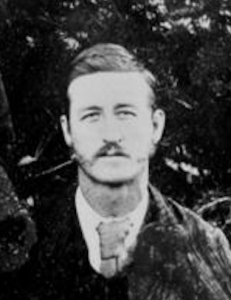
Christian William Harry Kyling (known as Henry) was a brother to my great-grandfather John William Kyling. This article records Henry’s short life and a couple of relics that have appeared after having been lost to the family.

Henry’s Life

Henry was born on 7 September 1866 at Allora near Warwick. His German-migrant parents Fred and Caroline Kyling were living there at that time where Fred worked as a carpenter. By the time of his christening on 11 May the following year the family had moved to Warwick township where Fred would work a while longer as a carpenter before taking on the licence of the European hotel. Henry was the third child of the family of 10 children (12 if you include the two girls from Caroline’s first marriage). He was 20 years of age when his father Fred passed away, and his mother would soon thereafter suffer insolvency and depression that would see her sent to Willowburn, Toowoomba in 1892.

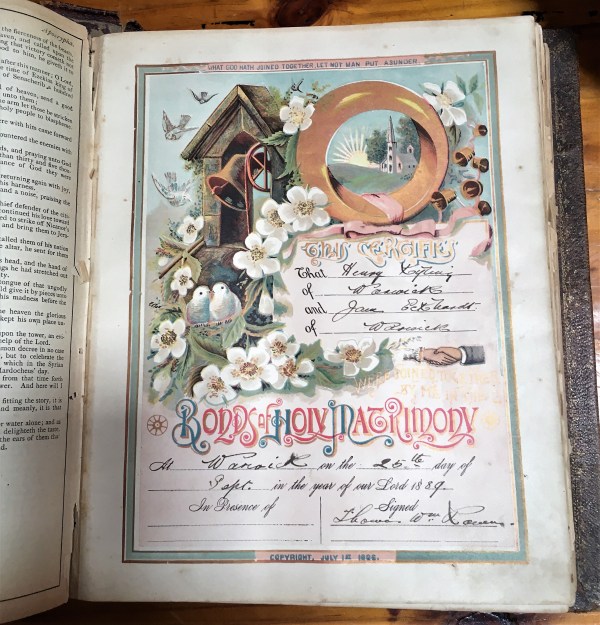
At the age of 29 Henry married Jane Eckhardt on 25 September 1889. The wedding occurred at the Eckhardt family home at Sandy Creek. Consent for Jane, who was aged 19, to marry was given by her father George August Eckhardt. At the time of the marriage, Henry was working as a labourer and residing at Warwick.

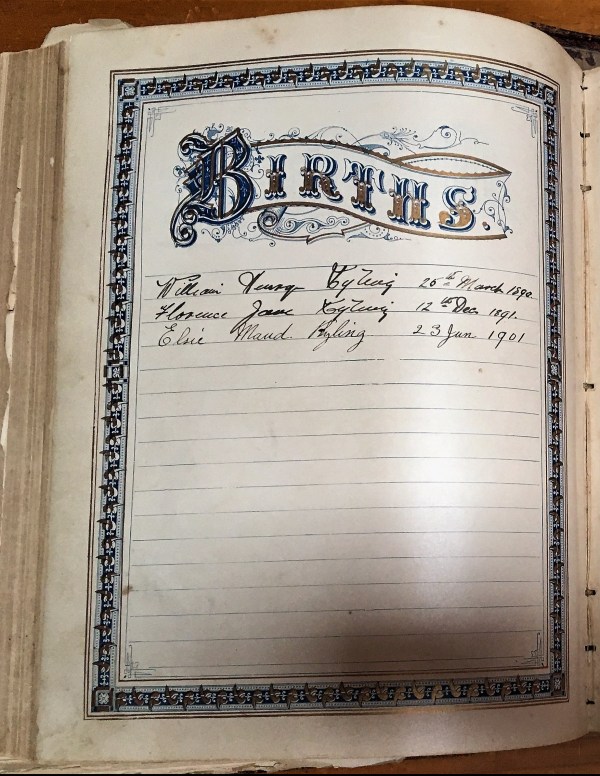
Henry and Jane had three children: William Henry (b. 25 Mar 1890), Florence Jane (b. 8 Dec 1891) and Elsie Maud (b. 23 June 1901).

Soon after Elsie’s birth Henry took on a new work role:

WARWICK, December 21
CEMETERY TRUSTEES
A meeting of the trustees of the Warwick Cemetery was hold in the Town Hall yesterday afternoon for the purpose of appointing a sexton. For the position, which is worth, all told, £100 a year and a free house, there were eight applicants, and it was unanimously decided to accept that of Henry Kyling.
(Brisbane Courier, 25 Dec 1901, p. 6)

The 1903 electoral roll shows the family residing at the Cemetery:

He was an amateur runner, and participated in a number of local events including the Grand Handicap at Warwick on Queen’s Birthday weekend in 1888.

Henry was also a musician – an accordion player and is noted in the Warwick newspapers as playing at various local functions such as:

In 1890 at a social gathering for the Warwick Rugby Football Union: 'The music, provided by means of a piano, violin, and accordion, was quite up to the required standard of excellence. Mr. Harry Kyling handled the latter, while Mr. Sedgwick, and Mr. Jensen occasionally relieved on tho piano and violin.' 
(Warwick Examiner and Times, 11 Oct 1890, p.2)
In 1901 at a social dance at the Oddfellows' Lodge: Capital dance music was supplied by Mr. "Harry" Kyling and the Misses Ethel Sellars, A. Locke, and Noyes (piano). 
(Warwick Examiner and Times, 20 Apr 1901, p.2)
In 1901 at another social dance to celebrate the centenary of the Oddfellows' Lodge: 'The ball was brilliantly lighted with gas, and decorated beautifully with evergreens and a display of bunting. Mr Harry Kyling supplied music in his usual perfect style with an accordion, being occasionally relieved by Mr. Sedgwick at the piano.' 
(Warwick Examiner and Times, 13 Sep 1890, p.2)

Henry’s Death

Obituary. Mr Henry Kyling, sexton at the Warwick cemetery, died at his residence on Saturday evening last. The sad event was not unexpected, as the deceased had been laid up for some time with an affection of the heart. He was obliged to take to his bed six weeks ago, and for the last month paralysis deprived him of the power of speech. The late Mr Kyling, who was 38 years of age, leaves a widow and three children. The funeral took place on Monday, the service at the grave being conducted by the Rev. T.L.H. Jenkyn.
(Warwick Examiner and Times, 22 Jun 1904, p.3)

The death certificate notes aortic valvular disease, dyspnea (breathlessness), paralysis and asthenia (abnormal physical weakness or lack of energy) and that he had these health issues for some years. The informant on the death certificate was Jane’s sister ‘Mrs G. Bell’ (Elizabeth nee Eckhardt) and George Bell is one of the listed witnesses to the burial that occurred at Warwick Cemetery on 20 June 1904. The children were aged 14, 12 and 3.
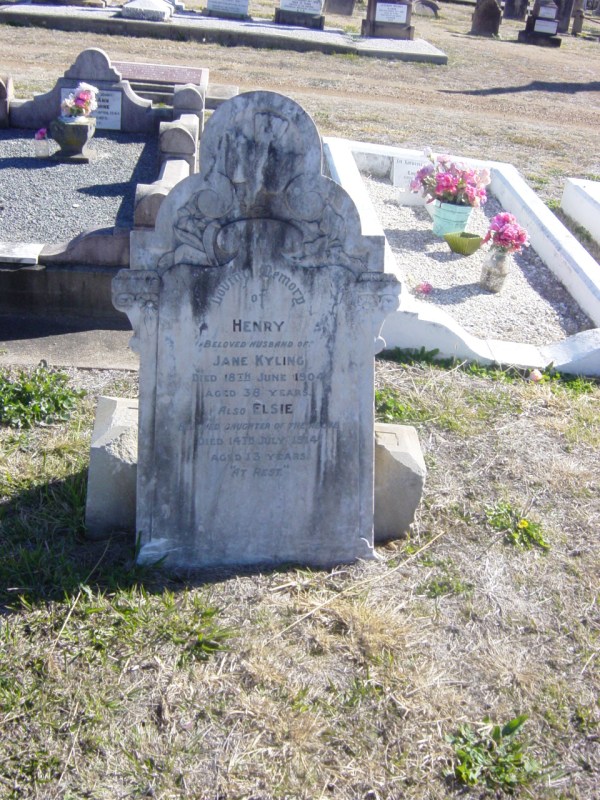
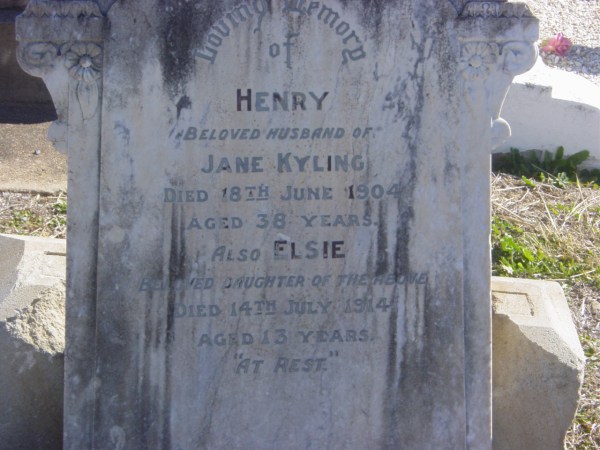
Two days after the burial Mr A. Clark was appointed as the new sexton of Warwick cemetery, and Jane and the children moved to William Street, Warwick.

Two years later Henry’s mother Caroline passed away at Toowoomba and was brought back to Warwick for burial with Fred. In 1910 all of Henry’s siblings gave their signed consent for assets to be sold so that Jane would be able to provide for her dependent children from what would have been Henry’s share of the proceeds.

In 1910 Florence married Vincent Cody, and Jane moved to Paddington (Brisbane) and William worked as a baker there.

OBITUARY.
The death took place in Brisbane on Tuesday night of Miss Elsie Kyling, who was only thirteen years of age at the time of her decease, which was due to heart failure. A daughter of the late Mr. H. Kyling who passed away about seven years ago, the deceased girl had been a resident of Warwick until a short time back. Her brother (Mr H. Kyling) and her sister (Mrs J. Cody) both live in Warwick, and to them sympathy is extended. The body was brought to Warwick on Thursday, and the funeral, which was well attended, then took place to the Warwick cemetery.
(Warwick Examiner and Times, 18 Jul 1914, p.3)

Elsie had suffered a severe bout of gastritis resulting in convulsions and heart failure. Her brother William Henry Kyling was the informant on the death certificate. She was buried with Henry and her name can be seen on the headstone above.

Soon after Elsie’s death William Kyling seems to have enlisted as a merchant seaman in the First World War. Though I haven’t been able to locate his enlistment papers, the National Archives in London holds a medal card for him:
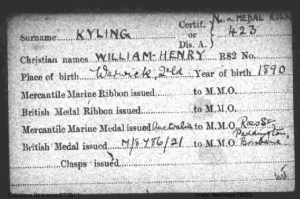
and the National Archives of Australia holds an application for his war medals by William’s wife in 1951.
Applicant – KYLING Bertha Blanche [widow of William Henry Kyling] : Born – 1890 : Place of Birth – Warwick : Application for – Campaign Stars and War Medal : Date of Application – 9 February 1951.

He seems to have had an interesting life – along with his military contribution he travelled and worked in Melbourne and Sydney before his marriage to Bertha Blanche Bright in 1925. They appear not to have had any offspring. William died in 1946 in Sydney and he and Bertha are buried at the Eastern Suburbs Memorial Park.

KYLING.—June 30, 1946, at his residence, 5 Bobmos Flats, 151 Todman Avenue, Kensington, William Henry Kyling, dearly beloved husband of Bertha Blanche Kyling, age 56 years. Privately interred on July 1, 1946.
(Sydney Morning Herald, 2 Jul 1946, p.14)

Jane had passed away five years earlier in Brisbane:

KYLING.— The Relatives and Friends of the late Mrs Jane Kyling, of 28 Latrobe Terrace, Paddington, are Invited to attend her Funeral, to move from Alex. Gow's Funeral Chapel. Petrie Bight, this (Friday) afternoon, at 3.30 o'clock. for the Toowong Cemetery.
(Courier-Mail, 10 Oct 1941, p.10)

Florence and Vincent Cody had four children. Florence died in Brisbane in 1975, and she and Vincent are also buried at Toowong.

The Relics

Back in 2006 I typed ‘kyling’ into the then Picture Australia database and found a copy of the funeral cards of both Henry and his mother. They had made their way into the John Oxley Library collection at the State Library of Queensland.
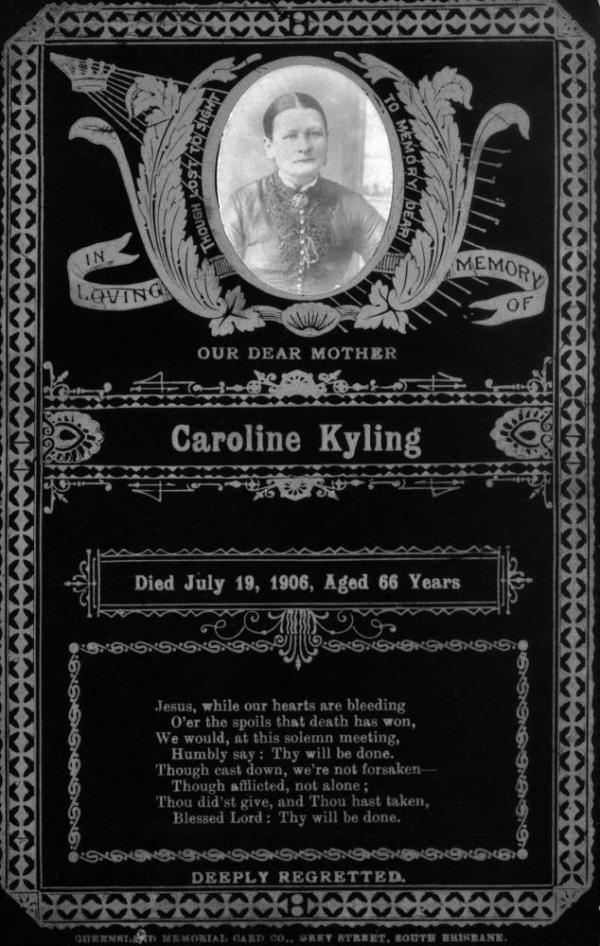
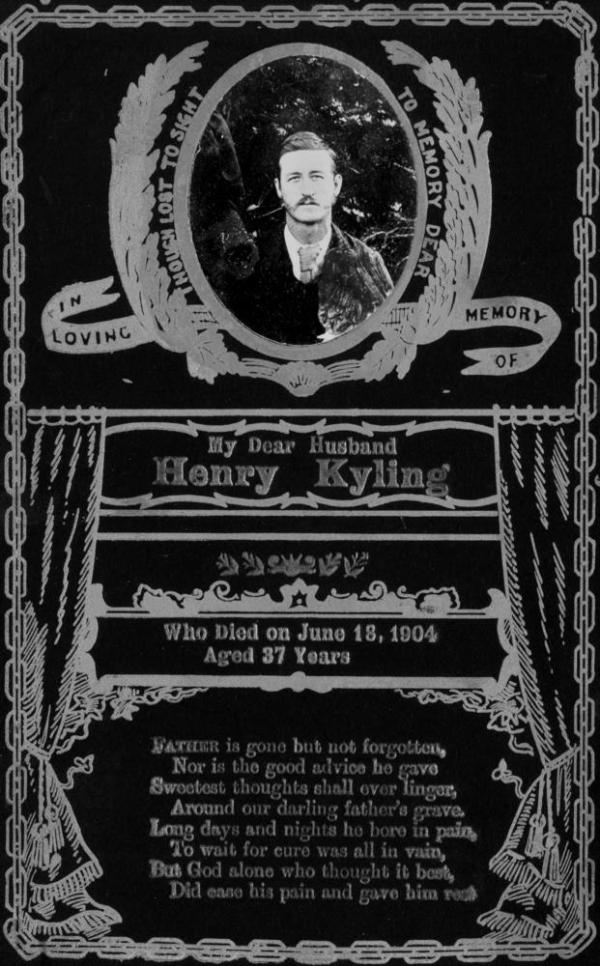
I wrote to the John Oxley library and asked if there was any providence information for them. The reply from the library was:

Unfortunately, there is no record of the source of these photographs in the past, a great number of items in the collection seem to have been accumulated with very little information provided by the donors. l’m so sorry we are unable to help you with this.

Regardless of how these items made it into the library I’m so glad they did; if they had not, the only known images of these two might have been forever lost. The text around Henry’s picture reads ‘Though lost to sight … to memory dear’. In fact the opposite is now true – though there is now no living person with a dear memory of Henry, this photo means he is not lost to sight.

The Picture Australia database was later absorbed into Trove and the here are the links to these items for Caroline and Henry.


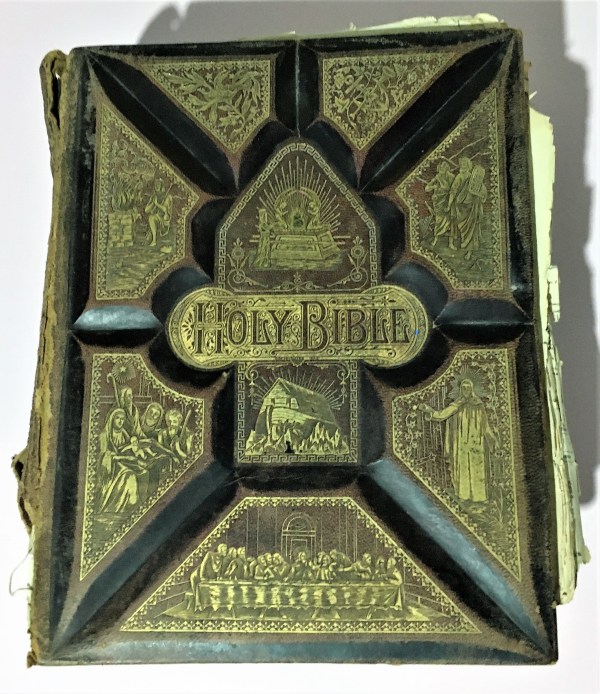
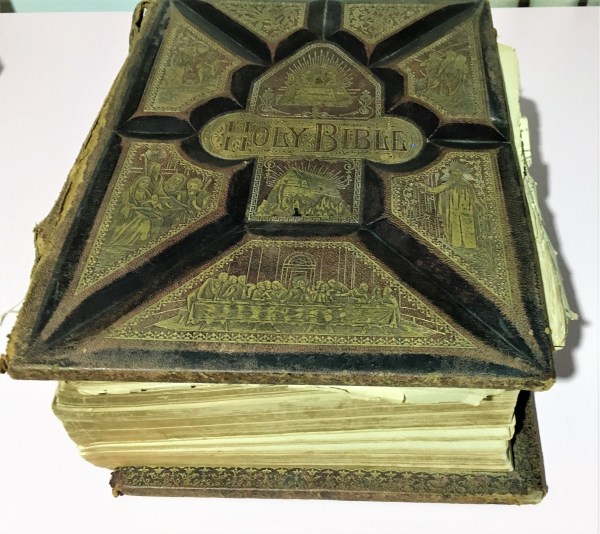
In May 2021 I was contacted out of the blue by a person who 30 years ago had purchased an old bible from a collectibles shop in Queensland in a state of disrepair. She recently inspected it again, noticing the inscriptions and very generously sent me some photos of it.

It was the bible presented to Henry and Jane on their wedding day at Sandy Creek on 25 September 1889!
bible-7
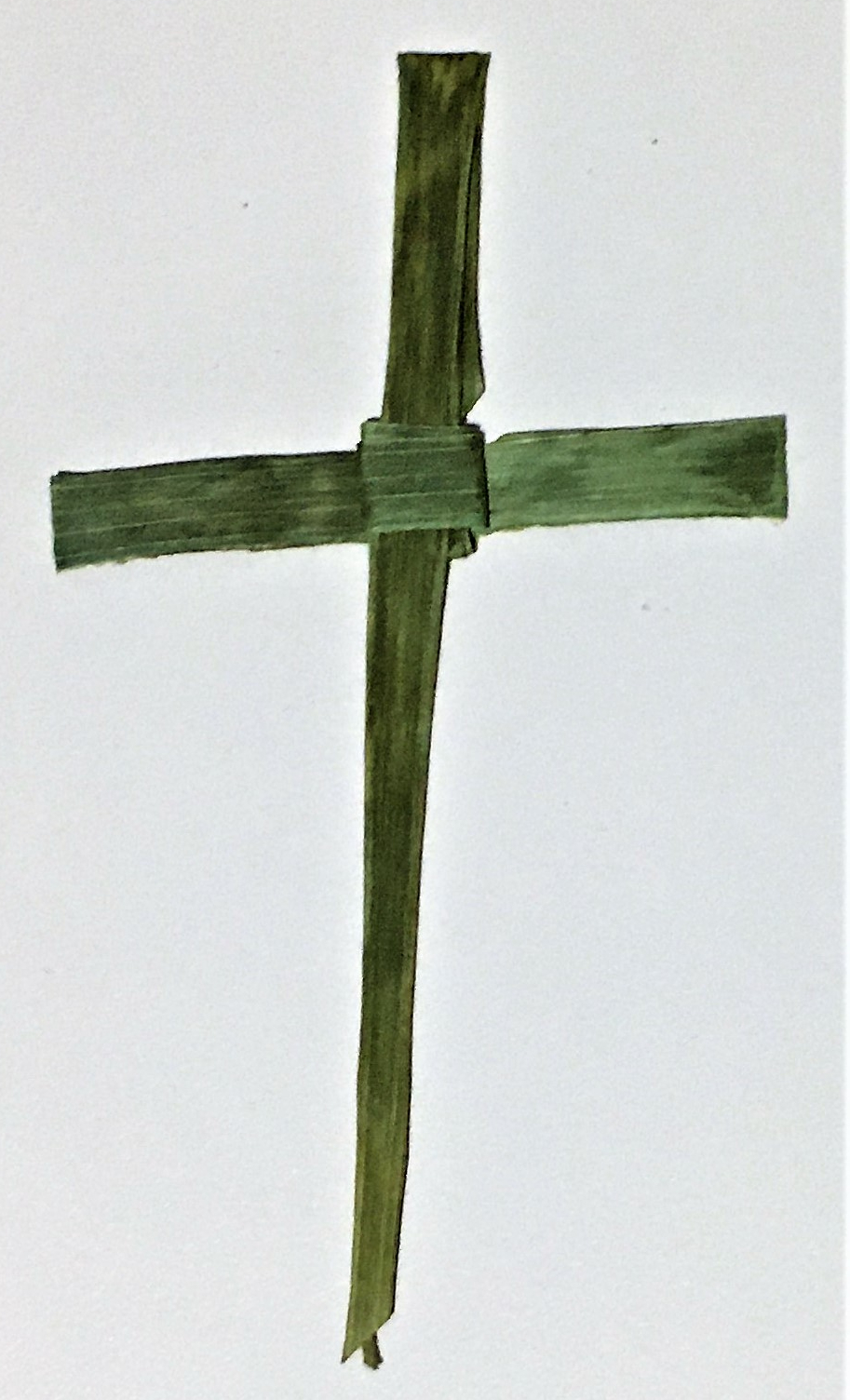
Inside is a bookmark, fashioned from piece of long grass or reed and pressed in the shape of a cross.

If you have ever found a family relic and sought a family member to send or provide a copy to – then thank you.
You may have added something significant to the story of a person’s life!

Bella Hall: Small Clues from the Life of an Ordinary Single Lady

Bella Hall: Small Clues from the Life of an Ordinary Single Lady

I’m not quite sure what this article is for, only that I’ve been thinking about writing it for some time. Normally in family history we’re writing about families, and single people tend to get left out unless they have been extraordinary for some reason. Bella Hall wasn’t extraordinary, but there are some things she leaves behind.

Her brother and my great-grandfather, William Hall, was born and raised in Allansford, the middle child of five siblings: Mary Ann, David, Isabella and John. Bella was born on 8 October 1863 and was two years younger than William.

William’s work on the railways took him to Kilmore, where he met and married Jessie McKenzie and settled there for the rest of his life. I don’t know how much he might have visted Allansford over the years, or whether his family visited very much, but a surviving photograph album of Jessie’s contains quite a few photographs that were taken in studios at Warrnambool (near Allansford) which are likely to be from the Hall side. None of the photos are labelled, but my grandmother (daughter of William and Jessie) was able to recognise a handful of people, including Bella Hall, of whom there are three photos.

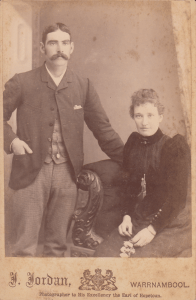
One is a standard portrait.

Bella Hall

Another is a studio picture taken with an unknown man, to whom Bella might have been engaged, as in the picture she is clearly wearing a ring on her left ring finger. If so, the marriage never eventuated.

Bella Hall with an unidentified man

And the final picture is the only one in the album taken outdoors, Bella appears with her nephew Alexander John Jamieson Fraser.

Bella Hall and her nephew Alex Fraser

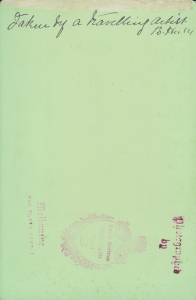
Verso of photo of Bella Hall and Alex Fraser

On the back of the picture Bella has written Taken by a travelling artist. B. Hall. The stamp on the back says Louis Bertram Photographic Artist.

The story in the family is that Bella Hall was something of a meddler, and that she convinced her sister Mary Ann to be rid of her husband Simon Fraser. Nobody knows if this is true.

She appears to have lived at Allansford her whole life until the death of her mother in 1918, in fact all of the children apart from William were living at Allansford at that time.

In 1891, 11 year old Edwin McMillan (a grand nephew of Bella’s parents, so perhaps a second cousin to her) visited Allansford and wrote remarkable letters to his parents about his experiences. In the letter to his mother he wrote Bella and I went to Tooram on Saturday with Mrs Lenox and Mary and Jack and we caught about 3 doz small bream and one trover valley [trevally]. In the letter to his father he wrote I am going round in the cart with the hot cross buns. Bella is the old woman that is to run the show and I hold the money. No doubt Bella was doing deliveries for the family business.

After her mother’s death in 1918 she moved to Melbourne, and from then until her death 28 years later she lived at four addresses in Malvern.

On arriving in Malvern she lived at 63 Jordan Street, Malvern with or very near her nephew pictured above, John Alexander Jamieson Fraser and his wife, Emily Margaret (nee Patterson). JAJ Fraser was a butcher, like his Uncle John Hall (Bella’s brother) who ran a butcher shop in Allansford for many years.

In the electoral rolls of 1924 and 1925 she appears living at 22 Evandale Road, Malvern. In the roll of 1931 she’s living at 14 Winter Street. In 1936 and 1937 she’s at 20 Lambeth Street and her occupation for those years is ‘Art needlework’. JAJ and Emily were living at 28 Lambeth Street during this time. In 1943 she’s still in Lambeth Street but at number 35 and her occupation is home duties.

She died on 1 August 1946 aged 82 and was buried the following day at St Kilda Cemetery. Mary Ann Fraser was buried with her two years later. Mary Ann’s daughter and son-in-law Mabel (nee Fraser) and Walter Phippard’s ashes were later interred with them.

Tangental Families: Reardons

Tangental Families: Reardons

Various Reardons pop up here and there on the paternal line,
and I have varying degrees of clarity around their origins and connectedness if any. I will add to this article as I find out more.

Reardons Around Wangaratta

My 5x g-grandmother Anne was a Reardon, and she was apparently born in Liverpool, England in 1824, the daughter of Patrick (a soldier ranked private) and Mary (surname unknown). She made her first appearance in Australia in 1846 marrying William Thorpe in Melbourne, and after some time residing with him in Geelong, she left with her children in around 1853 and went to Wangaratta to live. She had a brother there named Henry Reardon who worked as a carrier.

Anne had a daughter at Reed Street Wangaratta on 10 Jun 1855 named Mary Ann Donohoe. The stated witness was a ‘Mrs Sarah Reardon of Wangaratta’.

Mary Ann’s father, William Donohoe, was also a carrier at Wangaratta and may have been a workmate of Henry.

Henry Reardon suffered an untimely death aged 30, the result of stab wounds sustained at the hands of a man named Patrick Murphy, in a dispute over a game of cards at the Broadmeadows Hotel on 14 November 1855. Henry died four days later, and the police had taken a statement from him before he died.

The deposition of the deceased, taken on his death bed before Mr Hackett, police magistrate for the district of Bourke, was here read. The following is a copy: —
‘I am a carrier residing at Wangaratta, I saw the prisoner at the Broadmeadows Hotel on the 14th instant. Prisoner charged me with cheating him at cards. Prisoner left the room stating he would put a knife into the wretch. A few minutes afterwards I was speaking to the landlord. Prisoner said something which the deponent does not know, and then inflicted the wounds I am now suffering from with a knife. I then called out, ‘A knife, a knife !’ Prisoner was seized by the landlord, and then dropped the knife. I have known the prisoner for three or four months, and never had an angry word with him. The prisoner was not quite sober, but seemed sensible, I was not playing for money, but for nobblers. I do not think the prisoner bore any animosity to me.’
Henry Reardon, His mark. Witness : J. Barlow. Taken in the presence of the prisoner, on the oath of Henry Reardon.
(The Age, 18 Dec 1855, p.5)

Anne is shown as next of kin in the probate notice published the following year.

Interestingly, the newspaper report of the trial says that ‘After Murphy was secured he said, ‘I could not have done it, for I and he have been like brothers these nineteen years’. Nineteen is a specific number and if Murphy’s assertion is correct this might point to a migration date around 1836. On  Anne’s 1908 death certificate, her granddaughter Mary Keetly declared that Anne was 77 years in Victoria and New South Wales, indicating arrival in 1831 at the age of 8.

Henry’s death certificate was made out by the Coroner in Melbourne and there was no substantial information about him on there, other than the fact that he was 30 years of age, which would mean he was just a little younger than Ann.

Reardons at Collector & Cootamundra

Patrick Reardon and Bridget Egan were married in Campbelltown NSW in 1841. Patrick was a convict transported aboard the Norfolk from Ireland in 1832. Bridget Egan, also a native of Ireland a, arrived aboard the Alfred in 1839 as an unmarried female immigrant.

They settled and farmed in the Goulburn region of New South Wales, firstly at Berrima and then at Collector, north of Lake George. Two of their six children married offspring of James Worthington and Mary Byrne. William Reardon (1843-1933) married Frances Mary Worthington in 1873 at Collector and Maria Reardon (1847-1927) married James Joseph Worthington.

I have not been able to establish any connection between these Reardons and Anne and Henry Reardon, above, and it may be just a coincidence that Anne Reardon’s daughter would later, in 1880, marry a man whose aunt and uncle had both married Reardons.

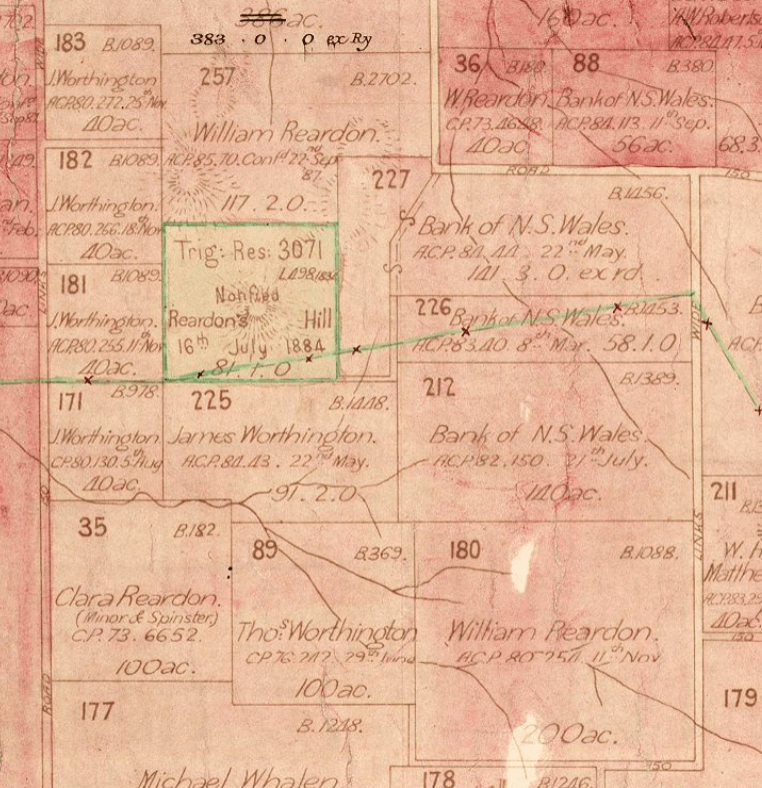
The following section of a parish map from the NSW Department of Lands shows an area called Yeo Yeo, east of Stockinbingal and north of Cootamundra. William and Frances Reardon were next door neighbours of Frances’ father James Worthington, who died at Yeo Yeo in 1889.

One of William Reardon’s many obituaries gives a good overview of his life:

Born in Sydney (such as it was then) in 1842, his parents moved to Collector, and acquired land there known as “Rose Glen”, which is still in the Reardon name. His father died when he was but a boy of eight years, leaving his mother with three sons and one daughter, he the second eldest. His grandmother had brought beautiful horses and cattle from Ireland, so the whole Reardon family had the opportunity of a good ground work in the knowledge of horses and cattle, so essential to land operations. At the age of 28 he married Miss Frances Mary Worthington, the ceremony taking place at Goulburn on the 18th January, 1871. We may mention that Mrs Reardon was a sister to Mr E.J. Worthington, of Boona Mount, in this district. In 1873 the late Mr. Reardon moved to Cootamundra district, purchasing the property known as “The Oaks”. For 20 years he lived there. Finding himself with a family of seven sons and four daughters, all craving for life on the soil, he launched out in a big way and bought Milby Station, in Condobolin district, from the late Yeomans and Hales.
(Lachlander and Condobolin and Western Districts Recorder, 23 Aug 1933, p.2)

The property was sold in 1905:

The Oaks pastoral and agricultural property, comprising 7860 acres, has been sold to Mr Alexander McCulloch, of South Australia. It was formerly the snug home of Mr William Reardon, JP, now of Miiby, in the Condobolin district. It adjoins the famous Geraldra run, and it comes within a few miles of Cootamundra, and the railway runs through it from there to Temora and Wyalong. In it is situated the silver lode on which Florance and party’s well-known mine is located.
(Tumut Advocate and Farmers and Settlers’ Adviser, 14 Nov 1905, p.3)

A subsequent map shows that McCulloch purchased the whole area, so it’s likely that James Worthington, Thomas Worthington and Clara Reardon leased from William.

The Clara Reardon in the map is labelled in the map as ‘spinster and miner’ (could she have been William and Frances’ oldest child who was born in 1872 and married Daniel Lane in 1904?). She would have been less than 20 years of age in the late 1880s – a bit young to be a miner, and a bit young to be labelled a spinster!

Gateway Ancestor Migration

Gateway Ancestor Migration

Most Australian family histories are full of migration stories.
As an auditing exercise, I am listing gateway ancestors,
where they came from and the circumstances of their migration.

James Byrne

1801 (Anne)

Wicklow, Ireland

convict

John Worthington 1806 (Fortune) Lancashire, England convict
Catherine Maloney 1806 (Alexander) England convict
Sarah Franklin 1812 (Minstrel) Clare, Ireland convict
Janet Grant 1837 (William Nichol) Inverness, Scotland assisted immigrant
Peter Hunter about 1840 Durham, England  
Alexander McKenzie 1840 (Glen Huntly) Ross & Cromarty, Scotland assisted immigrant
John Hall 1841 (Sir Thomas Arbuthnot) Glasgow, Scotland assisted immigrant
Roseanna Fitzpatrick 1844 (Sea Queen) Cavan, Ireland  
Anne Reardon before 1846 England  
Elizabeth Getliffe before 1854 Staffordshire, England  
Joseph Webster before 1855 Derbyshire, England  
Fred Kyling 1856 (Johan Caesar) Lower Saxony, Germany assisted immigrant
Rachel McCaughey 1858 (Tornado) Antrim,
Northern Ireland
assisted immigrant
Thomas Maher before 1862 Tipperary, Ireland  
Catherine Costigan before 1862 Laois, Ireland  
Caroline Schweinsberg before 1862 Hessen, Germany  
John Noble Pennington before 1872 Lancashire, England  
Harriet Ann Missing before 1872 Cambridge, England  
Patrick Buckley about
1872
Tipperary, Ireland  
James Budd before 1873 Shropshire, England  
Alice Jane Payne 1878 (Glamis) Worcestershire, England  

I compiled this listing as something of an auditing exercise resulting from a Talking Family History information session.

The new Ancestry ethnicity algorithm results came out soon after and the results don’t quite line up with the above ..
46% Scotland (with connections to the communities of Skye, Outer Hebrides and Ross & Cromarty)
40% Ireland
10% England & Northwestern Europe
4% Norway


The previous estimate was:
52% England, Wales & Northwestern Europe
48% Ireland & Scottish


Tangental Families : The Thorpes

Tangental Families : The Thorpes

Prior to her marriage to William Donohoe, my g-g-g-grandmother Annie (nee Reardon) had another family.

This article is under construction.

Though it is possible that Anne Reardon came to Australia aged 21 aboard the Strathfieldsaye in 1841, this can’t be confirmed with certainty. On her 1908 death certificate, Anne’s granddaughter Mary Keetly declared that Anne was 77 years in Victoria and New South Wales, indicating arrival in 1831 at the age of 8.

Her death certificate and the 1856 birth certificate of daughter Mary Ann indicate that she was born in Liverpool, England in 1823 according to the death certificate or 1827 according to the birth certificate. Her father was a Patrick John Reardon (a soldier ranked Private) and Mary.

Anne married William Thorpe on 19 July 1846 at St Francis’ Catholic Church. Not very much personal information is given, but they are shown as both being residents of Melbourne, and the witnesses were John Mansfield and Catherine [Brady?].

By 1849 William and Anne were living in Geelong where William worked as a boot maker and they had four children:
1848 William Thorpe (died aged nine months)
1849 Anna Bella
1850 William (died aged four see below)
1852 Francis Bengally (he died the same year aged 8 months)
c1853 Henry John (no birth entry can be found for him)

Around this time Anne departed Geelong for Wangaratta, where she had relations, including a brother named Henry who worked as a carrier. She met William Donohoe who was also working as a carrier at Wangaratta.

William Thorpe continued to live in Geelong, and in the electoral roll of 1856 can be found listed as a shoemaker and resident of William Place, Geelong North.

Young William Thorpe died in Wangaratta aged 4 on 2 June 1854 from hydrocephalus (fluid on the brain) and was buried at Wangaratta Cemetery. Anne and William Donohoe’s child Mary Ann was born at Wangaratta on 10 June 1855.

Henry Reardon suffered an untimely death aged 30, four days after stab wounds sustained at the hands of a man named Patrick Murphy, in a dispute over a game of cards at the Broadmeadows Hotel on 14 November 1855.

In the 1860s the family went to Grenfell looking for gold. Many others flocked there during this time, ncluding Mark Fitzgerald, Annabella Thorpe’s future husband.

[FURTHER TEXT TO COME]


 Obituary of Henry John Thorpe

The many Orange friends of Mr Thorpe, of Girilambone, will be grieved to hear of his sudden death at his home, on Tuesday last. Mr Thorpe, with his wife, spent the whole of last summer in Orange, and at the time of his demise appeared to be in his usual state of robust health. Heart failure was the cause of death. His eldest son was to be married to Miss Gaynon, of Dubbo, this month, who is a sister of Mr J. Gaynon, of Orange.
(Leader (Orange), 14 May 1917, p.1)

 Obituary of Hannah Maria Thorpe (nee Brennan)

Mrs Thorpe, mother of Messrs. Henry, Will and Ted Thorpe, also of Mesdames Larson and Tom Mackinnon, died in Nyngan at the residence of her son (Will) on Wednesday morning at an advanced age. She had come from Girilambone on Saturday to consult a doctor. She had lived at Girilambone practically all her life.
(Western Age (Dubbo), 13 Mar 1936, p.2)

 Obituaries of Mark Fitzgerald

MARK FITZGERALD.
This grand old pioneer, whose death took place on the 2nd inst, was one of Womboyne's most remarkable figures and respected of citizens. After spending his boyhood days at Bathurst (born at Botany Bay), the lure of the goldfields had their swaying attraction, and he first went to Taron fields, thence to Kiandia, subsequently to Adelong, Lambing Flat and Forbes. At the latter place, where he did fairly well, he married.
In the early sixties, as the diggings were giving out, he selected about 9 miles from Forbes, but, on finding later that he had erected bis house on another man's portion, left it and went to the Grenfell goldfields.
There for seven years, he followed mining and timber getting. From there he went to Ooma Station fencing. Returning to Forbes district, be opened the hotel at Moonbie and did a roaring business, for those were days of great traffic, when Mt Hope and Nymagee fields were working well and two Cobb and Co coaches ran daily between Condobolin and Forbes. Whilst here, the saddest blow of their lives befell Mr and Mrs Fitzgerald, by the drowning of three of their children, who were boating, in a longboat, in the Lachlan River nearby.
Leaving Moonbie in 1883, he went tank sinking on Youngee Plains. Leaving there he again took to mining operations at Calare, near Forbes, putting in three years, but meeting with poor success. In 1890 he took up land at Wombovne, residing there till his death. Though 79 years of age, he was a very strong man up till six months ago, when an attack of' 'flu left him very weak and from which he never regained his old strength. The funeral took place at Wyalong and was a very large one, including friends and relatives from Condobolin, Altogether there were 16 children in the family, 9 of whom are still living. To these and the bereaved widow, we extend our sincere sympathy.
(Lachlander and Condobolin and Western Districts Recorder, 21 Jan 1920, p.4)
MR. MARK FITZGERALD.
A WELL-KNOWN PIONEER.
Mr Mark Fitzgerald, the much-respected head of the Fitzgerald family of Wamboyne district, died on Friday last at the advanced age of 79 years. Thus ends the life of one who has played an important part in the development of this State, and of this and neighboring districts in particular. He has been ailing for the past six months, and during the past week or so he has been subjected to severe attacks, bronchitis and heart affection eventually resulting in his death.
The late Mr Fitzgerald was a native of Botany Bay, Sydney, but spent his boyhood days at Bathurst. When quite a young man, he was lured to The Touron Goldfields, and from there he left for Kiandra in company with the famous jockey, Billy Yeomans.
Still in search of the precious metal, he went to Adelong, thence to Lambing Flat, and thence to the Forbes rush. He did fairly well at Forbes, where he married. When the diggings were played out, he selected a small area about nine miles from Forbes, under the Sir John Robertson Act. This was in the early sixties.
But after holding it for 12 months, when the surveyors, came around, it was found that he had erected his house on another man's holding. Disgusted with his luck, he went to the Grenfell goldfields, which had just broken out, and did not return to his holding. For seven years he followed mining and timber-getting at Grenfell, and from there he went and fenced in the major portion of Mr John Dent's "Ooma" Station. Returning to Forbes, he went down the river and opened an Hotel at Moonbi. This was in the "roaring days" when the Mount Hope and Nymagee goldfields had just broken out, and when two 4-horse coaches were running daily between Condobolin and Forbes, via Moonbi. A sad misfortune befell Mr and Mrs Fitzgerald at Moonbi, three of their daughters being drowned by a long-boat in which they were sailing on the river turning over.
He left Moonbi early in 1883—a drought year—and put down one of the first big tanks on Youngee Plains resuming mining operations at Calare, near Forbes, he put in three years hard toil, and left it poorer in pocket than when he went there. It was in 1890 that he and his eldest son Richard took up land at Wamboyne, the only other selectors in the locality at the time being the McCormick's, Ridley's and Frosts. He has resided there ever since, carrying on grazing pursuits principally. Until Wyalong was established, he was drawing his supplies from Forbes, a return journey of 104 miles. He was a thorough bushman from every point of view, having spent 60 years of his life in the back country. In his younger days, he was a great sporting enthusiast, taking part in horse-racing, and all sorts of games. He remembered well the first pile which was driven for the bridge across the Macquarie at Bathurst, when a bullock was roasted whole and cooked meat distributed to all present.
There were 16 children of the marriage, and his aged wife and nine sons and daughters survive him. The sons are Messrs. Richard, Edward and Henry, of Wamboyne, Patrick, of Sydney. The daughters are Mrs Riley, of Goolagong; Mrs. D. Jones, of Girral; Mrs. J. Anderson, of Ellerslie; Mrs W. Harrison, of Euglo; and Miss Isabel Fitzgerald of Wamboyne.
The remains were laid to rest in the R.C. portion of the Wyalong cemetery on Saturday afternoon, a large number assembling from all parts of the district to pay their last tribute to the departed, Rev. Fathers Shan non and O'Connor officiated at the graveside, the funeral arrangements, being in the able hands of Mr Mills. We extend our deep sympathy to the bereaved.
(Wyalong Advocate and Mining, Agricultural and Pastoral Gazette, 6 Jan 1920, p.2)

 Obituary of Annabella Fitzgerald (nee Thorpe)

Mrs M. Fitzgerald
Another old pioneer of the State in the person of Mrs Annabella Fitzgerald, (relict of the late Mr Mark Fitzgerald) has crossed the Great Divide. The old lady, who had reached the advanced age of 74, had only been ill for about 10 days previously. About that time she was visited by Dr Maloney who found that she was suffering from heart trouble, but she afterwards had an attack of pleurisy, which was the actual cause of death. The day prior to her death she seemed to make a good recovery and passed a peaceful night, but she collapsed and died suddenly on Thursday afternoon.
The late Mrs Fitzgerald was a native of Wangaratta, Victoria. In the early days of the Forbes goldfields, she went there with her mother and brother, where they resided for a number of years. She was the first teacher of a school at Parkes. She married the late Mr Mark Fitzgerald at Forbes, and shortly afterwards they selected land, under the John Robertson Act, eight miles from Forbes on the Lachlan. In those days, surveyors were few in number and their visits were few and far between. When a surveyor came along to "take stock" of the land Mr Fitzgerald had selected it was found that he had erected his residence outside the boundary of his selection. Just about that time, the Grenfell goldfields broke out, and Mr Fitzgerald went there, abandoning his selection.
It was in 1890 that the Fitzgerald family went to the Wamboyne district. The eldest son, Richard, selected his present holding, and the family resided there for a time. Later on, the father selected "Uplands," which was held by him and his wife up to the time of their respective deaths - the former predeceasing his wife two years ago. Mrs Fitzgerald was the mother of 16 children nine of whom are now living. Whilst at Moonbi, three of her daughters were drowned through a log-boat capsizing on the river.
Deceased was of a kindly, charitable and hospitable disposition and won the esteem and affection of all with whom she came in contact. She has played a worthy part in the development of this district in particular, and the State as a whole.
The remains were brought from Wamboyne on Friday afternoon and interred alongside those of her late husband in the R.C. portion of the Wyalong cemetery. The Rev. Father Shannon officiated at the graveside, the funeral arrangements being conducted by Mr E. Mills.
A family of nine sons and daughters are left to mourn their sad loss. The sons are Messrs Richard, Edward and Harry, of Wamboyne; and Patrick, of Sydney. The daughters are Miss Fitzgerald, of Wamboyne; Mrs Harrison of Sydney; Mrs Riley of Goolagong; Mrs J. Anderson, of Clear Ridge; and Mrs D. Jones, of Girral. The whole of the members of the family were present at the funeral, with the exception of Mrs Rilev, who had just returned to Sydney after visiting her mother at Wamboyne.
(Wyalong Advocate and Mining, Agricultural and Pastoral Gazette, 25 Apr 1922, p.4)
Lost Family … Reginald Lawson

Lost Family … Reginald Lawson

Occasionally I find people that have been lost to the family.
Reginald Worthington (who became known as Reginald Lawson) was a sibling of my paternal grandfather, and the details of his life are sketchy.

bwwaratah

Birth and Marriage

Reginald Worthington was born at Paddington, Sydney in 1912 to my great-grandmother Clara Worthington, probably named after her oldest brother, Reginald Mark Worthington.

No father was declared at registration, and there seems no likely identifiable candidate. The father of her first two children, Harry Budd, was a resident of Cobar and Clara was residing in Sydney by 1909. Harry married Elsie White in 1910 and they had three children, two of whom were born by the time of Reg’s birth. Clara’s two youngest children (whom she kept with her and raised), Kathleen Leah and John Arthur were declared as the children of WWI soldier Thomas Goodwin.

But Reginald, in the middle of the five has no links confirmed with any father.

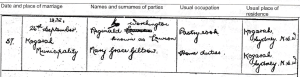
On 26 Sep 1932 at the age of 20, he married Mary Grace (‘May’) Giltrow at Kogarah near Sydney. May, the daughter of a coach builder, had been born in Sheffield and had migrated to Australia. She was 19 years of age and had just completed a course in millinery at Kogarah Trades School.

On his marriage certificate, he gave his occupation as pastry cook, he stated that he was born at Paddington, that his mother was Clara Worthington, no father listed.

Reg and May lived at Bexley and had two children. He passed away on 10 Dec 1993 aged 81 and May died 23 Aug 2012. Both are buried together at the Woronora Memorial Park, New South Wales.

I’m interested in Reg’s early life and how he came to have the name Lawson, the surname he used all the time, though on his marriage certificate he declared his name to be ‘Worthington known as Lawson’.

Arthur Charles Leitch Bayliss, Guardian of Minors, gave consent in writing for Reg to marry, indicating that he had previously been a ward of the state.

One of the witnesses to the marriage was a man named Frederick Dobson.

Frederick Dobson

The electoral rolls for 1936 and 1937 reveal at least three residents of 27 Princes Hwy, Kogarah:

Lawson, Jessie, dressmaker 
Lawson, Reginald, labourer 
Dobson, Frederick, clerk

In 1938 Frederick married Beryl Reid and seems to be missing from the rolls until 1954 and 1958 he and his wife Beryl are shown as living at 27 Princes Hwy, Kogarah

Frederick and Beryl’s marriage was reported in The Hurstville Propeller on 9 June 1938 and show that Fred and Reg were more than mere lodgers at 27 Princes Hwy:

LOCAL WEDDINGS: DOBSON-REID
Floral arches decorated with autumn-toned flowers were features of the decorations in the Rockdale Methodist Church on Saturday afternoon, 14th May, for the marriage between Beryl, youngest daughter of Mrs D. and the late Mr F. Reid, of Baxter Avenue, Kogarah, and Frederick Dobson, of Princes Highway, Kogarah. Given away by her brother (Mr Herbert Reid), the bride wore a tailored gown of trained off-white satin with a tulle, veil embroidered in true lovers' knots mounted on cut tulle and held in place by a coronet of orange blossoms. She carried a shower bouquet of orchids and tube-roses, with trails of Cecil Bruner roses. Mrs Rose Sonta attended her sister as matron of honour, wearing gold brocaded satin with a circular tulle veil, dotted with gold sequins, mounted on a floral halo. Her shower bouquet comprised autumn-toned decorative chillies and gladioli. Little Pauline Forrest was flower-girl, in an early Victorian frock of ice-blue brocaded taffeta, with a blue tulle veil held in place by a gold medallion in her hair. She carried a basket of pink frangipani and autumn-toned flowers. The bridegroom's cousin, Mr Reginald Lawson, was best man, and during the signing of the register, Mr Jack Brown sang "Until," with organ accompaniment. Navy-blue crepe splendour was worn by the bride's mother for the reception at her home, with a shoulder posy of lily of the valley. She was accompanied by the bridegroom's aunt (Miss J. Lawson), who chose a navy-blue costume, her posy being also lily of the valley.

So according to the article, Fred and Reg were cousins, and Jessie was Fred’s aunt.

Fred was two years younger than Reg but, like Reg, he was born at Paddington with no father listed. His mother’s name was Belle Georgina Dobson.

From the New South Wales Police Gazette 14 October 1914:

Paddington.—A warrant has been issued by the Children's, Court Bench, Sydney, for the arrest of Fred. Holstein, charged with failing to make adequate provision for the payment of preliminary expenses of and incidental to and immediately succeeding the birth of an infant. He is 35 years of age, 5 feet 4 or 5 inches high, medium build, florid complexion, fair hair, ginger moustache, blue eyes, round face; dressed in a blue serge sac suit and black hard hat; a German; sneaks good English: recently employed at Millard s Motor Garage, Phillip-street, Sydney. Complainant, Belle Georgina Dobson, 125 Wallis-street, Woollahra.

Belle never married, lived at 125 Wallis Street, Woolhara throughout her life and died there in 1943.

The Lawsons (updated April 2022)

Miss Jessie Lawson is shown as living at the same addresses in Kogarah in the electoral rolls:

1930-33: 27 Rocky Point Road, Kogarah, dressmaker 
1935-43: 27 Princes Highway, Kogarah, dressmaker

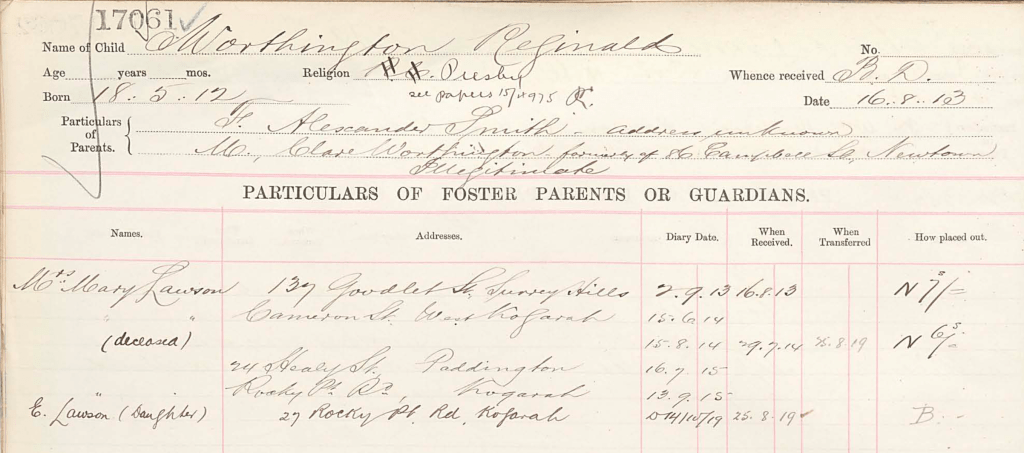
The entry for Reginald Worthington in the NSW Dependent Children Register shows that he was born on 18 February 1912 and fostered to Mrs Mary Lawson of Surry Hills (later of Kogarah) on 16 August 1913, when he was only 18 months old. After Mary Lawson died in 1919, when Reginald was only 7, her daughter Ethel Jane Lawson became his guardian, and she is noted as living at 27 Rocky Point Road in that year. Ethel died in 1929 aged 42 and her sister Jessie appears at the address from the following year.

The entry lists Reginald’s parents as Alexander Smith (address unknown) and Clara Worthington (formerly of 86 Campbell Street, Newtown). As yet I haven’t been able to find out anything further about Alexander Smith.

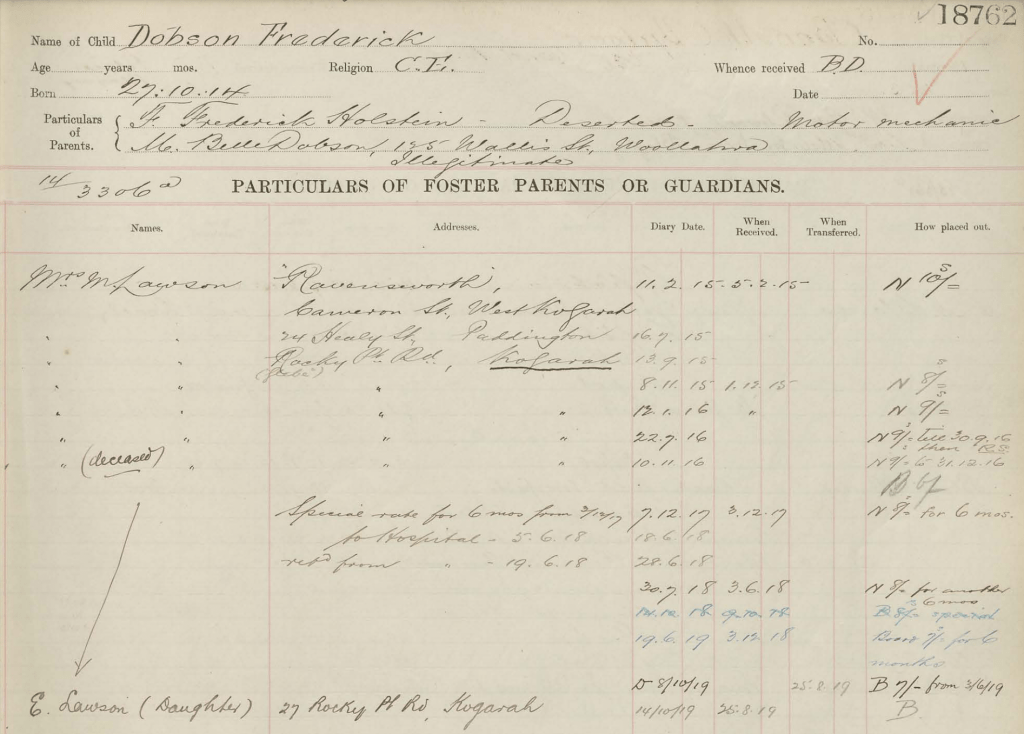
Fred Dobson also has an entry in the NSW Dependent Children Register, which confirms that he was also fostered by Mary Lawson of Kogarah

Photo Gallery of a Petty Criminal

Photo Gallery of a Petty Criminal

Many hardworking, law-abiding ancestors have lived their lives leaving behind a sparse and unremarkable trail of records, and often no images. My great-grandmother’s brother Leo Albert Worthington was not one of these people. His criminality spread over thirty-five years and at least eleven aliases.

I’ll start by saying that Leo was not a particularly good criminal, as his arrest record seems to show.

I’ll also state from the outset that even though Leo’s family life was rough and poverty-stricken, this is not meant to provide excuses for Leo’s actions, only to provide some context for his life.

He was born on 26 September 1893 at Forbes in central New South Wales to John Joseph and Mary Ann Worthington. He was the ninth child of eleven children. As the drought and depression of the 1890s set in, John Joseph lost his farm at Moonbi and the family moved into the Forbes township and he took work as a contract labourer. When work opportunities dwindled in 1900 he left the family, going north to seek work and was never seen again. Mary Ann went to the police in 1903 reporting him missing and a warrant was issued to no avail. She stated that she and the children were left destitute.

Mary Ann took the children to Cobar where her mother lived. Here the family were subject to a number of sad events, one being that on 4 Apr 1905 Leo, aged only 12, was convicted of stealing goods from a railway carriage at Cobar and was sent to the Carpentarian Reformatory for Boys for three years.

The Carpentarian Reformatory was established at Brush Farm, Eastwood, NSW in Sydney’s north west. It was named after the philanthropist, Mary Carpenter. At the time Leo was sent there it was run by the State Children’s Relief Department.

A year before Leo got there, the annual report of the Reformatory was reported on in the Goulburn Herald:

THE CARPENTARIAN REFORMATORY.
THE annual report of the superintendent of the Carpentarian Reformatory, Mr F. Stayner, has been received by the Minister for Education. Dealing with the way in which inmates are recruited, he says they come to the institution from the various police courts, quarter sessions. and so on for minor offences. Instead of sending them to jail, the magistrate orders them to the institution for not less than one year and not more than five years. Sometimes, however, the lads are not allowed to remain for a year, and no impression can be made on them in less than the time named, and nothing taught them in less than two years. Truancy and wandering in the streets also furnish their crop of recruits to the reformatory. Several trades are taught, such as tailoring, joinery, boot-making, and so on, and the boys are also employed in gardening and orchard work. Out of 361 boys who have at various times been discharged from the institution, 83 per cent have turned out well.
(Goulburn Herald, 1 April 1904, p.5)

Leo was unfortunately not to be amongst the reformatory’s success stories.

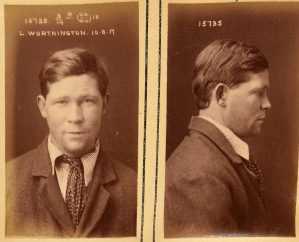
If he was released after the three years was up, it would have been a month before the death of his grandmother aged 85 at Cobar, but there is no evidence that he returned to Cobar. In fact, it’s hard to pinpoint where he was until his next convictions in May and June 1914 in Sydney for drunk and disorderly, stealing from the person and indecent language. His sheet has him as a labourer from Forbes who was born on 23/07/1893.

By this time he was aged 21 and had the tattoos that would appear beside all his mugshots ‘pierced heart inside left forearm and woman’s head outside right upper arm’.

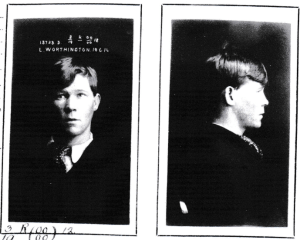
Leo Worthington, Sydney, 1914

At some stage, Leo’s mother contracted tuberculosis and from September 1914 until March 1916 she was a resident at the Waterfall hospital for consumptives. She succumbed to the illness on 20 March 1917 and Leo’s name was left off the family notice in the newspaper.

In the meantime, in 1915-1916 Leo was racking up convictions at Molong, Crookwell and Sydney, mostly for bad behaviour and violently resisting arrest.

Two months after his mother’s death, on 8 May 1917 Leo, aged 23 and apparently a shearer, enlisted in the Australian Imperial Force, 1st Light Horse. Though the lives of soldiers were difficult and dangerous, for young men with few prospects, enlistment in the armed services could provide an opportunity to break out of a cycle of crime, to travel, to be a part of something, and two of his brothers had already enlisted. However, Leo was discharged on 28 Nov the same year because of his criminal convictions.

In August 1917, before he was officially discharged, he was convicted in Sydney for two charges of shop breaking for which he received a sentence of two years. His sheet says he was a labourer from Forbes who was born on 23/07/1893.

Leo Worthington, 1917

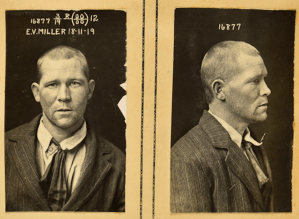
After release (and before his prison haircut had had time to grow out) in October 1919 he was charged in Sydney with unlawfully wearing a military uniform and a month later with shooting with intent to cause grievous bodily harm, for which he was sentenced to 12 months. He used the name Edward Vivian Miller and said he was a wool classer from Orange born 3/8/1894.

‘Edward Vivian Miller’, 1919

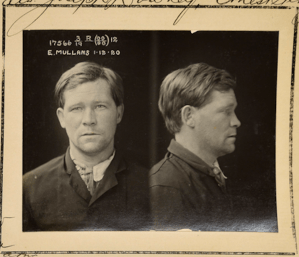
On 9 November 1920 at Maitland Quarter Sessions he was convicted for breaking into a warehouse and stealing goods valued at £300 and sentenced to four years penal servitude. His sheet has him using the name Edward Mullins, a labourer from Forbes born on 01/08/1893.

‘Edward Mullins’, 1920

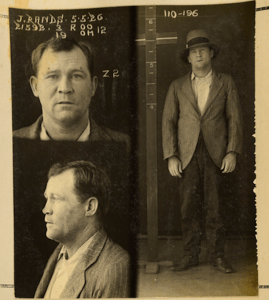
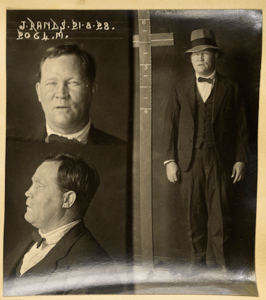
After release, he was charged in May 1924 with attempting to break into a shop with intent to steal. He absconded after release on bail. He finally ended up at Sydney Quarter Sessions in May 1926 and was sentenced to three years hard labour.

‘James Rands’, 1926

In 1928 his photo was retaken for some reason, and he doesn’t seem very healthy.

‘James Rands’, 1928

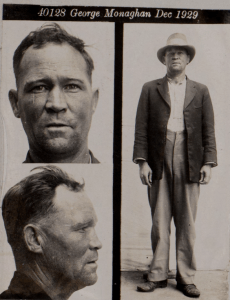
Upon release, Leo ended up in Victoria where he was convicted of shop breaking and sentenced to 12 months. He used the name George Monaghan, and said he was a native of Victoria born in 1893.

‘George Monaghan’, Victoria, 1929

Having pleaded guilty to a charge of shop breaking, George Monaghan, who said that his correct name was Leo Worthington, aged 36 years, shearer, of Gertrude Street, Fitzroy, admitted 14 previous convictions, mostly in New South Wales.He had served a sentence of imprisonment for 12 months for shooting with intent to do grievous bodily harm and a sentence of imprisonment for four years for shop breaking.

Judge Moule said that on the occasion which had given rise to the charge nothing of much value had been stolen. Monaghan would be sentenced to imprisonment for 12 months. He would also be declared an habitual criminal and would be detained in a reformatory prison at the expiration of his sentence during the pleasure of the Governor.
(The Argus, 14 Dec 1929, p.32)

I’ve given an overview of some of the crimes that caused incarceration on the occasions of his photographs being taken, but his petty criminality extended well beyond these charges, and finding all reports in the police gazettes to put together a timeline was like untangling a ball of sticky wool. Apart from Edward Vivian Miller, Edward Mullins, James Rands and George Monaghan, he used the aliases Joseph Downey, James Downey, Ernest Sergeant, James Mitchell and James Cavanagh. It must have been a very difficult job for the police to match up descriptions of offenders trying to evade detection by giving false information. Additionally, many of his cohorts had numerous aliases. Fortunately, each prison portrait sheet contains all the known aliases and all the previous photograph numbers so it’s relatively easy to collect the set.

The online criminal photographs go up to 1930, and when further records go up there will be at least two more photos to add to the gallery from the next decade.

In March 1933 Leo was sentenced to twelve months’ imprisonment for having stolen a silver watch and chain from a man in the street in Sydney. He was convicted under his own name and was recorded as a 41-year-old labourer.

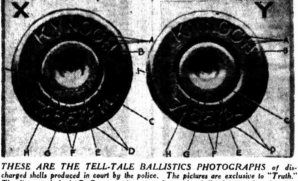
In 1934 he was sentenced to six months’ imprisonment for possession of an unregistered automatic pistol at Redfern. Ballistics testing on that pistol revealed that it was a match for a casing found at the scene of a shooting that had occurred at Glebe four days before the gun was recovered.

Arthur North of Glebe had initially told police that he had found the gun in an alley at Redfern nine months before he was shot in the leg, that it had accidentally gone off while he was looking at it, and that he had given it away before police arrived at the scene.

When Leo’s involvement was unearthed by the ballistics, he said that he had taken the gun to North’s house, and that he was showing North how to use it when it accidentally went off, and that he had fled the scene and called an ambulance. The story was corroborated by North and accepted by the magistrate.

In police circles, the case is regarded as being of considerable importance in that it established a precedent for the legal acceptance of ballistics photographs. Science had proved that both shells had been fired from the same weapon and the proof was corroborated — if proof can be corroborated— by the dramatic admission of Worthington that the shot which wounded North was fired from the identical pistol.
(The Truth, 8 April 1934, p. 19)

I don’t believe that anyone else in the family has ever made a contribution to forensic science but, apparently, The Truth thought Leo did!

In June 1939 he was sentenced to three years imprisonment for assault and robbery at Maroubra in January that year.

After the expiration of this sentence, things seemed to settle down. In 1943 Leo was living in Bourke Street, Surry Hills and is recorded as a labourer in the electoral roll. In 1949 he was living in Toowomba and is recorded as a labourer.

In 1951 he married Rose Ann Mitchell Cuddy (nee Teague) at Toowomba. He was 58 years of age and Rose Ann was 75. In 1954 they both appear in the electoral roll residing in White Street, Everton Park, a suburb of Brisbane.

Rose Ann died in 1956 aged 79 and was buried at Lutwyche Cemetery, Brisbane. In 1958 Leo was living at 139 Latrobe Terrace, Paddington, an inner suburb of Brisbane, and working as a salesman.

Leo died on 26 Feb 1961 in Brisbane Hospital of heart failure, the culmination of heart problems he had apparently been suffering with for about 12 years. He was buried with Rose Ann at Lutwyche Cemetery.

Leo’s youngest brother Eugene Henry (‘E. Worthington, brother, 68 Albany Road, Stanmore, Sydney, New South Wales’) gave information for his death certificate. Interestingly, Gene gave their father’s name as Leo Albert Worthington.

Unsurprising that Gene would be hazy on his father’s name, as he hadn’t seen him since he was four years of age. Leo’s passing left Gene as the only living child of the family.

What Happened to Florence?

What Happened to Florence?

Many hardworking, law-abiding ancestors have lived their lives leaving behind a sparse and unremarkable trail of records, and often no images. My great-grandmother Florence Rosaleigh Mary Webster was not one of these people. The details of her early life are a little hazy, but her descent into vagrancy, alcoholism and petty crime kept Brisbane law enforcement and court reporters occupied for over two decades.


Florence’s life began near Caboolture, Queensland in an area ironically called Downfall Creek. Now a part of Chermside West, it was possibly named in 1843 by missionary and farmer Carl Friedrich Gerler (1817-1894) when a bullock dray broke down there while establishing a mission outstation at Caboolture.

Her father, George Thomas Webster, had been born in Maldon, Victoria, where his father Joseph searched for gold. Joseph and Elizabeth Webster moved their family to Queensland in around 1867 and farmed at Downfall Creek and later at Kilcoy. The year 1867 coincides with reports of gold having been discovered in the area, so no doubt he Joseph Webster made some efforts in that regard as well.

On 16 May 1883 at the Methodist Church in Ann Street, Brisbane, George married 16-year-old Alice Jane Payne. Alice was born in Birtsmorten, Worcestershire, and had migrated to Australia with her parents at the age of 10. At the time of the marriage, George was a 22-year-old labourer of Downfall Creek, and Alice was a resident of South Brisbane, so how the two became acquainted is unknown.

George and Alice’s firstborn was a boy named William Joseph, born on 18 June 1884, but he died only 40 days later on 28 July, and was buried at Lutwyche Cemetery. Next came George ‘Victor’, born 1885, then Florence Rosaleigh Mary in 1886, then George Arthur in 1889.

A little boy, aged three years, named Victor Webster, was drowned in a well on Tuesday at Downfall Creek. The lad was on a visit to his aunt, and between 11 and 12 o’clock he was missed. His aunt called him, but getting no answer she went outside and looked down the well in the back yard. There she saw bubbles coming to the surface, shortly followed by the boy’s head. She immediately ran to where her father was working, a distance of about one mile. When he arrived he took the body out of the well. The well was roughly covered by a few slabs. An enquiry will be held.The Week (Brisbane, Qld.), 2 Nov 1889, p. 11.

The aunt was Ada, she was 13 years of age at the time, her mother Elizabeth was visiting Sandgate, and before she left she had instructed Ada to ‘take care of the children’ (how many she was taking care of is not mentioned any of the reports). Nor do any reports mention George Snr or Alice, but one can only imagine the loss of this boy to be devastating for all concerned. Florence was three years old at the time and Alice was weeks away from giving birth to George Arthur. The inquest ruling was accidental death and Victor was buried at Lutwyche Cemetery with his brother.

What became of Florence’s father after this time is uncertain. Some Ancestry family trees have him passing away at the Dunwich Asylum in 1920, though there doesn’t seem to be any evidence for this. He seems to have disappeared by the late 1890s. Alice had two further daughters Edith Payne Osborne (1897) and Laura Osborne (1901), and would later wed their father, William George Osborne in 1908. On that marriage certificate Alice declared she was a widow living at Charlotte Street, Brisbane.

By this time Florence had met and married John William Kyling, a labourer from Warwick in the Darling Downs region, where his German immigrant parents were hotel keepers.

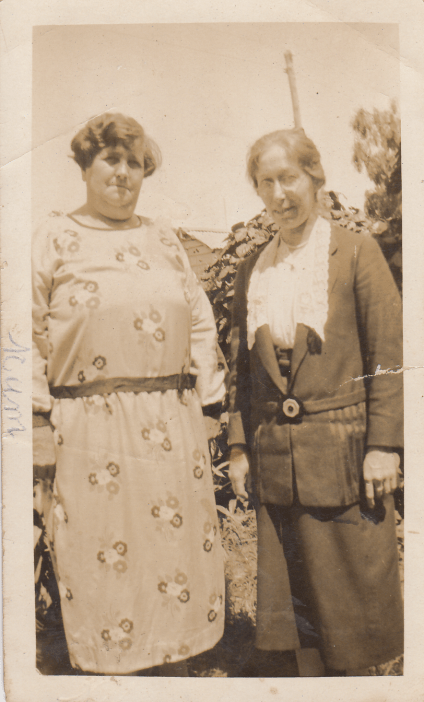
Their first child John Henry Kyling was born in October 1905 and John and Florence married the following month. This photograph from the christening was published in the Queenslander in March 1906 and shows five generations: Elizabeth Carseldine (nee Payne) (middle left), Mary Alsop (nee Kendrick) (middle right), Alice Osborne (nee Payne) (left), Florence Kyling (nee Webster) (right), and baby John Henry Kyling.

In 1908, at the age of three, John Henry died of measles and bronchopneumonia and was buried at Toowong. On the death certificate, John was listed as a wharf worker and the couple were living at Warren Street, Fortitude Valley. Two girls followed, Marie Alice Caroline (my grandmother) in 1909 and Mervis Florence Irene (pronounced Mavis) in 1911.

In the 1913 electoral roll John and Florence were living at Stanley and Peel Street, Brisbane South, and John was working as a salesman. In June the same year the final child was born, but something was wrong. He was registered as Charles Allen Arthur Kyling with no father listed. In fact, the certificate has the word ‘illegitimate’ written across under the father’s details section. Florence was 24 years of age and living at ‘Stephens Street West End’ (South Brisbane). I cannot find what happened to this child, and I assume he was adopted. I wonder whether he might have tried to find his mother later on, as someone has written in pencil ‘D. 1951’ next to her name on the original birth certificate.

In 1917 Florence’s remaining brother, George Arthur Webster, was killed in Begium fighting with the 9th Battalion, leaving his widow Augusta Elizabeth Madeline (nee Hoffman) and four young children.

In 1919 John had commenced working as a coach painter and was living at Melville Terrace, Wynnum with a woman named Anna Kruger. In 1925 and all the way through to John’s death in 1947 Anna appears as Annie Kyling in the electoral rolls. As the informant on John’s death certificate, she appears as ‘Annie Kruger, no relation’.

Florence appeared in the electoral roll in 1925 at Kingsley Terrace, Wynnum, then not again until 1949 when she was at Eventide Home.

In the intervening 24 years Florence, was homeless, and is noted in newspaper reports as having camped at Victoria Park and Anzac Park, Toowong, and occasionally sleeping in vacant houses. She went before the court on at least 26 occasions under her maiden name, usually receiving a short sentence of less than six months. Charges were mostly for theft, trespass and vagrancy, and one charge of unlawful assault when she was confronted by an angry house occupant in 1933. She carried out her offending in areas such Spring Hill, Brisbane, Kedron, Fortitude Valley. It would be safe to say that she committed many more crimes than those she was charged with, as from the timing of the court visits that she would reoffend almost immediately upon release from gaol, and sometimes when her ‘camp’ was searched she would be found with other items obviously stolen.

She would take anything she could lay her hands on, hiding as many small as items as she could inside her clothing. Cash, watches, silverware, jewellery, bicycles, all of which (unless she was caught with them) would be sold to her cohorts or pawned for money to buy food and alcohol. Her modus operandi was to enter houses alone during the day when either the occupants were out or when occupants were at the rear of the house, and enter through a window or unlocked door. At one stage she engaged in a door knocking campaign to beg for money and entering those houses where she received no response to her knock.

Senior Constable D. McGrath of the City Police Court, acted as prosecutor for at least a dozen of Florences court appearances. He had an extensive record of presenting such cases in court, and there were many, many petty criminals he saw time and time again. Florence always pled guilty, so he usually only had to present the details to the judge who would pass usually a moderate or light sentence depending on the circumstances.

On the rare occasion where there was a quote from Florence she was appealing to the judge that she was hungry and needed money to buy food. Mention was made of her and her homeless cohorts consumption of methylated spirits. In 1946 at age 60 when she was picked up on her final vagrancy charge, for which she received a sentence of two months’ gaol, she was described as having been sheltering in a tennis court shed in Anzac Park, Toowong, and in a filthy condition.

After a short stay at Eventide Home in where she resided from 1949, she was admitted to Brisbane Mental Hospital, Goodna on 12 March 1951 and died there on 20 August from cerebral thrombosis.

Mervis was the informant on her mother’s death certificate. Under children she lists Marie Alice Caroline 42 years, Mervis Florence Irene 40 years, I male deceased. There is no mention of Charles Allen Arthur Kyling.

Wider Circles : Maher & Buckley

Wider Circles : Maher & Buckley

Witnesses to family events can shed light on extended family and friends. I have added articles about other Maher families (the Dookie Mahers and the Epping Mahers) that also had connections to Springfield, Kilmore and Lancefield in an effort to one day establish more precise family connections.

Here is a list of sponsors and witnesses named on baptism and marriage certificates for this family. (This is still a work in progress.)

1862 Thomas Maher & Catherine Costigan, marriage Michael Behan
Johanna Lawler
1863 Anne Maher, baptism
Parents Thomas Maher & Catherine Costigan
Matthew Dwyer (1843-1921)
Anne Maher
1864 Catherine Maher, baptism
Parents Thomas Maher & Catherine Costigan
John Dwyer (1816-1901)
Anne Dwyer (1845-1943)
1866 Mary Maher, baptism
Parents Thomas Maher & Catherine Costigan
Edmond Farrell
Mary Moylan
1868 Roderick Maher, baptism
Parents Thomas Maher & Catherine Costigan
Charles Maher (1825-1902)
Mary Dwyer (1848-1935)
1870 Sarah Maher, baptism
Parents Thomas Maher & Catherine Costigan
Sarah Maher
1876 Patrick Buckley & Anne Hunter, marriage Timothy Crough
Catherine Hunter (1857-1891)
1884 Patrick Buckley & Maryann Scanlon, marriage James Lyons
Sarah Maher
1886 Mary Cantwell, baptism
Parents Thomas Cantwell & Anne Maher
Kate Maher (1864-1931)
Roderick (Rody) Maher (1869-1951)
1888 Elizabeth Cantwell, baptism
Parents Thomas Cantwell & Anne Maher
Sarah Maher (1882-1936)
Patrick Maher (1875-1966)
1889 Ellen Morley, baptism
Parents Walter Morley & Mary Maher
Patrick Maher (1875-1966)
Catherine Maher (1864-1931)
1890 Christina McLeod, baptism
Parents William McLeod & Catherine Maher
Thomas Hunt
Sarah Maher (1882-1936)
1891 Catherine McLeod, baptism
Parents William McLeod & Catherine Maher
Roger (Rody) Maher (1869-1951)
Johanna Mulvey (1871-1939)
1891 Catherine Morley, baptism
Parents Walter Morley & Mary Maher
Johanna Maher (1872-1933)
1892 Thomas Graham Cantwell, baptism
Parents Thomas Cantwell & Anne Maher
Robert Graham
Annie Heffernan
1893 Alice Morley, baptism
Parents Walter Morley & Mary Maher
Ellen Maher (1877-1921)
John Fitzpatrick (1882-1960)
(son of Mary Anastasia Dwyer)
1895 Roderick Cantwell,
Parents Thomas Cantwell & Anne Maher
Edward Fitzpatrick (1879-1956)
(son of Mary Anastasia Dwyer)
Ellen Maher (1877-1921)
1902 Roderick Maher & Anne Buckley marriage John Buckley (1881-1945)
Margaret Maher (1888-1935)
1902 Thomas Michael Maher, baptism
Parents Roderick Maher & Annie Buckley
Patrick Maher (1875-1966)
Nellie Buckley (1849-1935)
1903 John Curry & Hanora Maher marriage Michael Curry (either father
or brother of John Curry)
Johanna Maher (1872-1923)
1903 Richard Oswald Cantwell, baptism
Parents Thomas Cantwell & Anne Maher
Margaret Maher (1888-1935)
1903 Patrick Maher, baptism
Parents Roderick Maher and Annie Buckley
Mary Buckley (1859-1923)
Roderick John Maher, baptism
Parents Roderick Maher and Annie Buckley
John Buckley (1881-1945)
Catherine McLeod (1864-1931)
(per proxy Christina McLeod)
1907 William Maher, baptism
Parents Roderick Maher & Anne Buckley
Katie Cantwell (1883-1936)
(daughter of Anne Cantwell, nee Maher)
(per proxy Chrissie McLeod)

Timothy Crough (1853-1889)

Witness to the marriage of Patrick Buckley and Annie Hunter in 1862. Patrick Buckley’s obituary stated that he had been “in the employ of the late Mr James Crough, when that gentleman was resident at Bawnmore.”

THE LATE TIMOTHY CROUGH.
There are very few old residents of Kilmore but will remember the late Mr Timothy Crough, whose remains were interred in the Kilmore Cemetery on Wednesday, 24th April. Thirty-two years ago when the Government of the country did not pay that attention to our wants which the people can demand from them today, the late Mr Crough, who was connected with the postal department in Ireland before he decided to try his fortunes in Australia, volunteered to give a house to house delivery of all letters and newspapers arriving in Kilmore, trusting for remuneration from the people whom he benefitted. So steady was his conduct and sterling his character that the most important commissions were entrusted to him and were carried out with a fidelity which gained him the confidence of all. After about two years of this important service, he was appointed first Government letter carrier at Kilmore. After about four years’ service in this capacity, he was appointed mail guard on the Sydney line, his section being from Seymour to Badaginnie-the worst patch of road, without exception, between Melbourne and Sydney. This position he occupied until the North-Eastern railway line was opened when he took charge of the travelling post-office between Melbourne and Longwool. This position he occupied till within about two years of his demise, when failing health caused him to relinquish it for the position of sorter in the General Post Office, retaining the salary and emoluments of his more active position. Continual failure of health caused him about five months ago to retire on an allowance, and since then he has been scarcely ever well.
He died at the comparatively early age – for a man who had lived so steadily–of 56 years, and there is scarcely a doubt but that the hardship and accidents of his early coaching days told against him in the end and considerably shortened his days.
Though the notice of his demise was a very short one to his Kilmore acquaintances, a very large number of vehicles and horsemen met the train conveying his remains from Melbourne at the Kilmore East station and followed them to the old Cemetery. The deceased gentleman was well liked and respected along the whole line from Benalla to Melbourne, and there are few who knew him but will have a kindly word for his memory.
He leaves a large family, most of whom, however, are grown up.

(Kilmore Free Press, 2 May 1889, p.2)

Dwyers (Anne, John, Mary, Matthew) and Fitzpatricks (Edward, John)

These seem to be all connected to another Maher family which may have been distantly related to Thomas and Catherine Maher – these are children of John Dwyer and Honora Maher (Hanora being the sister of Catherine’s former employer John Maher). Another of the Dwyer children, Mary Anastasia married Patrick Fitzpatrick and Edward and John Fitzpatrick were two of their children.

James Lyons (1834-1914)

Mr. James Lyons, a resident of Kilmore for about 66 years, died on Friday last after an illness of about eighteen months. The deceased who was about 80 years of age, reared a large family of eight sons and two daughters, some of whom are still living in Western Australia. He was a contractor for many years mostly under the local councils. He was a man, who in early life, was possessed of much sense of humour and full of anecdote. The remains we interred in the Kilmore Catholic cemetery on Saturday, Father Dolan attending to the solemn rites at the grave.(Kilmore Free Press, 14 May 1914, p.3)

Johanna Mulvey (1871-1939)

Johanna Mulvey was born at Kilmore in 1871 to John Mulvey and Mary Ann Hyland, and she died in Fitzroy in 1939. She married James Nugent in 1904, they resided at Essendon and had three children. In 1891 at the age of 20 she was a baptism sponsor of Catherine McLeod, daughter of William McLeod and Catherine Maher.
This is the obituary for her brother, James Patrick Mulvey, that gives an overview of the Mulvey family in the Kilmore district.

Another Kilmore identity passed to eternity on Sunday last, when Mr James Patrick Mulvey succumbed to a somewhat lengthy illness. He was born at Kilmore 74 years ago, being the only son of the late Mr and Mrs John Mulvey, who settled in the district about 80 years ago. They were engaged in farming generally and dairying in particular. After the demise of the parents, the family separated, Mr J.P. Mulvey carrying on the farm for a brief period. He eventually relinquished the rural life and took over the livery stables carried on by Mr Thomas Hammond, the stables being on the site now occupied by M. O. Burgess’ Rendezvous Cafe. Mr Mulvey conducted the business for many years, combining with it passenger traffic between Kilmore and Kilmore East railway station, also conveying the mails. At that period there were seven trips per day with horse-drawn vehicles. He was the first to introduce a motor bus for the conveyance of passenger but did not persist with it on account of the imperfection of the vehicle, which, at that time, was regarded as one of the best obtainable. Mr Mulvey retained the horses when using the motor, and carried on with them to the period when he sold out the business to Mr P. O’Connor. With rapidly increasing motor traffic the livery stable trade commenced to dwindle, and in a couple of years was practically a thing of the past. Soon afterwards it became a memory only, and the whole concern was sold off by auction. Some of the vehicles failed to attract purchasers and were left to fall to pieces. Mr Mulvey, having disposed of his local interests, removed to the metropolis, finally settling at Garden Vale. He had six sisters, four of whom survive, one (Margaret) being Sister St. Paul, of the Carmelite Monastery, Kew. Another (Johanna) is the wife of Mr J. Nugent, who carried on business at Kilmore as blacksmith, wheelwright and coachbuilder prior to his removal to Melbourne. A second sister (Alice) became the wife of Mr Thomas Hammond, who was a licensee of the Railway hotel, Kilmore, for a lengthy period, but relinquished the business and, with Mrs Hammond, transferred their abode to Western Australia, where they remained some years, subsequently returning to Melbourne. Another sister (Esther Ellen-Mrs McGrath) also, with her husband, made their home in Western Australia. Mr Muivey’s remains were brought to Kilmore on Monday and temporarily deposited in St. Patrick’s Church, if which he had been a devoted adherent during his long residence locally. A short service having been conducted, the remains were conveyed to the Kilmore general cemetery, where the interment took place in the Church of England portion, deceased being buried with his wife, who predeceased him many years ago. Rev. Father McHugh, P.P., read the burial service, and the mortuary arrangements were carried out by Messrs Beegan and Matthews in conjunction. Mr James Mulvey, solicitor, of Kilmore, and Miss M. Mulvey, of Garden Vale, are the surviving family, two others being deceased.

(Kilmore Free Press, 26 Sep 1935, p.2)


Tangental Families : The Epping Mahers

Tangental Families : The Epping Mahers

Before her marriage to Thomas Maher in 1862, Catherine Costigan, my gg-grandmother had migrated to Australia and worked as a servant for a family of Mahers in Epping, north of Melbourne.


Catherine Costigan and Thomas Maher married at St Paul’s Pentridge (later renamed Coburg) on 13 February 1862. Catherine declared she was a 21-year-old servant at Epping, and Thomas declared he was a 22-year-old labourer at Lancefield. The details of Catherine’s employment at Epping may shed some light on how she and Thomas came to be acquainted.

In reports of an inquest at which Catherine Costigan and her employers John and Margaret Maher all testified, John Maher is recorded as a wheelwright who had set up his business adjacent to the Travellers Rest Hotel in Epping. Details of the family are as follows:

Charles MAHER

b. c1790 Silvermines, Tipperary, Ire.

m. 2 Jun 1811 Parochial House, Loughmore, Tipperary, Ire.

Anne CAHILL

b. c1792

Children

1. Honora MAHER b. 1812 Loughmore, Tipperary, Ire.; d. 24 Jan 1886 Tatura, Vic.; m. 1839 Tipperary, Ire. John DWYER, 4 children:
Matthew DWYER (1843-1921)
Anne DWYER (1845-1943)
Mary Anastasia DWYER (1848-1935)
Charles (1851-1904)

2. William MAHER b. 1813 Loughmore, Tipperary, Ire.; d. 8 Sep 1893 Kyneton, Vic.; bur. Riddells Creek, Vic.; m. Johanna RYAN, 3 children

Clustered around that picturesque locality [Lower Springfield] there were the following heads of houses:- John and Daniel Egan, James and Thomas Quinlan, William Maher - a venerable uncle of 'yours truly', James Galvin, all of whom-- with the one exception already noted [Mrs P. Sheehan, nee Egan] are only remembered as former residents.

('Reminiscences of an Old Road' by James Alipius Maher, part three 1839)

3. James MAHER b. 1816 Loughmore, Tipperary, Ire.; d. 1911 Yabba, near Dookie, Vic.; m. 11 Apr 1850 Drom and Inch, Tipperary, Ire. Catherine DWYER, 4 children
This family arrived in Australia in 1866 aboard the Fitzjames– James 37, Cathne 35, Mary (Ryan, domestic servant) 16, Ann 11, Honora 9, Cathne 7 & Matthew 5. Catherine Dwyer was previously married to a John Ryan and Mary was her daughter from the first marriage.

One by one the old colonists—the men who moulded this district into the shape it is today, are passing away. The latest to go is Mr James Maher who died at the residence of his son-in-law, Mr Thomas Ryan, of Yabba South, on the 21st October, after attaining the ripe old age of 97 years.

Deceased was a native of Tipperary, Ireland, and arrived in this country with his wife and family in the year 1866. He first settled in Lancefield, district, where he lived for the past 30 years.

The late Mr Maher was a remarkably strong and healthy man, and despite his great age was able to get about till within a month of his death. For months past it was seen that the end was approaching, and five weeks ago he took to his bed. He gradually sank and died, as stated, on the 21st, being conscious to the end.

The deceased gentleman leaves a family of three daughters and one son—Mrs. Moylan (Dookie). Mrs T. Ryan (Yabba South), Mrs P. Moylan (Gowangardie) and Mrs Matthew Maher of Cosgrove South, besides three step-daughters, Mrs Keating, Mrs O'Shea (Cosgrove), and Mrs Tobin (Kaarimba), He also leaves 40 grandchildren and 37 great-grandchildren.

The funeral took place on Monday week and was largely attended. The coffin was borne to the grave by his six grandsons, Messrs. J. and J. Moylan, M. and W. Ryan, J. Maher and R. O'Shea. Mr N. Torgrimson had charge of the mortuary arrangements, and Rev Father Rooney officiated at the grave.

(Dookie and Katamatite Recorder, 2 Nov 1911, p. 2)

4. Margaret MAHER b. 1818 Loughmore, Tipperary, Ire.

5. John MAHER b. 1820 Ire.; d. 9 Jul 1883 Tatura, Vic.; m. Boston, USA, Margaret RYAN, 7 children
Apparently travelled to USA in 1848, then he, his wife (Margaret nee Ryan) and baby Charles (2nd) travelled to Australia aboard the Oliver Lang, arriving 25 Sep 1854. For his business as a blacksmith and wheelwright, John Maher rented a house and paddock near Patrick Burke’s Travellers Rest Hotel in Epping from 1855 to 1862. He later retired to Tatura. Catherine Costigan worked for John Maher at Epping prior to her marriage to Thomas Maher in 1862.

6. Charles MAHER b. 1825 Drum, Tipperary, Ire.; d. 30 Jan 1902 Lancefield, Vic.; m. 17 Apr 1856 St Patrick’s RC, Kilmore, Vic. Bridget RYAN, 9 children
First a farm labourer at Coburg, then a bullock teamster between the Melbourne & Bendigo goldfields. About 1854 he took up farming at Lancefield on a property he called ‘Annievale’.

In the demise of Mr Charles Maher, which sad event occurred last week, the Lancefield district has lost one of its most spirited and enterprising residents. The gentleman named, who was about 76 years of age, resided upon his handsome property for many years where he reared a large and respectable family with whom there is widespread sympathy in their bereavement. Mr.Maher was always a supporter of the Kilmore A. & P. Society, and a frequent successful exhibitor at the annual shows, but he generally left his prize money to augment the society's fund, a circumstance which tended to illustrate his generally generous character. The Lancefield district will mourn deceased very much and Victoria may be said to have sustained a loss in the demise of so worthy a citizen.

(Kilmore Free Press, 6 Feb 1902, p.3)

James Alpius Maher (1869-1940)

J.A. Maher was one of nine children of Charles Maher and Bridget Ryan. He was the author of Kilmore: The Tale of a Century 1837-1937 and wrote a series of three articles about people and places along the Kilmore-Lancefield Road published in the Kilmore Free Press in March 1939.

OBITUARY MR. JAMES A. MAHER

There was widespread regret throughout the Lancefield, Pyalong and Kilmore districts at the death of Mr James A. Maher, of Pyalong, which took place at St. Vincent's Hospital, Melbourne, on the 18th December.

The late Mr Maher was a native of Lancefield, his father, the late Charles Maher, having settled there about the year 1854.
For many years Mr James Maher took a leading part in all activities of the district. He was a member of the West Bourke Agricultural Society when that body was active and was interested in racing, football and other kindred sports.

About the year 1900, Mr Maher took up his residence at "Hollymount," in the Pyalong district, and shortly afterwards he married Miss M. Mulcahy, who predeceased him by some years. Mr Maher continued to live in the Pyalong district until his death, save for a comparatively short residence in Melbourne and a period of about five years when he became a prominent and active citizen of Kilmore.

Here he took a leading part in the Centenary Celebrations in 1937-1938 and was vice-president of the Committee. His book The Tale of a Century is the only available history of the old town and district of Kilmore and his painstaking efforts produced a most valuable and interesting book.

Mr Maher was for some years a member of the Board of the Kilmore Hospital and was always a good friend and supporter of the Institution.

In the Pyalong district, Mr Maher's name was a household word and his advice was frequently sought and never refused. He was liberal-minded and essentially sane in his ideas and opinions, and his place in the community will be hard to fill.

The sympathy of all goes out to his daughter, Mrs Kevin Butler, his son, Mr Gerald Maher, and his surviving brother and sister, Mr Mathew Maher, of Lancefield, and Mrs Norah Minogue, of Melbourne.

After Requiem Mass at St Patrick's Church, Kilmore, celebrated by Rev. Father McHugh, a very large cortege representative of the citizens of Lancefield, Pyalong and Kilmore, followed his remains to the Kilmore Roman Catholic Cemetery on the 20th December.
The coffin-bearers were Dr Commons and Messrs G. C. Maher, K. Butler, T. C. Maher, C. Maher and E. McCarthy.
The pall-bearers were Dr T. Wilson and. Messrs R. Graham, O. Graham. J. Morrissey, C. T. Loughnan, R. Paterson, G. Mulcahy and Colin McNab.

(Kilmore Free Press, 2 Jan 1941, p.4)

The Mystery Noras

Above: Catherine Maher nee Costigan (left) with another woman and the inscription by Catherine’s granddaughter (Jean Hanson nee Ryan) on the verso reads Dear Grandma Maher and Auntie Nora.
Above: Sarah Ryan nee Maher (left) and Jean’s inscription is My Mum and Nora Fitz, whom Jean said was a Nora Fitzpatrick, but she couldn’t say for certain how she was related.

The background indicates to me that they might have been taken on the same day, and that day might have been in the late 1920s, since Catherine died in 1930.

A photograph we have of Catherine and Thomas Maher’s daughter Nora (Honora Curry nee Maher) appears to rule her out as a candidate. We can also rule out Honora Dwyer nee Maher, (above, sister of Catherine’s employer John Maher), as she died in 1890. While they seem to be two different women, there seems to be a resemblance between them.

Honora Maher and John Dwyer had a granddaughter named Honorah Mary Veronica Fitzpatrick (1894 Kilmore-1955 Wangaratta). On the dates, this may be a match for the ‘Nora Fitz’ in the photo on the right. Honorah Fitzpatrick’s mother’s dates fit (1848 Tipperary-1935 Tatura), however, her name was not Nora, she was Mary Anastasia Fitzpatrick (nee Dwyer). Jean may appears to have labelled the photos decades after they were taken, and it’s possible that her memory was not 100%, especially if contact with these other Mahers was very scarce.

If all this is true, it’s another piece of evidence to link the two Maher families, but still, we are no closer to knowing how the families fit together back in Tipperary. There is more digging to do.

If you have any information or photographs that might shed some light on this, or to confirm a relationship between these two Maher families I’d love to hear from you.