
 The Grant family migration to Australia from Scotland
In 1837 Alexander and Marion Sarah (nee Fletcher) Grant migrated from Inverness to Australia with their three children James, aged 10, Janet aged 7 (my g-g-grandmother), and Marion aged 4, aboard the William Nichol. Another child, John had died in 1835 as a baby and a further child, whom they also named John, was born in Sydney in December 1837 about 8 weeks after they arrived. The family then travelled down to Port Phillip where Alexander Grant farm laboured, squatted and farmed.
An interview with Marion in 1912 stated that “the ship took the news of the Queen’s [Victoria’s] accession to the Cape of Good Hope, where the event was duly celebrated. But speedier craft carried the tidings to New South Wales, where the celebrations were in progress when the William Nichol arrived.”
Below I’ve gathered together a few reports from newspapers and journals about the 1937 journey of the William Nicol, the spelling of Nicol, (Nichol, Nicholl) varies according to publication.

Departed: 06 Jul 1837 – Isle of Skye, Scotland
Arrived: 27 Oct 1837 – Sydney, NSW
Master: Captain McAlpine
Particulars: 408t ; built 1834 ; travelled via Capetown ; second ship of the Lang Bounty Scheme.
Notes: 311 passengers. John Dunmore Lang became involved in immigration, because he feared for the fate of a colony with no moral or Christan values. He felt that an injection of Protestant free settlers would provide a balance for the large numbers of convicts pouring into the colony, in the meantime calling for an end to transportation. Like most of Lang’s Scottish immigrants, the Grants were victims of the Highland Clearances. The rapid increase in population and the sheep farming for the expanding and popular wool industry forced many of the traditional oat and potato growers from their Highland land.
Bounty ships were often overcrowded, uncomfortable and insufficiently supplied with poor quality food, and it was reported that the William Nicol was no exception. Despite the fact that Dr David Boyter (Royal Navy) knew something of the characteristics of his potential candidates (he had travelled the Highlands on behalf of the Colonial Office searching for suitable candidates for the scheme), it was said that most of the crew of the William Nicol did not speak Gaelic and the Highlanders were not provided with any of their accustomed foods, such as oatmeal.
References:
Dougal McKenzie & Isabella McKenzie
Dokimon, John Dunmore Lang: Patriot, Republican, Statesman, Evangelical, & Engima [accessed 2012]
McKenzie, Roma. ‘Scotish Origins’ [research notes]
The mid 1830s were a time of great hardship and food shortage in the Highlands and Islands. The government did little to help. An impassioned plea for help by Caraid na Gaidheal, Dr Norman MacLeod was heard, and acted on by Rev Dunmore Lang, a Presbyterian minister based in Australia. He instigated a programme of assisted passages to Australia from the area. The first boat to leave was the William Nicol, which sailed from Isle Ornsay in July 1837 with 70 families from Sleat, the neighbouring parish of Strath and the adjoining mainland. Of the 322 passengers, 107 came from Sleat. The Edinburgh Courant of July 10 1837 reported that it took three days to complete the embarkation of the emigrants. It also reported that so many people wanted to emigrate that more people turned up than the ship could actually accommodate.
(Sleat Local History Society)
John O’Groat Journal, 21 Jul 1837, p.2
EMBARKATION OF HIGHLANDERS FOR AUSTRALIA.
Isleornsay has for some days past presented a busy scene. Last week, the ship William Nicol, of Glasgow, arrived in the bay, for the purpose of taking on board the emigrants. Monday the was the day fixed for the embarkation. At early hour on that day, Dr Boyter, the Government agent for emigration, attended. The Doctor was accompanied by Bowie, the commissioner for the McDonald Estates. In the course of the day, Glengarry, Mr Sellengston of Lochlash, and various other gentlemen connected with Skye and the adjoining mainland, came to Isleornsay to witness the interesting scene. The embarkation was soon commenced, and all was finally completed Wednesday evening when emigrants from the under-mentioned districts were all comfortably settled board the ship :
| From Slate, Isle of Skye | 107 |
| Straith, Ditto | 82 |
| Lochlash, Ross-shire | 43 |
| Glenelg | 29 |
| Knoydart | 48 |
| Lochaber | 4 |
| Lochbroom | 9 |
| In all, | 322 |
Of this number 104 were under seven years of age; and, judging from appearances, there is likely to be a considerable addition to the passengers before the ship reaches her destination.
On Wednesday afternoon, at the last muster of the passengers, every family was presented with a Bible. The ship was fitted up in the most commodious manner possible, and all who visited her were satisfied that the comforts of the emigrants had been most minutely attended to. Indeed as to this the poor people expressed themselves in the most grateful terms. The provisions laid in are of the first quality. Dr Roberts, surgeon of the Royal Navy, accompanies the ship as superintendent surgeon, and what pleased the people most of all was to find that a large and airy part of the ship was laid off as an hospital. An emigration is at all times an unpleasant scene to witness. On the present occasion, however, it was in many respects the reverse, for such was the eagerness of the poor people to be taken on board that all who presented themselves could not be received. This to many was a source of great disappointment; Dr Boyter, however, was firm in refusing to take one more than the ship could comfortably accommodate, and several families were in consequence left behind, with the hope, however, of being taken away by the next ship.
On Wednesday dancing commenced on board to the enlivening notes of the bagpipe and was kept up till a late hour. Early on Thursday morning the ship weighed anchor and sailed, and on passing Armadale Castle she was saluted with twelve guns. The salute was returned from the ship, followed by three hearty cheers from the emigrants.
All on board were loud in their expressions of acknowledgement to Dr Boyter for the great trouble he had taken, and thanks were as liberally poured out to Mr Bowie for the part he had acted in procuring for the poor Highlanders so great boon.
The first ship has therefore sailed with eclat, and other vessels are to follow, it earnestly to lie hoped that in process of time the poor Highlanders may he removed a scene where they can not only be useful to themselves, but also prove an important acquisition the colony to which they are to proceed.
Caledonian Mercury, 16 Nov 1937, p. 2
FROM OUR ORDINARY CORRESPONDENT
A melancholy statement is given of the condition of a cargo of emigrants from the Isle of Sky, in the William Nicholl, bound for New South Wales. It appears they were shipped on Government account, that they had a free passage given them, and put into Table Bay on 6th July. The poor creatures were in a state of starvation, and the distress was increased by the number of children amongst them. A public subscription had been set on foot for their relief.
From Parbury’s Oriental Register
The William Nicol, chartered by Government to convey emigrants from the Highlands of Scotland to Australia, and which sailed from the Isle of Skye in July last, had reached the Cape in a most distressing condition. It is stated that the ship was much too crowded; the berths ill-constructed, being just calculated to hold one person each and no more, and so arranged as neither to admit of the classification of families nor of the sexes. There was a great want of water-closets and other necessaries of cleanliness. Many of the children had died, and all the women and children were sickly, from an injudicious selection of food. The women had suffered the more, in consequence of the ship’s surgeon not knowing their dialect, and there being no female interpreter. They complained bitterly of not being allowed to go on shore. The Cape residents generously raised a subscription to purchase an adequate supply of articles of food and clothing. The Surgeon recommended that in future a couple of milch-cows should be sent out with emigrant vessels, and that no females having infants, or likely to become pregnant on the voyage, should be taken. The arrangements of emigrant ships are cruelly had, whether under Government or private direction.
Sydney Herald, 30 Oct 1837, p.2
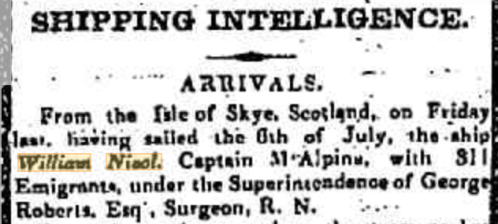
Sydney Morning Herald, 30 Oct 1837, p.2
The William Nicol, the first vessel chartered by the Government for the conveyance of Highlanders to this port, arrived from the Island of Skye on Friday last, under the superintendence of an old visitor here Dr. Roberts, R.N. In this ship there are 311 persons – the male adults consisting of 2 farm overseers, 19 farm-servants, 21 farm servants and stockmen, 19 shepherds, 2 blacksmiths, 2 carpenters, 1 cooper, 1 wheelwright and miller, 1 stonemason, and 1 tailor; there are also 73 female adults, and 169 children. The Midlothian was to sail from the Isle of Skye with seventy families for Sydney, about the end of July; and another ship was also taken up by the Government for a similar purpose. The ship Portland with emigrants from Greenock, was to sail for this port about three weeks after the William Nicol. The emigrants per William Nicol have arrived in a condition which is highly creditable to the Captain and the Superintendent.
Inverness Courier, 20 December 1837 p.2
THE WILLIAM NICHOLL
In consequence of several exaggerated and unfounded reports which have got into circulation upon the condition in which the William Nicoll, emigrant ship, touched at the Cape of Good Hope, we have been requested to insert the following statement: It is not true that the William Nicoll put into the Cape short of provisions. She had on board six months’ provisions of excellent quality and had not been sea more than two months when she called at the Cape, where she had no occasion to make any addition to her regular stock of provisions. It has been said that the Highland women suffered much in their health in consequence of there being no female interpreter. The short answer is that, independently of two general interpreters, who were allowed cabin passages for the purpose, there was a midwife, a female excellent character, who spoke the English and Gaelic, and undertook the charge of the women and children both in and out of hospital. Oatmeal is mentioned as an article that ought not to be omitted in voyages from Scotland. A good suggestion. It happens, however, that the William Nicoll had nearly five times the quantity of oatmeal customary, the allowance man and women being increased from a pint-and-half per week to seven pints. A state of filth is alleged to have prevailed in the vessel and berths. From the nature of the case, this does not admit so direct a refutation some of the other statements. Cleanliness, however, is enforced in all these vessels through the efforts of the passengers themselves; it is known that, in the present case, the men were in good health and orderly ; it in common sense, then, to believe that experienced surgeon the navy would have allowed sixty-five stout, healthy men, and husbands, to have been idle spectators in such case as is alleged? Some of the reforms proposed in future emigrant ships are, that livestock and jams and jellies should be carried, for the benefit the hardy peasants whom they convey ; and that, instead of “cribbing-up” the passengers in fixed cots, “berths should, if possible, be set apart tor families, with water-closet to each, every two.” To anyone who has the most trifling acquaintance with the sea, a word of comment on these truly amusing suggestions would be superfluous, except that they give stamp the remainder of the representations they accompany.
The plain state of the case is, that having sailed from the most distressed part ot the Highlands, with upwards of 300 men, women, and children, in a condition of the utmost want, the deaths amongst the passengers the William Nicoll, after being restored to full diet, and having made a sea voyage, amounted to ten children and one woman, the last having died of childbirth fever, cause totally independent of the ship. No other grown person had died. The men were in good health and contented. Letters from the emigrants themselves express gratitude for the kindness and good treatment they had experienced.
There appears no reason to suppose that, from want of experience sending such very large numbers of children, the diet in the earliest emigrant vessels this year, stood in need improvements in that respect, which have since been introduced. And with regard numbers, a rule has been enforced, under the management to which emigration has latterly been subjected, which is so strict as to defy the possibility of the people being crowded. There is every reason, therefore, to hope that this service, based as it is on benevolence, may rarely be afflicted with the misfortunes which, nevertheless, with every precaution, must occasionally occur in all human undertakings.
ABSTRACT OF PROVISIONS SUPPLIED.
| Beef and Pork | £509 5 0 |
| Flour and Biscuits | 392 5 4 |
| Oatmeal | 184 0 0 |
| Tea, sugar, and molasses (duty free) | 141 9 1 |
| Pease and suet | 63 8 6 |
| Port wine (duty free) | 146 8 0 |
| Preserved meals and Hospital stores | 79 1 0 |
| Other items | 307 0 0 |
| Total | £1822 17 11 |
Water laid in 44,000 gallons.
The vouchers of the above lodged with the Colonial Office. D.B.
 Christine's Compendium of Family History
One thought on “The Ship William Nicol”
Comments are closed.