Tangental Families : The Dookie Mahers

Tangental Families : The Dookie Mahers

This family of in-laws referred to by our Mahers as the ‘Dookie Mahers’ turns out to have closer connections to Kilmore and Springfield than first thought.

Thomas Maher b. 1843 Castlefarm, Hospital, Limerick, Ire. ; d. 1917, Dookie, Vic.

m. 1881 St Patrick’s RC Church, Kilmore, Vic.

Margaret Theresa Scanlon b. 4 Apr 1858 Williamstown, Vic. ; parents Thomas SCANLON and Mary Ann BATCH; d. 14 Aug 1948 Kilmore, Vic. bur. Kilmore RC Cemetery
Death notices and obituary

Children

1. Mary MAHER b. 1880 Cashel, Vic. d.1971 Kilmore, Vic.
2. Catherine Frances MAHER b. 1883 Dookie, Vic.; d. 21 Sep 1956 Kilmore, Vic.; m. 1917 Kilmore, Vic. Roderick John ‘Rody’ MAHER
3. John MAHER b. 1885 Cashel, Vic.; d. 1931, Geelong, Vic.
4. Margaret MAHER b. 1887 Cashel, Vic.; d. 1970, Woodend, Vic.
5. Thomas MAHER b. 1889 Cashel, Vic.
6. Ann MAHER b. 1891 Cashel, Vic.; d. 1901, Tungamah, Vic.
7. Michael Dennis MAHER b. 1893 Cashel, Vic.; d. 22 Jan 1990 Sydney, NSW
8. Patrick Matthew MAHER b. 1896 Cashel, Vic.; d. 1974 Box Hill, Vic.
9. Peter MAHER b. 1897 Katandra, Vic.
10. Laurence MAHER b. 1899 Tungamah, Vic.; d. 1970 Carlton, Vic.
11. Joseph MAHER b. 1902 Tungamah, Vic.
12. Francis Paul MAHER b. 1902 Tungamah, Vic.

Margaret Theresa Scanlon’s sister, Mary Ann Elizabeth Scanlon was married to Patrick Buckley, father-in-law of Rody Maher, in 1876 at St Patrick’s, Kilmore.

Ann Maher, b. Cashel, Victoria, died in Tungamah, Victoria, as a result of an horrific farm accident. They were clearing scrub and burning wood in the paddock when an ember landed in her hair and she ran screaming to her mother, thus, unfortunately fanning the flames. Her mother, Margaret Maher, tried to roll her in a blanket, suffering burns to her arms, but the 11-year-old died. Both she and her father, Thomas Maher are buried in the Catholic cemetery out of Dookie. (Kathryn McCrudden, correspondence 2019)

 Place Note : Dookie and Cashel

Dookie is a rural township and district 27 km north-east of Shepparton in northern Victoria. The area east of Shepparton is mostly flat, irrigated farm land, but Dookie is set in undulating country with Mount Major to the south of Dookie township. … During the early 1870s farm selections were taken up and a township site at the foot of Mount Major was surveyed. It was named Dookie South, later Cashel, and adjoins the agricultural college. In 1886 the Dookie agricultural college was begun on the site of the Cashel Experimental Farm (1877) which grew a wide range of fruit, vegetables and cereals. Two years later the railway was extended from Shepparton to about 3 km north of Cashel. The town which formed around the station became Dookie. … The 1903 Australian handbook included a brief reference to Cashel: ‘Cashel (Dookie South) was once a thriving township the business and population having been transferred to Dookie’. Victorian Places

Whereis

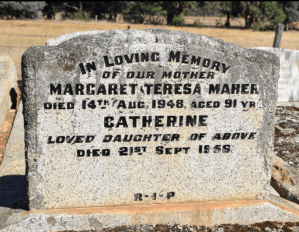
 Notices, Headstone and Obituary: Margaret Theresa Maher

The death occurred at his residence, Dookie, on Friday last, of Mr Thomas Maher, at the age of 75 years. Deceased had been in indifferent health for some time, and although he had received medical attention in the city, and later at his home, the trouble, which was an internal one, could not be conquered, and he passed away as stated above. The late Mr Maher was a native of Limerick, Ireland, and came to Australia some 55 years. He took up land at Dookie about 40 years ago, and had resided here ever since. He leaves a wife and large family of grown-up sons and daughters. The funeral, which was a fairly lengthy one, took place on Sunday afternoon at the Dookie Cemetery, the service at the graveside being conducted by Rev. Father Rohan. The mortuary arrangements wore carried out by Messrs Alexander and Torgrimson.
(Dookie and Katamatite Recorder, 21 Jun 1917, p. 3)MAHER.-On August 14, at the residence of her daughter (Mrs.R.J. Maher), Chapel St., Kilmore, Margaret Teresa, the beloved wife of the late Thomas Maher, late of Dookie, and loving mother of Mary, Catherine (Mrs. R. J. Maher), John (dec.), Margaret (Mrs,. T. Collery), Thomas, Anne (dec.), Michael, Patrick, Peter, Lawrence, Paul and Joseph. In her 91st year.
(Kilmore Free Press, 19 Aug 1948, p. 4)MAHER. — Requiem Mass for the repose of the soul of the late Mrs MARGARET TERESA MAHER will be celebrated at St. Patrick’s Church. Kilmore, THIS DAY, at 9.30 a.m. The funeral will leave the church at 3 p.m, for the Kilmore Catholic Cemetery.— D1GGLE and MAHER
(The Age, 16 Aug 1948, p. 4)

In loving memory of our mother Margaret Theresa Maher
died 14th Aug 1948 aged 91 ys
Catherine
loved daughter of above died 21st Sep 1956
RIP

The death of a very old identity of the Dookie and Kilmore districts in the person of Mrs Margaret Teresa Maher is announced with regret. The deceased was the widow of the late Thomas Maher and she passed away at the residence of her daughter, Mrs R.J. Maher, Chapel Street, Kilmore, on Saturday last, after an illness extending over several years.The late Mrs Maher, who was in her 91st year, was the third daughter of the late Thomas and Marie Ann Scanlon, of Springfield, well-known farmers in that district in the early days; her late father was previously a road contractor and resided at Geelong where the deceased was born. She came to Springfield as an infant and assisted her parents in farming pursuits and when a young woman married Thomas Maher, of Dookie, and they were pioneers of that district. There were 12 children of the union, two of whom predeceased her.On the death of her husband 31 years ago she carried on the farm at Dookie for some years and on retiring lived in Melbourne and Sydney for a number of years, coming to reside at Kilmore 9 years ago. The deceased was a wonderful mother, a great worker for her Church, and loved, and highly respected by all with whom she came in contact during her long lifetime.Left to mourn her loss are seven sons, Thomas (Sydney), Michael (Sydney), Patrick (Melbourne), Peter (Sydney), Lawrence (Melbourne), Paul (Sydney), Joseph (Melbourne), and three daughters, Mary (Sydney), Catherine (Mrs. R. J. Maher, Kilmore), Margaret (Mrs. S. Collery, Kerrie), together with 15 grandchildren and three great-grandchildren. A sister (Mrs. O’Rooke, Melbourne) also survives her.

After the celebration of Requiem Mass at St. Patrick’s Church, Kilmore, the remains were laid to rest in the Kilmore Catholic Cemetery and, the funeral was largely attended. Rev. Father Elliott officiated at the services and the mortuary arrangements were carried out by Diggle and Maher, Kilmore. The casket-bearers were Messrs. Joe Maher, Tom Maher, Michael Maher and L. Maher. Pall-bearers, Messrs. J. Collery, J. Ahearn, T. Scanlon, J. Scanlon, T. Collery and J. Collery.

(Kilmore Free Press, 19 Aug 1948, p. 8)

Place Note: Springfield, Goldie & Forbes

The Scanlons of Springfield

Thomas Scanlon b. 1825 Shanagolden, Limerick, Ireland; parents Bartholomew Scanlon and Catherine McMahon; d. 16 Dec 1882 Springfield, Vic.; bur. Kilmore, Vic.

m. 22 Jul 1855 Shanagolden, Limerick, Ireland

Mary Ann Batch b. 1834 Limerick, Ireland; parents John Batch & Mary Cope; d. 1874 Springfield, Vic.; bur. Kilmore, Vic.

1. Catherine Scanlon b. 1858; d. 1942 East Melbourne, Vic.
2. Margaret Theresa Scanlon b. 04 Apr 1858 Williamstown, Vic.; d. 14 Aug 1948 Kilmore, Vic.
3. Mary Ann Elizabeth Scanlon b. 1859 Williamstown, Vic.; d. 21 Aug 1923 Kyneton, Vic.
4. Sarah Scanlon b. 1860; d. 1893 Bendigo, Vic.
5. Patrick Scanlon b. 1864 Carlton, Vic.
(this child isn’t noted in the text below, but he is listed with father’s name Thos Scanlon and mother’s maiden name Bath)
6. Bartholomew Henry Scanlon b. 1864 Riddles Creek; d. 1943 Kilmore, Vic.
7. Unnamed Female Scanlon b. 1865 Gisborne, Vic.
(father’s name Thomas Scanlon, mother’s name Mary Batt – perhaps died as an infant?)
8. Nora Elizabeth Scanlon b. 1866; d. 1935 West Melbourne, Vic.
9. Thomas P Scanlon
(if his second name was Patrick he may have been the Patrick above)
10. John Scanlon b. 1870 Springfield, Vic.; d. 1945 Werribee, Vic.
11. Alice Priscilla Scanlon b. 1872 Goldie, Vic.; d. 1944 Melbourne, Vic.
12. Ellen Scanlon b. 1873 Goldie, Vic.; d.1960 Carlton, Vic.

Notes from Romsey: A Veritable Garden of Eden

This text is reproduced as published and may contain some factual errors

In 1825 Thomas Scanlon was born to Patrick and Mary Scanlon in Shanagolden, County Limerick, Ireland. Thomas married Mary Batch, who was born in Ballyhahill, County Limerick.

In June 1854 Thomas and Mary left Ireland for Melbourne on the John and Lucy, arriving in September 1854. It is likely they spent time on the goldfields, but by 1864 the Scanlons were living at Riddles Creek. Thomas worked for Samuel Amess as a stonemason, building the bridges on the Melbourne to Bendigo railway line.
During this time, Mary had eleven children. Firstly there were four daughters: Catherine, Mary Ann, Margaret and Sarah. The first son, Bartholomew was born while they lived in Riddles Creek. The family was completed by the arrivals of Honora, Thomas, John, Annie, Alice and Ellen.

Thomas and Mary and their children settled on a 50-acre block of land they called ‘Happy Valley’, in Springfield. Thomas constructed roads in the Springfield and Kilmore districts.

Bartholomew was only eighteen when he lost both his parents. He bought the property from his family and supported his siblings until they left home. Bartholomew and his brother John continued for a while in their father’s road construction business, but Bart lost a lot of money on the contract for blasting the ‘Gap’ on the Lancefield-Kilmore Road.

John married Ellen Keenan of the Post Office Hotel in Romsey, and ran this business for some years until he retired in 1936. A public-spirited man and an excellent sportsman, John was honorary secretary of the Romsey Amateur Turf Club and the Romsey Coursing Club for many years. He was also a committee member of the Romsey Mechanics’ Institute, the Waterworks Trust, the West Bourke Agricultural Society, the football club, the cricket club and the gun club, of which he was club champion.

A keen businessman with a great sense of humour, John was also a highly respected judge of horses and dogs, and he and his brother Tom were both excellent football players for Romsey.

Tom went to the Western Australian goldfields and later purchased a farming property in Western Australia.

Bart Scanlon bought more land in Springfield and became progressively more involved in stock dealing. While establishing the Scanlon dynasty in Springfield, Bart married Bridget O’Dwyer, the daughter of Edmund O’Dwyer, the Springfield Shire Treasurer.

Bart and Bridget had eight children: Molly, who married Percy Smith; Alice, who married Roy Parks; Tom, who married Madge Cummins; Ann, who was unmarried; Peg, who married Horrie Green; Biddy, who married Jack Irwin; Ned, who married Rose O’Connor; and Jack, who married Mary Linehan.

Bart died in 1943 aged seventy-nine, and Bridget died in 1952.

(Mitchell, Peter. Romsey: a Veritable Garden of Eden p. 280-282)

In part three of his ‘Reminiscences of an Old Road’ in 1939, James Alipius Maher wrote ‘On down in the region generally described as Lower Springfield, the names Scanlon and Quirk remain’.

Shipmates and Cohorts

Shipmates and Cohorts

Some snippets of information about the brief time John Worthington (Fortune, 1806) spent in the colony of New South Wales 1806-1814.

bwwaratah


Attempted Escape

On Tuesday last a Bench of Magistrates was convened; before whom were brought Isaac Peyton, John McDonald, and several others, who stood charged by Benjamin Peat with contriving a plot to seize and take away a Hawkesbury boat the joint property of McDonald (one of the prisoners) and himself. In consequence of the witness having prudently given information to a King's boat of their design, which he considered manifest from the appearance of the mail boat in pursuit of him when going out, the pursuers were in turn pursued, and cheated a precipitate retreat; - which was by no means a proof of the equity of their intentions. A Frenchman who was recognized by the witness in the boat was shortly after apprehended, and he 'with the true French nonchalance' brought a Dutchman into the same predicament, and several Englishmen followed among whom was Peyton, whose wife being likewise implicated in the charge of intended escape, was also apprehended. In the course of the search about the small bays, creeks, and inlets, a considerable stock of provisions was found, which the two foreigners declared to have been purposely deposited there for their use of the voyage to some of the Asiatic settlements. The whole of this as well as a quantity of wearing apparel and other property, was claimed by Peyton ; who urged that his motive for removing it rather was a wish he had entertained of taking up his residence in that part of the country, where secluded from the eve of inquiry, he had designed to open a small distillery; - but a mariner's compass, quadrant, and Epitome, rather militated against the candour or the acknowledgement. Other persons, who had before eluded suspicion were now implicated by their companions, Dutch, French, and English, and all the parties committed for further examination.
(Sydney Gazette, 28 June 1807, p.1)
Isaac Peyton, Hugh McDonald, William Welch, and Susannah Harris were indicted for seducing from their duty the several prisoners hereafter mentioned, by contriving their escape from this colony in a vessel named the Argument whereof Hugh McDonald was a part owner; and Dennis Maloy, John Wetherington [Worthington], George Boyden, Jas. Darbyshire, and James Hargraves were likewise indicted for attempting their escape from this their lawful place of confinement, by consenting to the plan of the above, and assisting to carry them into execution.
Three persons who had likewise engaged in the plot being accepted as evidences for the Crown; viz. Brian Overhand, Francois Francisco, a Frenchman, John Simmons, a Dutchman, they gave evidence accordingly, which added to that of Peat was conclusive and incontrovertible. The principals rested their defence on a positive denial of the facts; but the accessories declared the charge to be just, and by an acknowledgement of their design in this last stage of the trial, threw themselves on the mercy of the Court; which cleared, and re-opening all but Susannah Harris were found guilty, and sentenced McDonald, Peyton, and Welch to pay a fine of £50 to the King, to be imprisoned 12 months; and to remain in gaol until the fine be paid :—The others to receive 300 lashes each.

The testimony of this case is documented at the Macquarie University website. Of the cohorts, John Worthington, Bryan Overand, James Hargraves and James Darbyshire all had travelled to Australia aboard the Fortune. All four admitted they intended to leave the colony, and received 300 lashes.

Who among the convicts was most likely to try to escape? There were occasional cases where the escapees were people who had been in the colony for some years, and who even had families and property. But escapees were most often from among the latest arrivals, those for whom the colony was strangest and most disorienting, and the urge to return strongest. In the earliest years they seemed to fear most of all the idea of unrelenting labour and slave-like existence, whether or not they actually experienced such conditions.
(Grace Karskens, '''This spirit of emigration'': the nature and meanings of escape in early New South Wales', Journal of Australian Colonial History, Vol. 7, 2005, p. 8)

In this case, they certainly were a mixed bunch. Karskens refers to Peyton and Harris as from the former group, having a large house, children and Peyton’s established stonemason business, and she says financial difficulties may have influenced his decision to leave. But Worthington and his Fortune shipmates, having arrived in August the previous year and having served only eight months of their sentences, were relatively unencumbered.

Surprise Release

Three years later John Worthington and James Hargreaves found themselves on the receiving end of an act of kindness by the incoming Governor Macquarie:

GOVERNMENT and GENERAL ORDERS.
Government House, Sydney,
Friday, 5th January, 1810.
HIS EXCELLENCY the Governor, as an Act of Grace and Favour on the Occasion of his taking Charge of the Government of this Territory, has thought proper to direct that the undermentioned Persons now confined in the Gaol of Sydney shall be released and set at Liberty this Afternoon: namely, James Hargrave, John Worthington, William Henry, James Hardwicke, Thomas Jones, James Stoneham, John Draper, Ralph Summers, James Smith, Thomas Hayes, George Dunstan, Garret Armstrong, John Anson, Lawrence Parory, and Hadji (a black man). The Governor trusts this Act of Clemency will have the desired effect on the minds of those men now released from Confinement, and that it will stimulate them to be more orderly, and better Members of Society for the future. By Command of His Excellency,
I. T. CAMPBELL, Sec.
(Sydney Gazette, 7 Jan 1810, p.2)

Macquarie was the last autocratic Governor of New South Wales and he would hold the post for 11 years. He took the reins after the chaos and tension of the previous Governor Bligh regime. There were controversial aspects to Macquarie’s leadership (as there were for all the previous governors), but as far as convict relations were concerned, he was a liberal.

In a developing society harbouring a divide between free settlers and convicts, Macquarie used the carrot rather than the stick – treating emancipated convicts relatively well, entrusting them with positions of authority, and providing plenty of work through infrastructure building. That Macquarie had landed at Sydney Cove on 31 December 1809 and had the above noticed published so quickly could be seen as a small olive branch to set the tone for a new chapter of administrator-convict relations.

Trouble Again

For all of Macquarie’s good intentions, John Worthington wound up before the judiciary again less than six months later, accompanied by two further shipmates from the Fortune, Isaac Hogg and Samuel West. While not a significant case in its own right, it’s significant to tracing John Worthington’s history in the colony, as there are so few records of him . Three chickens had been stolen on Saturday, 16 June 1810 from John Palmer at Woolloomooloo, and these were found having been killed and put in the yard at Worthington’s residence. In the courtroom, the three deceased chickens were presented for identification as those belonging to Palmer. Testimony was provided by William Yarls, a servant of Palmer (who had reared the fowls and discovered they were missing), John Redmond (who searched Worthington’s residence and found the fowls), Enoch Kinsela (publican and Fortune convict), John Robinson (butcher, neighbour of Kinsela, Palmer employee and Fortune convict).

Place Note: Woolloomooloo Farm, Sydney

After the First Fleet’s arrival in Sydney, the area was initially called Garden Cove or Garden Island Cove after the nearby small wooded Garden Island, off the shore. The first land grant was given to John Palmer in 1793 to allow him to run cattle for the fledgeling colony. In the 1840s the farm land was subdivided into what is now Woolloomooloo, Darlinghurst and parts of Surry Hills. Wikipedia Swampy land that was regularly flooded did not make it especially attractive to early settlers. But it was fertile, and after the colony’s commissary-general, John Palmer, was granted land here in 1793, he built a house and made a good fist of farming. The native melaleucas and casuarinas were replaced with fruit trees and he even experimented with growing tobacco. The success of his endeavours resulted in the valley becoming known as The Farm. Dictionary of Sydney

West (also a Fotune shipmate) had been an employee of Palmer and was seen in Palmer’s yard on the night of the crime, but he denied involvement. Hogg had been an employee of neighbour Enoch Kinsela, who had allowed him to stay there, and in the time Hogg had been there other birds had gone missing from Palmer’s. Blood and feathers had been found in the pocket of the jacket Hogg was wearing and he confessed.   Worthington denied involvement, saying that he merely gave accommodation to his shipmate on the evening of the robbery. The court found Worthington and Hogg guilty, sentencing them both to twelve months’ hard labour. West was directed to sleep at the gaol until further orders.

The Lumber Yard

Worthington is shown in the muster of 1811 as a carpenter in the government lumber yard. The lumber yard was not far away from Palmer’s farm, Sydney Gaol and the Male Orphan Institution where his children would later reside.

Worthington’s time in the colony preceded the construction of Hyde Barracks, and prisoners lived in individual (presumably very basic) places of residence.

The Last Official Record : Settling a Debt

Thomas Rose of Sydney, dealer ... Plaintiff

and

John Worthington of Sydney ... Defendant

Writ for sixteen pounds sterling on a promissory note dated 5th January 1814 drawn by defendant payable to bearer on a day now past.

Upon the defendant's voluntary confession and consent, the court gives judgement for the plaintiff.

Damages £12.0.0 Costs £3.15.4. Execution to pursuant to the confession.

Thomas Rose was a baker operating in Chapel Row (later renamed Castlereagh Street) and he later dealt in imported goods. An advertisement in the Sydney Gazette in 1815 shows him offering imported linen, clothing, footwear, copper tea kettles, tools, haberdashery items.

Tom Maher’s Memories of Kilmore

Tom Maher’s Memories of Kilmore

This is an interview with Tom Maher (son of Rody Maher and Annie Buckley)
by Sister Pauline of St Joseph’s Convent, Kilmore, Victoria. The recording was made in 1978 and I transcribed it about 20 years ago.

Tom was involved with the Kilmore Historical Society and would speak to visiting groups of school children about early Kilmore, but when he got too elderly to do this Sr Pauline recorded an interview with him to use with the students.

Some parts of the recording were inaudible and Tom was elderly when the interview was done and so there are some gaps in the transcription.

SP: I’m just getting a project ready about Kilmore, Tom, and we want to see what you can remember about different things in Kilmore. First of all, where did the town get its name?

TM: There’s two Kilmores. There’s Kilmore in Ireland and Kilmore on the Isle of Skye, and my friends from Scotland didn’t know that until I told them. It’ s the Irish one that we got it from I think. It’s from Kilmore in Ireland.

SP:     Does it mean ‘big church’?

TM: Yes, and of course the first church here was St. Bridget’s that was out in Willowmavin and it was on a property that the Aherns had. There’s only the remains of it now. There’s just a heap of rubble and mould and a few old bluestones just to show where it was. I believe that the first mass here was celebrated by a priest going through on a property that Tom Sheehan had, it was then a hotel called …

SP: Doesn’t matter, you’ll think of it later. How many hotels were here, Tom?

TM: It was reputed that there were 52 in the district.

SP: How many hotels here?

TM: Officially it was 32, but then there was shanties all over the place. Where Dr Jayne recently came from up there in the new township, Powlett Street, that was the shanty on the road. It was only road traffic, you see, there was only tracks through here, there was no main road. And they went through about three different directions, three different ways that I can remember of anyhow, that I knew of. Eventually then when the main road opened up … Kilmore wasn’t intended to be built here at all on the situation where it is, it was out at Lake Logie, and there was only one building put up out there. Then as the people with the horses and the wagons came through the town, through what is the town now, they pulled up to water their horses down behind the post office. And as they did there were different places started to pop up and the result was that the town never went out to where it was originally intended by Rutledge, out to Rutledge’s survey. And that’s where Rutledge Street gets its name. As Kilmore got the butter factory there, the manager, Mr J.D. Ryan, he’s pointed out to be about 40 different farms around Willowmavin supplying milk and cream to the factory. But, as the families got larger they had to move on, the population was too big they couldn’t keep up to it. So Gavin Duffy was our Member of Parliament at the time and Kilmore East was known as Gavin Duffy Town and why they changed it I don’t know. But he was the Member of Parliament at the time and he brought in what was known as the Duffy Act and he opened up all the Goulburn Valley to settlers at pretty cheap rates and they started to expose people to the land and that’s why up around the Goulburn Valley and those areas Kilmore was so well known and everywhere you went the people knew of Kilmore. And all over Australia really. One chap recently I knew on holidays, he went up to Queensland, and he remarked he came from Kilmore, and this chap said ‘that’s where they have the trots and the races’. Kilmore is known everywhere, no matter where you go you’ll find somebody that knows somebody or something about Kilmore.

SP: Of course it’s very famous for Ned Kelly was born around here. Tell me what you can remember about Ned Kelly.

TM: Ned Kelly was born at Beveridge, only about a mile from where the old Beveridge church is now. He went to school, or whatever schooling he did (it wouldn’t be much at the time). But Kelly weren’t a bad fellow – he only did what most lads of the time did. They’d often take a horse that was there staying around the village for the night. And they’d plant it in the trees, hide it, and then in a day or two there’d be a pound reward or something like that, and they’d bring it out. Well that was the only thing they done. It was really the fault of the police that the Kellys went out. They were coming around and they were making a nuisance of themselves to Kate Kelly and Mrs Kelly, and one of them went to molest Kate Kelly and Mrs Kelly hit him with a shovel and then the police were down on them all. That forced the boys to go out. When they went out on the road, as they called it in those times, they were well looked after by all the people, because whatever they took – they didn’t take anything for themselves, and whatever they took they gave to the poor people. The banks they held up at those times, Jerilderee and Euroa, they never hurt anybody or done anything wrong in that way. In fact I’ve got a gun here that belonged to my brother and that was Sergent Kennedy’s gun who was in the affair at the Longback Ranges, where one of them was killed.

SP: That was Sergent Kennedy.

TM: Yes, it was Sergent Kennedy’s gun, and it was given to my brother. It’s still here, have you ever seen it?

SP: I think you showed me, yes.

TM: When they were on the road they never done anybody any harm. And this friend of mine who had a property out at … he was a hawker. He saw them and he knew they were in the district. He though when he saw them coming up the road ‘Well this is it, I’m going to be stuck up now’, but to his surprise they just pulled up and asked him if he had any tobacco. He said ‘Yes, how much to you want’, he said. They told him and he gave them what they wanted, and they threw him more money than paid for the tobacco.

A friend of mine and my father’s was a young man, he was only 16 when he went up around the Dookie area breaking in horses. There was a lot of horses tied up around the Ryan’s shanty. He was paying attention to one, looking at it, and a chap said to him ‘You seem to know that horse laddie’ and he said ‘Yes I think I broke that mare in for Tom Ryan’. He asked him in for a drink. He didn’t say he did break her in, he said he may have. So they went in for a drink, and Kelly, asked for a strong drink. The other fellow didn’t know what to ask for and he said ‘I’ll have the same’ and he said ‘No laddie you won’t’ and he got him a soft drink. And he didn’t know until after they’d gone that that was Ned Kelly that he was speaking to.

SP: And what happened towards the end of his life, Tom?

TM: No, it was all up around Glenrowan. There was a school teacher from Romsey was the man who tried to flag the train down, when they took the cannon on the train to Glenrowan when they had the shootout. It was reputed that there was a portion of his armour made here in Kilmore, at the old blacksmith shop, where that was, it’s demolished now, about three miles from here. I don’t know whether that’s correct or not, but it was reputed that the armour was made in different places.

SP: Now, Tom, your brother was a blacksmith. Tell us about him and how he started.

TM: He started working in … in the depression times and he worked very hard. He was taught by a man who was very good and he showed him a fair bit. He was such a good shoer that he was offered a job by the Victoria Racing Club as chief in charge of shoers and blacksmith on the racecourse. He done very good work with trotters. There was a horse over here from Sydney, he came over he accompanying another horse as a foal, and they brought him over again when he was racing. They had difficulty in getting him shod properly. Anyhow they got my brother to do him, and he went down to Flemington and he won the race. They offered him a trip to Sydney for a week, pay all his expenses and everything, and my brother declined. He was going over to the show, and I thought he was foolish, he didn’t take his gear and do the horse but he said he was on holiday and he didn’t want to do it. But he’d been a successful blacksmith here in Kilmore, he’s known practically all over Victoria.

SP: Is he still working?

TM: Yes, he does a little bit just to keep his hand in for friends who were good customers of his years ago. He leased the shop to another chap, but he doesn’t look after it, he just turns up occasionally, doesn’t work it at all. But my brother can’t get out of doing jobs for people who were good customers years ago.

SP: Yes. Tom, tell us a little bit about Whitburgh Cottage – that historical cottage. Do you know anything about that?

TM: The people who started that, Mr Smeaton, he came here, going through like a lot of others at the time. He pulled up on the corner of Powlett Street and … that’s right on the main road. He started doing a few jobs there and he eventually bought the property from there right up to Melbourne Street corner. He started on getting Whitburgh cottage built and he got one portion done first, and then added to it later.

SP: How did it get the name, Tom?

TM: I should think it might come from the Scottish people – it might have been a name from over there. There were Mrs Smeaton and the sons, and Mrs Smeaton reckoned that when she got the stove in the back portion … First of all, they had a kitchen, and they had what’s called a crane and they hang the kettle or whatever they’re cooking with on this crane and they swing it in and out. Mr Smeaton made this crane himself, and I think it’s worthwhile if you ever get the chance to go in and see it when it’s open on Sundays, and ask to have a look at this crane. He’s made it himself. I have a crane in my back yard, it’s not erected of course. This one of his has rather great workmanship because it can be raised or lowered as you wished. Most of them had a chain hanging down and they’d just work it on the chain, lower or higher the article they’re cooking in. When Mrs Smeaton, used to cook in a camp oven of course, then when she got the stove she reckoned she was made, you know. Whitburgh Cottage was eventually procured by the Historical Society, and it’s well worth a visit, especially for anybody who knows much about the earlier days.

SP: Tom, you tell me that you used to go down to Melbourne by horse, how long ago would that have been, do you remember?

TM: Well, when Mrs Morrissey was in hospital, she had a broken leg. Her leg was broken as she was coming home from Kilmore East after taking Mr Morrissey down to the train. She was in Koonara (?) Hospital out in St Kilda Road. It belonged to the Quinlans from Yea, and some of them had connections around Kilmore. We used to go down to see Mrs Morrissey on weekends, and we’d go down from Kilmore on the Saturday afternoon and go right into the centre of the city to the City Club Hotel.

SP: Was it horse or horse and buggy, Tom?

TM: Horse and jinker, and we’d stable the horse there. We’d get from here to right into the centre of the city in three and a quarter hours, and it was good for those times when you come to think of how it would take you that long to drive it sometimes in the traffic now. On the Sunday morning, rather than have the horse standing in the stable all the time, just on the hard bricks or whatever, we’d go in and get her and we’d go for a drive to where the shrine is now. We’d come back, put the horse away, feed her up, then on the Sunday evening after the evening cooled off (it was generally in the summertime then) we’d set home for Kilmore.

SP: What sort of roads were they, Tom, were they bitumen?

TM: No it was all metal roads. They called it McAdam, after McAdam the man who invented it, McAdam, a Scotsman. And we’d drive home to Kilmore.

SP: What year approximately would that have been, Tom.

TM: Somewhere about 1920. Whenever they were short of a driver for one of the fruit wagons, Mr Portbury’s father owned the business then (Mr Portbury’s still in Kilmore), they’d come and they’d get me. Mr Ashton used to drive the wagon with two horses in it and I’d drive one wagon with one horse in it. We’d take all the empties to Melbourne on Monday and we’d stay in the hotel, the Royal Saxon on Monday night, get up about two o’clock in the morning, Mr Ashton would do all the buying, and his daughter is married to my brother, Toc, the blacksmith. We would then load up and be ready to leave the market about 7 o’clock, and we’d set home for Kilmore. It was a big long drag all loaded up with vegetables. We’d get home to about Wallan that night and we’d stay at the Inverlochy Castle Hotel, it’s now demolished, there is a few remains showing where it was. The reason why we stayed that night was that Pretty Sally was a stiff hill in those times, and it was too much on the horses after the long drag from Melbourne to face the hill. So we’d get up early on the Wednesday morning and come into Kilmore. That was your fresh vegetables. And now – later on my two boys used to go down with the man that went down from here in a motor vehicle, go to Melbourne, leave here about midnight, go down, and they’d get the vegetables [and return] in the same morning. A bit of a difference to the times then.

SP: Tom, you were connected with the racing club. Tell us how it began and remember about it.

TM: Kilmore Racing Club was established long before Flemington. We had a few meetings and we had the Hibernians, of which I am a member, we held race meetings every year. The Hibernian race meeting was known as the Kilmore Steeple Chase and it was run over four miles. The big fences that were there then when I was a boy weren’t used when I was a boy, they were finished with but they were still remaining on the course. There was a low fence, paling fence and post and rail and a water jump (there were only two in Victoria, one in Flemington and one here but Flemington was later). When I was a boy Mr Morrissey always had an interest in a racehorse or two and I started looking after them as well as helping him in the shop. Of course I got riding horses on the track, and very keen on it. I was working at the racecourse by that stage, actually I worked 60 years without missing a meeting. I missed working one meeting because of an operation, but I was present at the meeting. I worked 59 out of the 60.

SP: That’s a great record, wasn’t it?

TM: It was mostly honorary those times. I was 44 years Clerk of Course, which is a record for Victoria so far, and mostly without any pay. Until one fellow was paid one time and the other man wasn’t the day I was on, and he jacked up on it and I was offered payment the next time.

SP: What was the duty of the Clerk of Course?

TM: The next day this chap, the secretary said to me, you can take pay if you like or you can give it back as a donation. I said that I’d let the other man go first and if he takes it I’ll take it. He took it and I took it and I’ve taken it ever since. The duty of the Clerk of Course, and the coat that I wear, or did wear is now about a hundred years old. My brother has a whip that belonged to the man that gave it to us, and it’s the same age. It was the whip of the hounds. There were two packs of hounds in Kilmore – a public one and then there was a private pack. The Clerk of Course gets the horses out of the stalls and into an assembling yard, takes them into the mounting yard, and takes them out of there down to the start stalls, or in my day that was an open barrier, and then the stalls came into being. Sometimes there would be nine races and you’d have to do it all on your own. Later on the VRC brought in a rule that there had to be two. I was so keen on the horses and being with them so much that I became an amateur rider. I rode in the central districts of Victoria, and I won the main amateur riders’ race in Victoria twice. During my time of riding, amateurs were not supposed to take money but they did. I found out some of the others did. But I never accepted a penny for riding from anybody, and I never during a race pulled a horse up for anyone, nor did I hit a horse. I got roasted a couple of times for not hitting, but I realised that when a horse was doing it’s best, there’s no point hitting it. As a matter of fact I was told, accused, by the police one day of pulling a horse up and I was trying for my life. He didn’t know that if I hit it, it would have stopped. It was moving at the time. It was a pony called Palaco, his father was Stickup and his mother was Clobber and he was called Palaco. If I’d hit that horse it would have lost – instead of losing by about a head or half a head he’d have lost by a length or more. I had a great time riding around the country … I would say this – that I am one of the only riders who rode against women in races. That happened at Kilmore and Pyalong. The most famous of them all was Mrs Murray who lost her life trying to save Garryowen. They both got burnt, and that’s why the Garryowen trophy got its name.

SP: Tell me, the coat you were talking about, do they still wear heavy a one like that?

TM: No, they don’t. They have a shorter coat. But the one I have is really outstanding as regards to work on it, you know, needlework. I tried to get one one time, but I couldn’t get one from around Australia at the time and I couldn’t get one from England. But it was a heavy coat, it was heavy in the summertime, but in the wintertime it withstood a lot of rain. To my knowledge there was only one man ever killed here at Kilmore in a race.

SP: Kilmore is one of the biggest racing places in Victoria

TM: Yes, racing and trotting. As a matter of fact I’m just reading now about the pacing cup coming up. It’s worth about thirty thousand dollars, trophies and a motor car, things like that … jewellery, things that are given to the owners of the winner.

SP: Tom, can you remember anything about that old gaol, down there near the state school, it was a gaol wasn’t it?

TM: It was a gaol. Some people would say that Kelly was in it, but he was never in it – his father was. It was only a gaol for about eleven years I think. It was sold then and eventually it was made into a butter factory. Mr J.J. Ryan, Geoff Ryan’s father – he was the manager and then he bought it, and it went for quite a few years. And then a — bought it and they were going to extend it — put all the men who were working there out of work.

SP: What about that monument?

TM: The monument up there, I had a lot to do with that. That was a sentry tower from the gaol and it was situated approximately behind, between the Presbyterian Church and the gaol. It was about fourteen foot six high and about six foot six square. There were windows to look out and you could go to the top of it. It was taken up there by volunteer labour. As a matter of fact the road that it was taken up on was built by soldiers after the First World War. I know very well because I carted the shovels and picks and things to them working on it. I know some of the men who worked on it, and they’ve gone now, those fellows. There were three men worked on that job, farmers and different ones. Mr Clancy was one of them, he carted material up. It was taken down brick by brick, bluestone by bluestone. It was marked, I don’t know how, and it was re-erected up there and used as a Hume and Hovel memorial.

SP: Did they actually pass over there?

TM: No they didn’t pass there, they passed nearby. The plaque is on the front. A few years ago when I was more active I used to go up there and keep it clean. It’s always messed up by vandals, rubbish around, and a target for bottles and things like that, even rifle shooting. The girls used to come up with me and clean it up. We did put a container up there but they used to empty the containers and make a mess around. Eventually we got the council to put up a very good container on a post and bolted and the vandals cut that padlock, and the beautiful drum that was there, that was taken.

SP: Senseless isn’t it? Can’t understand it.

TM: Some of the drums that we’d gave there had been rolled down the hill towards Kilmore East. I took lots of visitors up there and from that point you can see right up through to Bendigo, and you can see at the end of the ranges Mt Disappointment, right across to Mt Macedon. Everybody reckoned it was a wonderful view. Pretty Sally of course, you can see the traffic going along the main highway.

SP: What about that Mechanics’ Hall, Tom, what do they use that for?

TM: That’s not to be used.

SP: No, but it was used.

TM: It was used for years and years. I knew it had a library in the back but there were some great entertainments, dances and concerts and things held there. I won a competition there one time in bed-making.

SP: Good heavens, how did they do that?

TM: They had single beds there and they had the clothes to put on. Another thing I won there was a ladies’ hat dressing. I was pretty lucky I got an easy one to do and then you had to wear the hat. I was pretty lucky in sporting events.

(END OF SIDE A)

…that was built after St.Bridget’s, I suppose, in Willowmavin. When we were at St.Bridget’s there were about seventy-five pupils there.

SP: Who taught in it, Tom?

TM: I couldn’t tell you now.

SP: Not nuns or brothers.

TM: No, I don’t think so. I first started school in 1908 where you are now. That was just after my mother died. There was four boys. My father had a small property out there and we came into the town and he took on the mail contract from Kilmore to Lancefield. That was three days a week by horse drawn vehicle. We had to walk to school in those days, there were no buses or no school buses, no rides, nobody came to pick you up when it was wet. When my two boys started school Sr. Barbara, now Sr. Pauline taught them at school. After my mother died I went down for a while with my auntie to South Melbourne. I went to the nuns there for a while. My cousin stayed with my father and when he wanted to go to Melbourne to work, he was an apprentice saddler, he went down there and I came back home.

SP: What about that little brick place that used to be a school up near the church, Tom, wasn’t there a school up there?

TM: The bluestone, that was the old school that I went to there – two big rooms.

SP: Is that where you started or where you finished?

TM: No, I started down there … [meaning St.Bridget’s]

SP: … at the convent, and then the Brothers had that building, I see.

TM: The sisters were in the big buildings where the College is now, and later on when the changeover came the brothers had the buildings and they also had what we call the St.Pat’s – the bluestone buildings, two big rooms.

SP: Tom, tell us what you remember about Hume and Hovel.

TM: Hume and Hovel set out from Sydney or thereabouts to try and find Port Phillip or Westernport Bay. They travelled across country. The first I can remember of them was Mansfield and Euroa, and there’s camps at the different places showing where they passed nearby. That’s why the Hume and Hovel monument is built there because they didn’t pass close by but they passed within tow or three mile of it. Wandong, I believe, was called Hume’s Gap and I don’t know why they changed that. Anyhow they were criss-crossing as they travelled along. They crossed one creek on a Sunday and they called it the Sunday Creek, and it’s still known as the Sunday Creek. It flows into the Goulburn. They passed another creek and it was dry, there must have been a drought because they called it the Dry Creek. There were two Dry Creeks that I know of, there was the Dry Creek near Kilmore East and I’ve only known it to stop once. The other one is up in the mountains. As they were travelling along they got to the top of the mountains where we get our water supply from and they travelled along to the end of it. They should have been able to, with their … glasses, to have seen the Bay or Westernport Bay. It must have been a hazy day because they couldn’t see it and that’s why they called it Mt. Disappointment. They crossed from there to the hills just below between Beveridge and Wallan. They climbed that, and they couldn’t see anything from there and they headed out across country, and they came out at Corio Bay. They called one creek there that is now known as Hovel’s Creek and you’ll see a cairn or two along the road as you go down that way, if you’re going to Geelong. They weren’t very far out in their estimations after all that distance to get so close to Westernport Bay as what they did. I can’t remember much more about that.

SP: Can you remember the names of any other places that were named after the

SP: Where did Burke and Wills go Tom?

TM: No, I don’t know. There was a lot of timber brought in from the Mt. Disappointment area and it was cut up on the saw-mills out there. After the disastrous bushfires of 1939 they brought it in the logs and milled it in Broadford. Every other town was the same, they had to have dugouts and things like that. In fact my cousin was working at the mill and he was on holidays, and every one of his mates got burnt to death. He was brought back to try and identify them. I had a friend, she got so hot, she got into the waterhole, the dam that was near the house. The water got so hot they had to get out of it.

SP: Tom, can you remember how the priests used to travel in the early days?

TM: By horseback?

SP: Do you remember any of the priests?

TM: No.

SP: Was that around your time?

TM: They travelled fifty kilometres to get to Lancefield and Baynton. I think I might have a book on it or something there …

SP: How far, what radius would they have come? Lancefield would have been the furthest, would it?

TM: No Baynton was further. They used to say masses in private houses out in … places like that, the outlying places. They travelled in horseback. Then when Fr. Martin got the motor buggy, when we were kids, sometimes we’d have to give him a push up the road. The noise, you could hear it rattling, it used to frighten all the horses about the place. Tommy Kelly was driving it, he was the altar boy who worked around the church, rang the bell, which is not ringing nowadays, he rang it twelve, twelve, six or twelve and you could set your watch by that. You could hear that bell – I know that I’ve heard it about nine miles out. He was going with Tommy Kelly to say mass at Darraweit Guim when the motor buggy was a bit top-heavy and it overturned. The steering wheel pinned Tommy Kelly down and Fr. Martin got away. He tried to lift the motor buggy off him. He could only ease it but it weighed so much he had to let it down again and Tommy Kelly was killed. He is buried in the Kilmore cemetery.

SP: What relation was he to Tommy Kelly that we’ve got? Is Tommy Kelly related to him?

TM: No, no relation. Fr. Martin became Dean Martin afterwards. He was our parish priest. He reckoned he’d never have another motor vehicle, but of course as time progressed he’d be like everybody else and get another one – a motor vehicle.

I remember an old couple who had a building that’s on the corner of Rutledge Street and Powlett Street – it’s on the south side. Cregans was their name, they were an Irish couple. He was a bootmaker. When the First World War was started, he read it out of the paper. His wife said to him, ‘Oh John wouldn’t it be a terrible thing if the Britons invaded Australia’. Another old lady, she used to ask us as we were coming from school how the war was going. I Kilmore we had about twelve or fourteen cadets, and they were only school age. One of those kids was a bit of a wag and he said ‘oh, the Germans are out at Bylands’. She said ‘Oh, the cadets will stop them’. The brothers had a boat up on the reservoir. The chain was broken.

SP: Tom, tell me something about the hospital, was it always there?

TM: Yes it was, as far as I know it was. One of our priests, Fr. Clarke was one of the main ones I think that started getting a hospital started here in Kilmore. His name is on the memorial ward up at the hospital now.

SP: Wasn’t there a priest that had his hand blown off in some accident?

TM: Oh yes, I was coming home from Melbourne. I was riding a horse down the road and poor old Fr. Gleeson, he was a very … man Fr. Gleeson. He had a detonator and he had a nail or something and he was prising it and it blew off and blew his hand off.

SP: And there was something about his journey to Melbourne, who took him down?

TM: I don’t know who took him down, but I drove the first ambulance in Kilmore. It was a horse-drawn ambulance, no motor vehicle, I couldn’t drive one then. But every time anything would happen the police would come down and get me. I’d get nothing for it, it was a thank-you job. I’d have to drive this horse that was kept at the livery stables.

SP: Where was that, Tom?

TM: Down where Putkers Bakery is, and next door was a photographer’s. there was about five blacksmith shops and a goat … and a coach painter when I was young, and four or five bakers. You could get a loaf of bread for eleven pence those days.

SP: What about the fire brigade, Tom, were you connected with that?

TM: Yes, I was twenty-five years in the fire brigade. I had a long-service medal for that.

SP: And was that a horse-drawn thing too?

TM: No, it was manpower. We’d be generally knocked-up by the time we got there, and the water would hardly trickle through the hose.

SP: Why couldn’t they get a horse to pull it, Tom?

TM: We did when … came about. We tried sitting in a motor vehicle and holding it and dragging it that way, but it was so fast it nearly rattled the wheels off.

SP: But why didn’t the have horses?

TM: It would mean somebody keeping a horse and looking after it all the time.

SP: And how many men would pull the …

TM: However many turned up. There could be half a dozen of us or more. It had ladders on it, and it had buckets on it – little buckets they were.

SP: How much water would you carry?

TM: No water, you just had to take a chance on what was in the …

SP: How would they manage about bushfires and things like that?

TM: I saw my father and others go out to a bushfire and they had to break branches off trees and do the best they could. And by the time they got out to a bushfire, it had gone miles. One fire I remember, it went right down to Darraweit Guim and then the wind changed and it came back right alongside the same area that it went down. Things were difficult then. If you got a wet bag, if you were lucky, it’d soon dry from the heat. They’d only break branches and beat it as best they could. Things have changed now.

SP: Yes, they certainly have.

TM: I’d forgotten some things that I’d like to tell you about. I hope you’ve enjoyed these few words I’ve had to say. When I was fit enough to go round with you and some of the girls, I really enjoyed it. They seemed to enjoy the talks and whatever I showed them. So I wish you all well and hope you are obedient at school. So goodbye, Tom Maher.

Germans to the Darling Downs in the 1850s

Germans to the Darling Downs in the 1850s

Here are some snippets about German bounty immigration to the Darling Downs region of Queensland, as background to the voyage and life of my gg-grandfather, Frederick Kyling who arrived at Moreton Bay aboard the Johan Caesar in 1856.

From German Immigration to the Toowoomba Area

The Darling Downs during the 1830s to 1860s was divided into large lease land holdings. These settlers had come out from England, with reserves of capital, and had come to the Darling Downs taking large tracts of land under lease. The rich grasslands of the Downs and the low lease rents gave rise to a rich pastoral aristocracy. They chose to graze rather than till the rich soil. Most of these holdings were self-sufficient in that they maintained tradesmen and workers on the station and as such relied very little on the services of the nearby towns of Toowoomba and Warwick.  This powerful squatter class held dominance over Queensland’s affairs. In the 1850s there was a labour shortage on the pastoral properties of the Darling Downs due to the pastoral workers vanishing to the gold fields. To counter this phenomenon, the squatter aristocracy used German agents to recruit German shepherd migrants. German immigration to Australia under contract occurred between 1852 and 1855. As the squatter’s properties were unfenced, a Shepherd’s job was to live in isolated areas of the property and protect a flock of sheep from dingoes, aboriginal hunters and generally keep the flock in the boundaries of the station. They proved to be reliable, frugal and sober workers who managed to save sufficient cash out of their wages of 20 to 30 pounds per year (and rations) to enable them to purchase land in the Sixties. These immigrants were forced to come out not through religious persecution as their South Australian counterparts had done but through agricultural disasters that caused famine and abandonment of uneconomical land holdings caused by generations of land division. The Germans’ initial willingness ‘to hire themselves for whatever they could get’ was an early source of friction but in general, they were not competitors on the labour market.   British-German relationships were regarded as excellent in the nineteenth century, but cordial, surface attitudes did conceal some economic and political animosity.  ...  German immigrants were regarded as; white, Protestant, apparently ‘liberal’ politically, and present in manageable numbers.   The British minority overlooked their initial non-conformity to social mores. (Condensed from D.E. Waterson's Squatter Selector and Storekeeper)

From: Germanydownunder : They came and they stayed

In simplistic terms, German immigration commenced with the settlement of the Gossner group missionaries at ‘German Station’ (Nundah) in the 1830s – soon after Queensland gained separation from New South Wales as a free colony, until the era just prior to World War I with the influx of assisted German migrants for the Apostolic Church of Queensland community ventures.

After the small settlement of missionary pastors and their families at Nundah (now a suburb of Brisbane), the next major phase of immigration and settlement was in the 1850s/1860s with the need for shepherds in the Darling Downs region of southern Queensland.

Large pastoral holdings were being established and assisted passages were provided to many folk – the chance for a shepherding position for 2-3 years with an established wage. This enabled many immigrants to work, ‘learn the country’ and then set themselves up with their own (small) property. German labour was well regarded and the possibility of an assisted passage to Queensland was looked upon favourably.

Many hundreds of Germans partook of this opportunity, and with the associated need for skilled tradesmen, large regional centres, such as Toowoomba, were centres of this ‘second phase’ of German settlement. Many labourers and shepherds brought their families.

From: ‘A Little Bit of History’ by L.M. Tooth

The unmarried Frederick Kyling aged 26 experienced a similar voyage from Hamburg. Germany, travelling directly to Moreton Bay on the ·'Johann Caesar'' arriving on 8th February 1856. He travelled to the Downs to Ipswich via paddle steamer, and then by dray on the very treacherous Spicer's Gap Road to Woolpack lnn. He then went to work on Sandy Creek for his assigned squatter. He met his future wife Caroline Schweinsberg there on the Downs and started his family. Both new arrivals appeared to have started their new lives on Rosenthal, a property owned by the Steel family (future in-laws). Warwick was first established as an administrative centre on the Darling Downs in 1847 for the colony of New South Wales. This type of centre usually formed around river crossings for provision drays, becoming change stations for Cobb & Co. with usually a simple hotel and a store that often doubled as a post office and bank.
Tangental Families : the Beresfords

Tangental Families : the Beresfords

 It’s a great thing when people leave family name clues about. I’m very grateful to David Hall and Jane McQueen for leaving such clues in their children’s names:

Jamieson (Rachel McCaughey’s mother’s maiden name)
Beresford (married name of Mary Hall)
Innes (from the McQueen side)
Sinclair (from the McQueen side)
McMillan (married name of Mary Hinds, daughter of Agnes Hall)

The first names of the children were related as well: Rachel, Isabella, Gertrude, Mary, William, John, David and on the McQueen side: Stanley, Mary, Archibald, Duncan.

The names Beresford and McMillan provide linkages to two women John Hall (b. 1813?) travelled to Australia with, who may have been his sisters or perhaps first cousins – Agnes Hinds (nee Hall) (b. 1809) (whose daughter married a McMillan) and Mary Beresford (nee Hall) (b. 1819). These linkages helped to identify our John Hall from the many other John Halls in the shipping registers, and also provided context for how John would meet his future wife, who was not to arrive in Australia for another 14 years!

 Sir Thomas Arbuthnot

Departed: 17 June 1841, Greenock, Scotland
Arrived: 02 Oct 1841 Port Phillip, Vic.
Master: Captain John Brown
Particulars: 621t ship

Notes: The ship carried sundry cargo, 4 passengers and 260 bounty immigrants, one of whom was Irish John Hall. It was cleared from Melbourne 9 Nov 1841 and set off to Calcutta carrying original cargo plus tobacco and opossum rugs.

Aboard the Sir Thomas Arbuthnot were:

  • Mary Hall, aged 22 (born 1819), house servant, Protestant, reads and writes, native place Glasgow.
  • John Hall, aged 21 (born 1820), government servant assigned to Robert Smith of Melbourne 1 year, reads and writes (though subsequent documents indicate this not to be the case), native place Glasgow.
  • Hind, William, aged 25 (born 1816), Protestant, reads and writes, native place Glasgow.
  • Hind, Ann, aged 24 (born 1817), Protestant, reads and writes, native place Glasgow.
  • Hind, James, aged 18 months (born 1840), Protestant, native place Glasgow.

Mary Hall married William Beresford (recorded as ‘Berrysford’) on 28 February 1842 and the witnesses were John Hall and Helen Ritchie.

William Beresford (recorded as ‘Berresford’) was transported after conviction for larceny to Victoria aboard the ship Parkfield in 1939. He was sentenced to 14 years and was assigned to work as a labourer for Messrs Allan, River Hopkins.

push-pin-black-clipart-10Allansford

In 1839 the brothers William and John Allan took up their ‘Allandale’ pastoral run adjoining the Hopkins River. There was a dry weather ford across the river, and the combination of that and the name of the property owners resulted in Allansford becoming the place name. A timber bridge was built beside the ford in 1851. In 1855 the third brother, John Allan, owner of an adjoining property ‘Tooram’, subdivided land from the property for the Allansford township. Victorian Places: Allansford

He was later assigned to work for a pastoralist and grazier named Dutton, and while working for him he married Mary Hall.

The Convict System. — To prevent bigamy, and also to secure the government against being burdened with the support of the families of convicts, it has long been a standing ordinance of the government that no convict shall be married without leave first had and obtained from the Governor, and any evasion of this law is punishable as a misdemeanor. On Thursday last, a convict named William Beresford, who is assigned to Mr W. H. Dutton, one of the largest importers of this detestable species of labour, was brought before the Melbourne bench, charged with offending against this law by marrying one Mary Hall, without the sanction of the Governor. The prisoner, it appeared, was married in February last, by the Rev. Mr Forbes, of the Scots Church, to whom he represented himself as a free immigrant by the Thomas Laurie. The prisoner admitted his guilt but alleged he had the consent of his master, who had advised him should any questions be asked, to pass himself off as a free man. Mr Dutton when examined, admitted that he had given his consent to the marriage, but he denied altogether having advised the prisoner to deceive the clergyman. Mr Simpson, who was on the bench, expressed in strong terms his disapprobation of the conduct of Mr Dutton, who, as a magistrate, and for many years an assignee of convict labour, could not be ignorant of the enormity of the offence of which the prisoner was guilty. Beresford was informed that his marriage was a nullity, and sentenced to expatiate his offence “by working for six months in irons. During the examination, it transpired that on a previous occasion Mr Dutton had given his assent to the marriage of another of his assigned servants named Spicer, but that worthy having been insolent to the clergyman who was to have united him to his cara sposa*, the ceremony did not take place. The bench directed Mr Dutton to bring Spicer before them forthwith that he might be dealt with also. Mr Dutton’s conduct in this affair is altogether so inexcusable that we think the bench scarcely did their duty in failing to deprive him of the whole of his assigned servants.
* ‘cara sposa’ is an Italian phrase meaning ‘dear bride’
(Port Phillip Patriot and Melbourne Advertiser, 11 April 1842, p.2)


 William Hampden Dutton (1805-1849)

William ‘Hampden’ Dutton was an estate manager and livestock grazier who migrated to Australia in the late 1820s after studying the science of rural economy in Europe. During the 1830s he worked in various farming ventures for Alexander and Edward Riley in New South Wales, and in partnership with his own brother Frederick in New South Wales and South Australia. Frederick would become a reputable pastoralist and politician in South Australia. Hampden travelled between Sydney and Melbourne working on various pastoral and mercantile ventures, but in 1841, the year William Beresford is shown as working for him, he became insolvent with debts of £74,772 17s and assets amounting to £10. His affairs were placed in Frederick’s hands, who ensured that creditors were paid in full. Hampden Dutton died in Melbourne five years later.

William was granted a ticket of leave on 1 June 1844, and by 1850 the Beresfords left Melbourne with their first two children to settle in the Hopkins River area, where they would have two more children.

John (aka James) BERESFORD b. 1845 Melbourne, VIC d. 1884 Burthong, NSW m. 1873 VIC Elizabeth THORNTON, 6 children
William BERESFORD b. 1848 Melbourne, VIC d. 1859 Cudgee Creek, VIC
Mary Ann BERESFORD b. 1850 Hopkins River, VIC d. 1911 Auckland, NZ m. 1869 Terang, VIC John GIBB, 9 children
David BERESFORD b. 1852 Hopkins River, VIC d. 1914 Albury, NSW

A notice appeared in the New South Wales Government Gazette, Fri 22 Nov 1850 [Issue No.134], p. 1803

THE Tickets of Leave of the undermentioned Prisoners of the Crown, have been cancelled for being absent from their Districts, they are illegally at large …

– Port Phillip – William Berresford, Parkfield

William junior’s death in 1859 was the result of an accidental gunshot wound to the chest:

On Sunday last, two boys, sons of farmer’s in the neighbourhood of Cudgee Creek, went out into the bush to shoot birds. Whilst resting on the grass, one of the guns went off accidentally, and the contents were lodged in the breast of one of the boys who died in a few minutes. The deceased was about 11 years of age and was the son of William BERESFORD.
(Warrnambool Examiner, 31 May 1859)

William Beresford senior’s own death in 1868 was also the subject of an inquest:

An inquest was held at the hospital, Geelong, on Thursday, by Dr Ridley, coroner for the district of Queenscliff, on the body of William Beresford, an elderly man, a dairy farmer near Warrnambool, who died at the hospital on the previous day whilst under the influence of chloroform.
James Russell, Fiery Creek, recognised the body as that of William Beresford, whom he had known for twenty-one years. Deceased had been a heavy drinker for years.
Dr Shaw deposed to having attended at the hospital to assist in the removal of one of deceased’s legs. He was requested by Mr Reid, who was going to operate, to administer chloroform. Mr Reid, previous to his doing so, examined the deceased’s heart.
Witness was also satisfied, by examination, that the deceased was not affected with any disease of the heart, and proceeded to administer the chloroform in the usual manner. He had done so for five or six minutes and had used about two drachms, watching him intently, when he saw his eyes roll, and felt that his struggles became violent.
He called Dr Mackin, who was present, to feel the pulse, and just as witness did so he observed the deceased gasp and stopped the inhalation at once. Cold water was dashed on the head, the body and limbs were raised, and the head depressed.
Artificial respiration was commenced whilst the galvanic battery was being got ready. Galvanism*
 was immediately applied, and its use was persevered in for fully half an hour, without success. He had previously seen the deceased, who was suffering from cancer, and who agreed to the removal of the limb.
Witness believed the application of chloroform was the immediate cause of death. It produced paralysis of the heart, as respiration and the heart’s action ceased almost at the same moment. Nothing was omitted to restore the patient.
Dr Mackin confirmed the evidence given by Dr Shaw, and testified to the careful manner in which the operation had been conducted. A verdict was given in accordance with the facts of the case.
* Galvanism is the therapeutic use of electric currents
(The Argus, 5 December 1868, p. 6)

At the inquest, James Russell further said that William’s wife was still alive and living with their sons at Curdies Creek.

The following year a notice of insolvency was published:

James Beresford, of Terang, laborer. Causes of insolvency: Losses sustained on contracts and death of cattle, and from being compelled to pay debts contracted by his late father, William Beresford. Debts, £100 8s 5d; assets, £28 10s 1d; deficit, £71 18s 4d.
(The Age, 2 Sep 1869, p.3)

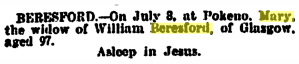
Some time after James Beresford died in 1884, Mary Ann Gibb (nee Beresford) and her husband moved their family to Pokeno, New Zealand and Mary Beresford joined them. She stayed with them for the next 19 years until her death 8 July 1902 aged 87. The death certificate says she was born in Ireland and that her father was J. Hall, a miller. There is a definite DNA connection to Beresford descendants, so if Mary’s father was indeed a J or John Hall, then it’s possible that Mary was a first cousin to John Hall aboard the Thomas Arbuthnot. Though her death certificate lists her as Irish born, her death notice has her correctly as ‘of Glasgow’ though the age at death is misprinted.

(New Zealand Herald, 10 July 1902, p.1)

Anvil Chorus Ends for ‘Toc’

Anvil Chorus Ends for ‘Toc’

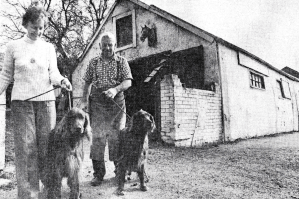
This article by Roger Sanders appeared in The Sun on 11 June 1975 and features Patrick Francis ‘Tock’ Maher (1903-2000), son of Rody Maher and Annie Buckley.

Pat “Toc” Maher, Kilmore’s landmark blacksmith, has hung up his apron for the last time.

“I’d say that 58 years in the game is long enough,” he said as he looked around his earthen-floor shop in the town’s main street.

“I’ll still potter about a bit and look after some stud horses, but generally I’ll take things easy.”

Toc, 71, has had the smithy’s shop with the plaster horse’s head over the door for 40 years.

He left Kilmore College at 13 to work for the previous owner Charlie Stray, a general blacksmith and wheelwright.

“In those days we charged seven shillings to shoe a horse and four bob for removes (removing shoes, trimming hooves and replacing the same shoes),” he said.

“Nowadays the charges are $12 and $10 for a pacer or trotter and a little bit less for a hack or pony.”

Toc, who can still swing a hammer with the best of them, can remember when up to 20 horses were waiting in the yard for shoes.

“We used to get a lot of customers of the highway before trucks and cars took over,” he said.

“A lot of them were furniture drays on their way to the bush from Melbourne.”

A big man, Toc is as well known in Kilmore, 60 kilometres (37 miles) north of Melbourne, as his white cement smithy’s shop.

He has been a member of the town fire brigade for 45 years, 20 of them as captain, and a member of the Kilmore Water Trust for 30 years.

He is also on the committee of Kilmore Racing Club and Kilmore Agricultural Society.

Although retired from his old forge and anvil, Toc still tends horses one day a week at Mr and Mrs Geoffrey Levitt’s Willowmavin Stud, near Kilmore.

One of his charges is the New Zealand-bred filly Philomel, which won the Hallam Handicap at Moonee Valley on May 31.

He also keeps a close watch on the 100 other thoroughbreds on the stud.

Toc has never shod a Melbourne Cup winner in the thousands of horses he has handled, but he has looked after horses for visiting royalty.

And until recently he and an assistant kept many of Melbourne’s milk cart horses on the road.

Now Toc will have more time to spend with his wife Hilda and their two dogs.

The busy ring of his anvil will still be heard in Kilmore, but from now on it will be a younger man wielding the hammer.

58 Years at the Track

58 Years at the Track

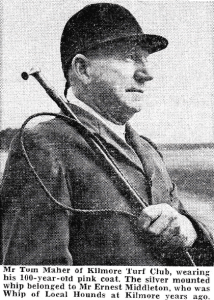
This article appeared in the Weekly Times, 3 July 1974 and features Thomas Michael Maher (1902-1978), son of Rody and Annie (nee Buckley) Maher.

Tom Maher, a groundsman for Kilmore Turf Club, would be tipped as a good stayer in anyone’s book. He started work at the race club in 1916 when only a lad and he’s still working there, 58 years later.

During that time, Tom has helped out as time-keeper and assistant judge, among other things, and he used to ride in pony races at the club years ago.

He worked on the scratching board until 1926, then took over as Clerk of Course, and continued in this position for the next 44 years, missing only one meeting during that time because of an operation. He did the job in an honorary capacity for the first 30 years. He retired in 1970, and the club had reserved a job for him on the gate in the mounting yard.

Tom was born at Springfield, near Kilmore. His father carried the mail from Kilmore to Lancefield for 33 years in a horse-drawn vehicle. Tom’s mother died when he was five, and at 14 he started work in Morrissey’s hardware and timber shop.

Tom rode track work for his boss, who had an interest in Synvanmore, and who owned several other race horses. The first race he won was a hack race at Kilmore. Other wins included the Richmond Cup at Caulfield, Coongy Handicap and Bagot Handicap.

Tom later trained as a hobby and rode as an amateur around the central district of Victoria, and thinks he would have been the last amateur to ride among the pros at Hanging Rock.

“I never accepted payment or pulled a horse,” Tom will tell you. “I once had to put up 42 pounds dead weight. I was nine stone and had to make up three stone, so I bought a lead weight.

“When I used to ride at Heathcote in the depression years I had to ride 30 miles home after the race, as there was no other means of getting there.”

A highlight of Tom Maher’s long association with Kilmore Turf Club came in 1973, when he was made an honorary life member in recognition of his service to the club.

Mr Maher owned a horse called Molineaux at one time. “It won at Moorfield three years in succession, and also won the Sunbury Trial Hurdle,” he recalls.

He’s a 50 cent bettor, and says he has a good bank balance from betting. “I keep my sporting kitty separate from my housekeeping money. My longest odds has been in doubles,” he saus.

“A lot of chaps who are riding now – well, I knew their fathers as apprentices. I’ve led in some famous jockeys too – including Billy Duncan, Bill Williamson, and Jack Purtell, who is the most gentlemanly man I’ve ever met on the turf.”

Mr Maher remembers the days when they used to have picnic races at Springfield, a big steeple-chase with a water jump at Kilmore, and a Kilmore Grand National run over four miles.

“There’s a lot of talk about women riders these days, but they’re not new,” says Mr Maher. “We had some jolly good women riders back in the old days, the most notable being the late Mrs Violet Murrell, and Mrs Spiers.”

Mr Maher is proud of his pink coat, which he thinks must be 100 years old. It was given to him by Mr Ernest Middleton, who was the Whip of Local Hounds in the days when Kilmore had a hunt club, before the turn of the century.

“Mr Middleton’s father wore it before him, so that would make it about 100, and it’s still in good condition,” said Mr Maher. He is also the proud possessor of Mr Middleton’s whip.

Murder at Epping

Murder at Epping

bwcommonheath Catherine Maher (nee Costigan) (my gg grandmother) was a witness to a murder that occurred at Epping in 1858. An inquest was not held until February 1864, after the victim’s body was discovered. Catherine, by then married and living at Lancefield, testified at the inquest.

The scene of the murder was the Traveller’s Rest Hotel, Epping. The proprietors of the hotel were Patrick and Sarah Burke, the accused was Patrick’s brother, Batholomew (‘Bartley’) Burke who was alleged to have murdered his wife Mary. Bartholomew, a labourer, and Mary had three young children and resided in a tent next to the hotel. In 1858 Catherine Costigan was a servant for John and Margaret Maher. John was a wheelwright who rented a house and paddock from Patrick Burke for his family and business. The house was next to the hotel and close to the tent.

In 1858 Mary disappeared and Bartley Burke had told everyone that he had paid her passage to Sydney. He continued to live in the tent for several weeks and, after leaving the children in the care of friends and relatives he moved on himself.

In February 1864 a detective named Williams, acting upon information he’d received, found the remains of Mary Burke on the former site of the tent. Patrick Burke and his son Martin were charged with being accessories and an inquest into the death was held at Northcote later that month. Catherine’s testimony concerned her having heard and seen what may have been the fatal shooting.

The Leader, 20 Feb 1864, p.6

THE EPPING MURDER.

Catherine Maher, a married woman, residing at Lancefield, deposed: I recollect residing with John Maher, at Epping, about five years ago, as a servant. He rented the piece of land his house was then on from Patrick Burke, the landlord of the Travellers’ Home Hotel. The house might be about thirty yards from the hotel, and was on the same side of the road. I knew Bartley Burke and his wife, as they lived in a tent just outside the back corner of Mr Maher’s house. The tent could be seen quite clearly from the house. One night, after ten o’clock, I heard the report of firearms in the direction of Burke’s tent, whilst I was going out of the back door of the house. The night was dark. I distinctly saw the flash of the gun. The report I heard almost simultaneous with it. There was no one with me at the back door at the time, Mr and Mrs Maher being in the house, but in a minute or so afterwards, as I was turning to go into the house, the latter came out beside me. When I went inside they both asked me where the shot had been fired, and I replied about Burke’s tent. Previous to that night I was constantly in the habit of seeing Mary Burke about the tent, but never saw her afterwards. Burke remained at the tent between six and seven weeks afterwards. On the next, morning after the shot was fired, Patrick Burke, the hotelkeeper and his wife went away in their gig towards Melbourne. Could not tell what particular dress Mary Burke wore or the color of her hair. On one occasion saw, her beaten by her husband. She seemed at that time to be, a little groggy. About a minute before the report of the gun I heard a person near the tent exclaim ‘look out.” I heard no screaming, however, either before or after the report. The tent contained no separate apartments. The chimney attached to it was built of stone. On the morning after the shot, the second child came to me and said that her father told her he had sent her mother off to Sydney. There were three children the, eldest I think was about eight years of age. I had no conversation with them afterwards upon the subject. To Inspector Bookey : I had no conversation with Mrs Patrick Burke about what evidence I was to give. To, the Jury : I never saw, Bartley Burke with firearms in his hands. The day after the shot was fired was not a Sunday, The tent remained up about a month after that.

John and Margaret Maher also gave evidence at the inquest …

John Maher, a wheelwright, residing : at Epping, deposed: I rented a paddock and house near Patrick Burke’s hotel, from 1855 till some time in 1862. I recollected Bartley Burke and his wife, living near my place in a tent. I often saw the latter, but did not know her Christian name. On one occasion, late at night, I heard a shot fired near their tent, as I was in bed. I did not make any inquiries at the time or afterwards regarding the shot ; it had become impressed in my memory from the fact that it was rather a late hour to go opossum shooting. I never saw Mary Burke afterwards, but I saw her husband frequently. He remained about the place for some weeks, but how many I do not exactly remember. Some days previous to the shot being fired, Burke and his wife had a quarrel at my place. Burke struck her with a stick of some kind, upon which I separated them, putting him out of the house. Where the blow was struck I cannot tell, it is too long since then.. Burke’s tent was situated about the place where the bones were found. I have not seen him within the last three years. I frequently saw him with a gun, but of what description I cannot remember.

Margaret Maher, wife of the preceding witness, deposed: I recollect living near Patrick Burke’s hotel, about six years ago and remember a tent nearby occupied by Bartholomew Burke and his wife. One night, about ten o’clock, I heard the report of a gun, near the tent, the night was dark and I saw the flash of the gun very distinctly. I remember the shot, because it was so near the tent. I was in the habit of seeing Mrs Burke almost daily, but I did not see her for two days before the shot was fired. Never saw her afterwards. I had some conversation with the second youngest child on the morning afterwards, I asked the child if her mother was at home, when she replied that her father had sent her to Sydney that morning. Mrs Burke left the place before, but she then called in and bade me good bye. On one occasion she had a few words in my place with her husband, who struck her with a stick. She was then a little groggy, but he seemed quite sober. Heard, no words near the tent before or after the report of the gun. There was no light in the tent at the time. It remained standing for two or three weeks afterwards. I saw Burke between eight and nine o’clock on the morning after the shot was fired, going from his own tent to the public-house. I afterwards saw him return to the tent. Patrick Burke and his wife had left in their gig for Melbourne, before that. Mary Burke’s hair was either brown or black, and very long, but whether it was ever plaited or not I could not tell.

After several days of evidence from about ten witnesses, a jury verdict was delivered …

The jury, without retiring, unanimously agreed upon the following verdict :— “That, on or about the 19th of September, 1858, at Woolert, Mary Burke died from violence, inflicted upon her by her husband Bartholomew Burke. We find the said Bartholomew Burke guilty of the wilful murder of the said Mary Burke.”

After the inquest the search was on for Bartley Burke …

Geelong Advertiser, 29 February 1864, p.2

A reward of one hundred pounds is offered in Friday night’s Gazette, for the apprehension and conviction of Bartholomew Burke, charged with the wilful murder of his wife, Mary Burke, on or about the 9th September, 1853 The following is given as the description of the man Bartholomew Burke—Irish, aged about 43, 5 feet 7 or 8 inches high, medium build, dark complexion, hair, whisker and moustache, probably now turning grey; formerly a soldier in H.M. 40th regiment at Melbourne, acting as officers’ servant, discharged in 1857. He afterwards lived with his wife at Gisborne or Kyneton. About 1860 he worked at Kew for two contractors, named respectively Morgan and Sobie, being then known by the name of Moore. In 1849 (? 1S59) he worked at Gardiner and Cheltenham under two contractors, named respectively Dwyer and Malone, at the time when one George Oldham was murdered there by one Regain About two years ago he was at work stone breaking near the Plough Inn, Plenty-road. His general appearance is that of a labourer. During his military service he was for some time employed on escort duty.

Kyneton Observer, 29 March 1864, p.2

Considerable difficulty seems to be experienced in coming, across the whereabouts of the missing Bartholomew Burke, the supposed Epping murderer. Scarcely a day passes but some one is apprehended who is fancied to answer the description, and, as a matter of course, shortly after discharged ~ but it seems hard that this should be the law, as many innocent persons may thereby have their characters materially damaged.

He was found in December 1864 in Tasmania, and further charged with absconding …

Mercury (Hobart), 19 December 1864, p.2
ABSCONDING – John Burke alias Bartholomew Burke alias Moore, charged upon his own confession with a murder committed in Victoria, was discharged, a further charge of absconding in June 1851, was preferred against him and he was remanded for examination to the 22nd inst.
The inquest was widely reported on and these reports can be found on the Trove Newspapers website.
Typhoid Ship Glen Huntly

Typhoid Ship Glen Huntly

bwship Glen Huntly (1840)

Departed: 14 Dec 1839 – Geenock, Scotland
Arrived: 17 Apr 1840 – Port Phillip, Vic.
Master: Captain John Buchanan
Particulars: 505t barque ; travelled via Oban

Notes: Eighteenth of the original Bounty Scheme ships ; 157 passengers including 25-year-old Alexander McKenzie (‘Black Sandy’) and his cousin, also named Alexander McKenzie (‘Red Sandy’). The nicknames distinguished the cousins by hair colour.

John O’Groat Journal, 16 August 1839, p.2

The beautiful new barque, Glen Huntly, Captain Buchanan, launched from Mr Bremner’s yard here, left Poulteneytown harbour on Friday evening, and was towed out of Wick bay by the steamer Sovereign. The Glen Huntly has a very fine appearance on the water, and from all we can hear, fully justifies the most sanguine expectations which were formed of her.

… We have been informed that the Flamer of and from Liverpool, for the Baltic, sunk off Barra Head on the 6th instant, having previously struck on a rock. The crew were saved by a Danish brig, and landed at Westray. Three of the men came here, and shipped themselves board the new barque, the Glen Huntly.

Inverness Courier, 6 November 1839, p.2

The splendid ship Glen-Huntly, which sailed a few days ago from Greenock to the West Highlands, for the purpose of taking emigrants on board for Sydney and South Australia, has struck on the rocks near Skye, and will be obliged to undergo repairs. The cabin passengers, we hear, will be taken out in the Tomatin, which is lying at the tail of the bank at Greenock, ready to sail for the same destination. This accident will be a serious loss to the poor steerage passengers, who all waited for embarkation after having parted with house and home.

The Herald, 26 Feb 1884, p.3

The Chronicles of Early Melbourne : Historical, Anecdotal, Personal (1835-1851) – New Series by Garryowen

Chapter XXV : Commerce and Quarantine
Defunct Quarantine Stations 1 – Point Ormond

The first yellow-flagged ship arriving in Port Phillip was the Glen Huntley, from Greenock, with immigrants, on the 17th April 1840. Typhus fever had shown itself on the voyage, and out of 157 passengers there were no less than fifty on the sick list. Great was the consternation amongst the townspeople on the appearance of so unexpected and unwelcome an importation as a probable pestilence, and no time was lost in arranging for the establishment of a Quarantine Station. The then umbrageously picturesque territory, now thoroughly civilised and known as St Kilda, was designated by the Aborigines “Euro-Yroke” from a species of sandstone abounding there, by which they shaped and sharpened their stone tomahawks. Its first European appellation was the Green Knoll, the ominence (then much higher) now recognised as the Esplanade, until Superintendent Latrobe named the country St Kilda in compliment to a dashing little schooner, once a visitor in the Bay. St Kilda was considered a smart walk from town, and adventurous pedestrians made Sunday trips there in the fine weather. About a mile further, looking out in perpetual watch over Hobson’s Bay, was a point known as the Little Red Bluff, afterwards improved into the Point Ormond, and here some four miles from Melbourne, a pleasant enough spot, was organised our first sanitary station, where tents were pitched and crew and passengers sent ashore. Ample precautions were taken to intercept communication with the interdicted world by land or sea, and Dr Barry Cotter, Melbourne’s first practicing medico, not being to full handed with patients in a small, healthy, youthful community, with a magnanimity that did him credit, volunteered his services to take charge of the newly-formed station. There was always a military detachment located here in those times, and from this a guard was assigned to protect the encampment on the land side, whilst the revenue cutter Prince George, from Sydney, then in port, was stationed seaward to shut off any communication by boat or otherwise. The surgeon superintendent entered upon his duties with a becoming sense of their importance. By an amusing perversion of terms he styled the place “Healthy Camp”, and whilst lording it there, issued regular bulletins upon the condition of the invalids and convalescents consigned to his care. Three of the immigrants named Armstrong, James and Craig, died there, and were interred near the Bluff. Their lonely graveyard was afterwards enclosed with a rough wooden railing, destroyed by time, and from oversight or culpable neglect, not replaced, and so the poor mortal remains (very little now), have rested in peace, unprotected, though undisturbed, from their burial day to this.

The Herald, 8 February 1930, p.25

When the Glen Huntley Arrived : Yellow Flag and Point Ormond

by R.J.H.

We must go back to the era of immigration, when new settlers landed on the beach at Sandridge (Port Melbourne), and took their way along the track that led to the encampment on the southern side of the Yarra, for the sad story connected with the Glen Huntley.

She was one of the many immigrant ships, a barque of 450 tons. On October 28, 1839, she put out from Obin, Scotland, and sailed to Greenwich (Eng.), where she remained some weeks. Then the voyage to Port Phillip was resumed. The ship’s immigrant passengers numbered 157. The run to Australia was fraught with uncomfortable incidents, the barque climbing a rock and colliding with another vessel on the way. But, worst of all, so far as the passengers were concerned, was the long confinement and unsuitable fare of their voyage. The ship was badly found, and the resultant misery robbed the migrants of their stamina. And so, with typhoid raging, the men, women and children, who had boarded the Glen Huntley full of high hopes and eager to try their fortunes in Victoria, neared the new land in a weakened condition. Finally the vessel sailed into Hobson’s Bay, the awful yellow flag flying from a masthead.

Fifty people aboard, it was reported, were down with typhus. This was sensational news. An immediate conference was held, and it was decided to fit up a quarantine station at Little Red Bluff (Point Ormond).

The passengers and crew of the stricken ship were hurriedly landed. Dr Barry Cotter rushed to render medical aid, and several women volunteered as nurses. Thanks to the immediate action taken to defeat the spreading of the disease, most of the Glen Huntley‘s passengers lived to prosper in the land of their adoption. But three unfortunates succumbed to the fever and were buried near the station. A fence set to four iron posts was erected around the grave. As the years passed and the enclosure gradually collapsed, leaving the spot unprotected and neglected. Then the encroaching surf threatened to cover the graves. When this was realised it was decided to remove the bodies to the St Kilda Cemetery, and accordingly the remains were re-interred, in 1898, and a memorial stone was erected over the graves.

But the original site – numerous cars whizz by it daily – is barely land-marked. Three of the iron fence supports disappeared, leaving one as the remnant of a kind of memorial. Visitors to the locality have wondered what the lonely post marked. Perhaps it is not there now.

The suburb of Glenhuntley, as well as Glenhuntley Road remain as a reminder of the immigrant ship.

The Australasian, 29 Nov 1930, p.4

First Yellow Flag Ship

by W.H. Hall

Ninety Years ago the barque Glen Huntly arrived in Hobson’s Bay under the command of Captain Buchanan (James Brown, surgeon superintendent), with 157 Government immigrants. She left Greenock, Oban, Argyleshire, on December 14, 1839. She came up to Port Phillip Bay with the yellow flag flying.

On the voyage typhus fever broke out. Eight adults and four children succumbed. There was consternation in the little five-year-old settlement Melbourne was then when it was learnt that about 50 of the newcomers were down with fever.

The Glen Huntly has the distinction of being the first yellow-flag ship to arrive in Hobson’s Bay.
In the Port Phillip Gazette, 1840, this notice appeared:-

Notice is hereby given, that the Glen Huntly, Government emigrant ship, and that infringement of the quarantine laws and regulations will subject the offending parties to the pains and penalties of the same. (signed) A.J.[sic] Latrobe.

The authorities had exerted themselves in a praiseworthy manner to relieve the distress and at the same time restore the health of the emigrants by establishing a quarantine station at the Red Bluff (St Kilda), a projecting point of land. Several cartloads of tents were sent down, and every comfort was provided for the accommodation of sufferers. The disembarkation took place without delay; on Friday, April 24, all the sick had been landed, and by Sunday the healthy had come ashore. One young man died after the vessel had arrived. He was buried on the sands above the high-water mark.

The emigrants in the healthy camp, as far as could be judged, appeared to be a very well-conducted set of people.

On April 30 six new cases of fever had made their appearance; the disease assumed a mild form. Five days later a report was sent to Melbourne that fresh cases had made their appearance, one of which assumed a serious aspect. A week later pleasing intelligence came to hand that eight cases existed and were improving.

Dr Barry Cotter, on May 14, reported as follows:- “I cannot today speak so favourably of our progress here, as, hitherto, fresh cases have broken out in the healthy camp; we have had another death.” (Dr Cotter, who had charge of the healthy camp, died at Swan Hill about 1895. At the first land sale he bought the corner of Bourke and Swanston Street for L30; in 1838 he had a chemist’s shop in Queen Street, near Collins street. He arrived in Melbourne on June 9 1836, by the brig Henry from Launceston.) Another report (May 21) said:- “We are happy to announce that the accounts from the sick camp have been removed to the healthy one.”

From a book kept in the Port and Harbours office, Custom House, Melbourne I made this extract:- “The healthy passengers by Glen Huntly released from quarantine station June 1st, and those sent over from the sick camp to the healthy June 13th and the others June 20 and brought up to Melbourne.” In that black exercise book you may find the names, ages, and occupation of the passengers, also of those who died on the voyage. George Denham, aged 35, succumbed on the day the vessel arrived and was buried above the high water mark. A few years later his grave was covered by the sea.

George Armstrong, aged 48, died on May 4; James Mathers, aged 38, on May 6. Armstrong and Mathers were buried in one grave on the top of the cliff. John Craig, aged 40, May 14, was buried about 3 or 4 ft on the west side of the other grave. These graves were surrounded by a picket fence, which ar=fterwards became rotten. This was replaced by two stone slabs. When the Central Board of Health decided to remove the bodies from the Red Bluff to the St Kilda Cemetery I received an invitation to be present. This took place on Saturday, August 28, 1898, at half past 7am. On the same afternoon a commemoration service was held at the cemetery; a choir, under the leadership of Mr George Andrews, was in attendance and solemnly sang the hymns Oh God Our Help in Ages Past and Days and Moments Quickly Flying, after which Mr Brown, town clerk of St Kilda, read a short history of the vessel and its passengers. Amongst those present were Mrs Bowman (a daughter of Mr Craig) and Mrs McGonagle, who was a girl of 14 on the ship; she died at South Yarra on April 1, 1904, aged 84 years. I had the pleasure of meeting Mr Peter Brisbane, another passenger, who died at Murchison, aged 76 years, on September 26, 1908. Mr David McKenzie, aged, aged 90 years, another passenger, died at Broadford on July 10, 1902. When John Craig left Scotland and the family consisted of himself and five, three sons and five daughters; the youngest daughter, Marion, an infant, died 16 days after sailing from Greenoch, and was buried at sea; the eldest daughter, Mary, a widow, died at Falconer street, St Kilda, on August 15, 1890, about a mile from Red Bluff.

A memorial was erected by public subscription over the remains of these unfortunate pioneers in the St Kilda Cemetery, and was unveiled by the mayor (Councillor A.V. Kemp) on Sunday, April 16, 1899.

A number of letters have appeared from time to time in the papers, some of the writers saying that they were shipwrecked sailors, others that Captain Ormond had command of the Glen Huntly. It was Captain Buchanan’s intention on arrival home to retire from seafaring life, but the call came to him before the voyage was ended. He succumbed to fever and was buried at Cape Town.

Glenhuntly road (Elsternwick and Caulfield) is named after the ship. Point Ormond after Captain Francis Ormond, who arrived here in command of the ship John Bull. 765 tons, from London on January 22, 1840.

[The foregoing article forms part of a paper read by Mr W.A. Hall before the Historical Society of Victoria recently.]

The Age, 21 May 1949, p.8

A Tragic Voyage : Glen Huntly _ Fever Ship

Of the thousands who pass through Glen Huntly daily, few may be aware of the tragic circumstances associated with its name.
By C.S.
The story begins in December 1839, when the barque Glen Huntly, 430 tons, left Oban, Scotland, for Australia. She was in charge of Captain Buchanan, and crammed into her confined space were 157 emigrants, as well as the crew.
Emigrant ships of that time were the subject of much bitter comment by the London newspapers. It was alleged that food was of Inferior quality, that pumps had to be kept going to prevent the vessels, which were badly overcrowded, from sinking. The Glen Huntly was certainly overcrowded, so it is little wonder that eleven migrants died at sea on the way out “from
either smallpox or fever”.
The high hopes of the emigrants approaching their new land had, therefore, been dashed, for it can be imagined that life aboard was anything but pleasant. When the Glen Huntly, on April 17, 1840, finally sailed Into Hobson’s Bay, 50 people aboard were down with typhus, and the dreaded yellow flag flew at the masthead.
An immediate conference was held on shore, and Captain Buchanan was ordered to divert the vessel from Williamstown (the usual anchorage) across the Bay to the Red Bluff, now known as Point Ormond. Several cartloads of tents were sent to form a quarantine station, and disembarkation commenced on April 23.
As Melbourne was but five years old at the time, It can be understood that an acute shortage of medical men existed. However, several women volunteered as nurses, and Dr Barry
Cotter and Surgeon Browne worked untiringly. Two camps had been established — one for the fever patients and the other for the immune — whilst a sergeant and four privates were on
duty to prevent any contact with settlers and others.
On June 5 there were reported discharged from quarantine 50 males, 25 females and 19 children. Others left later, but, although most of the emigrant patients lived to prosper in the
new land, three died and were burled near the station at Point Ormond.
A chain, supported by four iron posts, was erected around the graves, but gradually the sea encroached so far as to threaten to wash them away.
To the north of the kiosk at Point Ormond an old iron post marked the spot until only a few years ago. This replaced the wooden railing that originally bounded the graves. In the presence of about 100 people the graves were reopened on August 27, 1898, and the remains reburied In St Kilda Cemetery.
Public Memorial
In the south-west corner of the cemetery Is to be seen the memorial erected by public subscription to “John Craig, James Mathers and George Armstrong.” John Craig left a wife and seven children. Mathers was a single man and Armstrong a widower. The concluding Inscription on the memorial reads as follows: “This memorial was erected by public subscription to mark a notable event in the early history of the colony. — Glen Huntly Pioneers.”
The barque Glen Huntly returned to Melbourne In 1850, but this time she brought only 46 emigrants in the steerage. She left Melbourne for London on March 6 of that year, and, as far as is known, did not show herself here again. But Glen Huntly-road, as well as the railway station and district known as Glen Huntly, will perpetuate the memory of the stricken emigrant ship.

Memorials

Here is the memorial at St Kilda Cemetery where the remains of those buried at the beach were reinterred
On December 13th 1839, the emigrant ship “Glen Huntly” left Greenock, Scotland and arrived in Hobson`s Bay on 17th April 1840.  Many of the passengers suffering from fever were landed at the Red Bluff St Kilda on 24th April 1849.  That being the first quarantine station in Victoria.
A few days later JOHN CRAIG  JAMES MATHERS  GEORGE ARMSTRONG succumbed to the disease and were interred at The Bluff.  Owing to the encroachment of the sea their remains were exhumed and removed to the St Kilda Cemetery on 27th August 1898 by the Board of Public Health.
This memorial was erected by public subscription, to mark a notable event in the early history of the colony.
More about this monument at Monument Australia >


In 1990 a celebration was held by descendants of the Glen Huntly and on that day a cairn was unveiled at Point Ormond to mark the 150th anniversary of the ship’s arrival and Victoria’s first quarantine.

This plaque commemorates the 150th anniversary of the arrival of the ship “Glen Huntley” at a gathering of descendants of the original passengers.
Unveiled on April 22nd 1990 by Albert John Buntine, M.M.  Aged 95, oldest known descendant

More about the cairn at Monument Australia >.

After the unveiling of the cairn, a service was held at the St Kilda Cemetery, followed by an afternoon tea at St Kilda Town Hall.

The Ship William Nicol

The Ship William Nicol

sketchthistle bwcommonheath The Grant family migration to Australia from Scotland

In 1837 Alexander and Marion Sarah (nee Fletcher) Grant migrated from Inverness to Australia with their three children James, aged 10, Janet aged 7 (my g-g-grandmother), and Marion aged 4, aboard the William Nichol. Another child, John had died in 1835 as a baby and a further child, whom they also named John, was born in Sydney in December 1837 about 8 weeks after they arrived. The family then travelled down to Port Phillip where Alexander Grant farm laboured, squatted and farmed.
An interview with Marion in 1912 stated that “the ship took the news of the Queen’s
[Victoria’s] accession to the Cape of Good Hope, where the event was duly celebrated. But speedier craft carried the tidings to New South Wales, where the celebrations were in progress when the William Nichol arrived.”
Below I’ve gathered together a few reports from newspapers and journals about the 1937 journey of the William Nicol, the spelling of Nicol, (Nichol, Nicholl) varies according to publication.

bwship

Departed: 06 Jul 1837 – Isle of Skye, Scotland
Arrived: 27 Oct 1837 – Sydney, NSW
Master: Captain McAlpine
Particulars: 408t ; built 1834 ; travelled via Capetown ; second ship of the Lang Bounty Scheme.

Notes: 311 passengers. John Dunmore Lang became involved in immigration, because he feared for the fate of a colony with no moral or Christan values. He felt that an injection of Protestant free settlers would provide a balance for the large numbers of convicts pouring into the colony, in the meantime calling for an end to transportation. Like most of Lang’s Scottish immigrants, the Grants were victims of the Highland Clearances. The rapid increase in population and the sheep farming for the expanding and popular wool industry forced many of the traditional oat and potato growers from their Highland land.

Bounty ships were often overcrowded, uncomfortable and insufficiently supplied with poor quality food, and it was reported that the William Nicol was no exception. Despite the fact that Dr David Boyter (Royal Navy) knew something of the characteristics of his potential candidates (he had travelled the Highlands on behalf of the Colonial Office searching for suitable candidates for the scheme), it was said that most of the crew of the William Nicol did not speak Gaelic and the Highlanders were not provided with any of their accustomed foods, such as oatmeal.

References:
Dougal McKenzie & Isabella McKenzie
Dokimon, John Dunmore Lang: Patriot, Republican, Statesman, Evangelical, & Engima [accessed 2012]
McKenzie, Roma. ‘Scotish Origins’ [research notes]

bwship

The mid 1830s were a time of great hardship and food shortage in the Highlands and Islands. The government did little to help. An impassioned plea for help by Caraid na Gaidheal, Dr Norman MacLeod was heard, and acted on by Rev Dunmore Lang, a Presbyterian minister based in Australia. He instigated a programme of assisted passages to Australia from the area. The first boat to leave was the William Nicol, which sailed from Isle Ornsay in July 1837 with 70 families from Sleat, the neighbouring parish of Strath and the adjoining mainland. Of the 322 passengers, 107 came from Sleat. The Edinburgh Courant of July 10 1837 reported that it took three days to complete the embarkation of the emigrants. It also reported that so many people wanted to emigrate that more people turned up than the ship could actually accommodate.

(Sleat Local History Society)

bwship

John O’Groat Journal, 21 Jul 1837, p.2

EMBARKATION OF HIGHLANDERS FOR AUSTRALIA.
Isleornsay has for some days past presented a busy scene. Last week, the ship William Nicol, of Glasgow, arrived in the bay, for the purpose of taking on board the emigrants. Monday the was the day fixed for the embarkation. At early hour on that day, Dr Boyter, the Government agent for emigration, attended. The Doctor was accompanied by Bowie, the commissioner for the McDonald Estates. In the course of the day, Glengarry, Mr Sellengston of Lochlash, and various other gentlemen connected with Skye and the adjoining mainland, came to Isleornsay to witness the interesting scene. The embarkation was soon commenced, and all was finally completed Wednesday evening when emigrants from the under-mentioned districts were all comfortably settled board the ship :

From Slate, Isle of Skye 107
Straith, Ditto 82
Lochlash, Ross-shire 43
Glenelg 29
Knoydart 48
Lochaber 4
Lochbroom 9
In all, 322

Of this number 104 were under seven years of age; and, judging from appearances, there is likely to be a considerable addition to the passengers before the ship reaches her destination.
On Wednesday afternoon, at the last muster of the passengers, every family was presented with a Bible. The ship was fitted up in the most commodious manner possible, and all who visited her were satisfied that the comforts of the emigrants had been most minutely attended to. Indeed as to this the poor people expressed themselves in the most grateful terms. The provisions laid in are of the first quality. Dr Roberts, surgeon of the Royal Navy, accompanies the ship as superintendent surgeon, and what pleased the people most of all was to find that a large and airy part of the ship was laid off as an hospital. An emigration is at all times an unpleasant scene to witness. On the present occasion, however, it was in many respects the reverse, for such was the eagerness of the poor people to be taken on board that all who presented themselves could not be received. This to many was a source of great disappointment; Dr Boyter, however, was firm in refusing to take one more than the ship could comfortably accommodate, and several families were in consequence left behind, with the hope, however, of being taken away by the next ship.
On Wednesday dancing commenced on board to the enlivening notes of the bagpipe and was kept up till a late hour. Early on Thursday morning the ship weighed anchor and sailed, and on passing Armadale Castle she was saluted with twelve guns. The salute was returned from the ship, followed by three hearty cheers from the emigrants.
All on board were loud in their expressions of acknowledgement to Dr Boyter for the great trouble he had taken, and thanks were as liberally poured out to Mr Bowie for the part he had acted in procuring for the poor Highlanders so great boon.
The first ship has therefore sailed with eclat, and other vessels are to follow, it earnestly to lie hoped that in process of time the poor Highlanders may he removed a scene where they can not only be useful to themselves, but also prove an important acquisition the colony to which they are to proceed.

bwship

Caledonian Mercury, 16 Nov 1937, p. 2

FROM OUR ORDINARY CORRESPONDENT
A melancholy statement is given of the condition of a cargo of emigrants from the Isle of Sky, in the William Nicholl, bound for New South Wales. It appears they were shipped on Government account, that they had a free passage given them, and put into Table Bay on 6th July. The poor creatures were in a state of starvation, and the distress was increased by the number of children amongst them. A public subscription had been set on foot for their relief.

bwship

From Parbury’s Oriental Register

The William Nicol, chartered by Government to convey emigrants from the Highlands of Scotland to Australia, and which sailed from the Isle of Skye in July last, had reached the Cape in a most distressing condition. It is stated that the ship was much too crowded; the berths ill-constructed, being just calculated to hold one person each and no more, and so arranged as neither to admit of the classification of families nor of the sexes. There was a great want of water-closets and other necessaries of cleanliness. Many of the children had died, and all the women and children were sickly, from an injudicious selection of food. The women had suffered the more, in consequence of the ship’s surgeon not knowing their dialect, and there being no female interpreter. They complained bitterly of not being allowed to go on shore. The Cape residents generously raised a subscription to purchase an adequate supply of articles of food and clothing. The Surgeon recommended that in future a couple of milch-cows should be sent out with emigrant vessels, and that no females having infants, or likely to become pregnant on the voyage, should be taken. The arrangements of emigrant ships are cruelly had, whether under Government or private direction.

bwship

Sydney Herald, 30 Oct 1837, p.2

gr-1837-10-30

bwship

Sydney Morning Herald, 30 Oct 1837, p.2

The William Nicol, the first vessel chartered by the Government for the conveyance of Highlanders to this port, arrived from the Island of Skye on Friday last, under the superintendence of an old visitor here Dr. Roberts, R.N. In this ship there are 311 persons – the male adults consisting of 2 farm overseers, 19 farm-servants, 21 farm servants and stockmen, 19 shepherds, 2 blacksmiths, 2 carpenters, 1 cooper, 1 wheelwright and miller, 1 stonemason, and 1 tailor; there are also 73 female adults, and 169 children. The Midlothian was to sail from the Isle of Skye with seventy families for Sydney, about the end of July; and another ship was also taken up by the Government for a similar purpose. The ship Portland with emigrants from Greenock, was to sail for this port about three weeks after the William Nicol. The emigrants per William Nicol have arrived in a condition which is highly creditable to the Captain and the Superintendent.

bwship

Inverness Courier20 December 1837 p.2

THE WILLIAM NICHOLL
In consequence of several exaggerated and unfounded reports which have got into circulation upon the condition in which the William Nicoll, emigrant ship, touched at the Cape of Good Hope, we have been requested to insert the following statement: It is not true that the William Nicoll put into the Cape short of provisions. She had on board six months’ provisions of excellent quality and had not been sea more than two months when she called at the Cape, where she had no occasion to make any addition to her regular stock of provisions. It has been said that the Highland women suffered much in their health in consequence of there being no female interpreter. The short answer is that, independently of two general interpreters, who were allowed cabin passages for the purpose, there was a midwife, a female excellent character, who spoke the English and Gaelic, and undertook the charge of the women and children both in and out of hospital. Oatmeal is mentioned as an article that ought not to be omitted in voyages from Scotland. A good suggestion. It happens, however, that the William Nicoll had nearly five times the quantity of oatmeal customary, the allowance man and women being increased from a pint-and-half per week to seven pints. A state of filth is alleged to have prevailed in the vessel and berths. From the nature of the case, this does not admit so direct a refutation some of the other statements. Cleanliness, however, is enforced in all these vessels through the efforts of the passengers themselves; it is known that, in the present case, the men were in good health and orderly ; it in common sense, then, to believe that experienced surgeon the navy would have allowed sixty-five stout, healthy men, and husbands, to have been idle spectators in such case as is alleged? Some of the reforms proposed in future emigrant ships are, that livestock and jams and jellies should be carried, for the benefit the hardy peasants whom they convey ; and that, instead of “cribbing-up” the passengers in fixed cots, “berths should, if possible, be set apart tor families, with water-closet to each, every two.” To anyone who has the most trifling acquaintance with the sea, a word of comment on these truly amusing suggestions would be superfluous, except that they give stamp the remainder of the representations they accompany.
The plain state of the case is, that having sailed from the most distressed part ot the Highlands, with upwards of 300 men, women, and children, in a condition of the utmost want, the deaths amongst the passengers the William Nicoll, after being restored to full diet, and having made a sea voyage, amounted to ten children and one woman, the last having died of childbirth fever, cause totally independent of the ship. No other grown person had died. The men were in good health and contented. Letters from the emigrants themselves express gratitude for the kindness and good treatment they had experienced.
There appears no reason to suppose that, from want of experience sending such very large numbers of children, the diet in the earliest emigrant vessels this year, stood in need improvements in that respect, which have since been introduced. And with regard numbers, a rule has been enforced, under the management to which emigration has latterly been subjected, which is so strict as to defy the possibility of the people being crowded. There is every reason, therefore, to hope that this service, based as it is on benevolence, may rarely be afflicted with the misfortunes which, nevertheless, with every precaution, must occasionally occur in all human undertakings.
ABSTRACT OF PROVISIONS SUPPLIED.

Beef and Pork £509 5 0
Flour and Biscuits 392 5 4
Oatmeal 184 0 0
Tea, sugar, and molasses (duty free) 141 9 1
Pease and suet 63 8 6
Port wine (duty free) 146 8 0
Preserved meals and Hospital stores 79 1 0
Other items 307 0 0
Total £1822 17 11

Water laid in 44,000 gallons.
The vouchers of the above lodged with the Colonial Office. D.B.

bwship