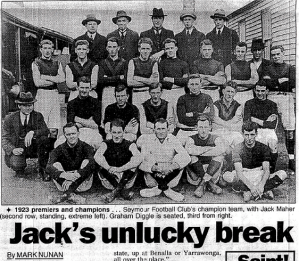
Jack’s Unlucky Break

Jack’s Unlucky Break

This article by Mark Nunan of the Seymour Telegraph appeared on 22 May 1996. Uncle Jack (my grand-uncle Roderick John Maher, son of Rody Maher and Annie Buckley) was a Carlton supporter all his life.

bwcommonheath

At ninety-two years of age, Jack Maher can still vividly remember the day when his VFL career ended before it began.
A Carlton recruit of considerable talent, Maher broke his right leg in two places during the final practice match before the regular season of 1925.
“I can remember kicking four goals before I broke my leg,” said Maher. “But I was being pretty well looked after by (then captain) Pat Kennedy. He was giving me a lot of the ball.”
Reflecting of taking six months to recover from his severe leg break, Maher said pensively: “I never went down there again after that.”
The other matter which contributed to Jack never playing VFL football, was his job on the railways, which he held for 46 years.
“Working on the railways my employment came before my football,” said Jack.
“At times I would be all over the state, up at Benalla or Yarrawonga, all over the place.”
At the time, less than a decade after the cessation of the First World War, Maher had already forged a reputation as a champion left foot goal kicker with the Seymour Football Club.
In 1926, after sitting on the sidelines for the entire 1925 season, Maher resumed with Seymour and kicked 12 goals in his first match back against Yea. In his next two games he kicked bags of eight and seven goals, taking the three-game total to 27.
Jack is quite confident that he is the oldest living member of the Seymour Football Club, having taken over the mantle when Percy Ballantine passed away three or four years ago.
He spent 15 years of his life playing for Seymour, between 1920-1935.
Despite never having played a game with Carlton, his loyalty for the club has stretched over three-quarters of a century.
“It would be an understatement to say I was wrapped to see them win the flag last year,” said Jack.
bwcommonheath

Popular Mailman

Popular Mailman

This article appeared in the Kilmore Free Press on 7 July 1838 (page 2) on the retirement of Rody Maher (my great grandfather) as mail contractor between Kilmore and Lancefield.

bwcommonheath

On Wednesday afternoon last week at the residence of Mr and Mrs Stockfeld, at “The Gap”, on the Kilmore-Lancefield Road, there being a gathering of residents of the Springfield, Mt William and Lancefield district, who met to do honour to Mr Roderick (“Rody”) Maher, who was making his last trip on the mail route from Lancefield to Kilmore, via Springfield. Despite the cold and showery nature of the day, there was a very representative attendance of about 50 persons present – a definite testimony to the popularity of Mr Maher.

Mr M. Clement, of Springfield, referred to the wonderful services and many kindnesses rendered by Mr Maher during his term, in which he travelled about 250,000 miles; and he then called on Dr Wilson to speak on behalf of the residents.

Dr Wilson said they all felt a certain amount of regret at parting with the services of their old friend Rody Maher, but he was pleased to have the honour of making the presentation. He was possibly the oldest friend of Rody, as they were boys together about 60 years before at Tickawarra school. His recollections of Rody were the happiest and most cheerful, and he recalled the Rody was a magnificent footballer. He had been on the track for 30 years, during which time he rendered services which would never be equalled for the courtesy, consideration, kindness and many little acts done for the people along the track. He had done wonderful service. In wet, sunshine or shadow, he was always punctual, and every obligation was always cheerfully carried out. He (Dr Wilson) had the pleasing duty of handing him a wallet of notes subscribed by the residents, not as a reward for many kindnesses, but as a token of regard felt for him, and as a slight recompense for all he had done for them. (Applause)

Mr Maher said that when he started on the job he fully intended to carry it out to the best of his ability. His work had never been questioned by the Postal Department. He also tried to do all he could to oblige the people on the route. He thanked the residents of Springfield, Mt William and Lancefield for all the kindness they had shown to him, and all postal officials for their treatment. He specially thanked Mr and Mrs Brazier, of “High Park”, who always had a warm lunch for him; the business people of Lancefield, who had never delayed him; and Mr and Mrs Heald who had treated him as one of their own. A lot of respect was due to Mrs Stockfeld, who looked after the goods for the Mt William people. If ever she left, he hoped the residents would gather as they had that day, and he would be there. He thanked them all sincerely. (Applause)

Prior to the above ceremony, an excellent afternoon tea was enjoyed by all present; and, afterwards, all stood and drank the health of Mr Maher, with musical honours.

“Mercury”

bwcommonheath

Esteemed local historian James Alipius Maher penned a series of articles entitled ‘Reminiscences of an Old Road’, published in the Kilmore Free Press in March 1939 about the Kilmore-Lancefield Road. Part one discusses Rody Maher and other mail contractors who carried out the service before the advent of the railway.

Early Memories of Marion McKenzie (nee Grant)

Early Memories of Marion McKenzie (nee Grant)

In 1837 Alexander and Marion Sarah (nee Fletcher) Grant migrated from Inverness to Australia with their three children James, aged 10, Janet aged 7 (my g-g-grandmother), and Marion aged 4, aboard the William Nichol. A third child, John had died in 1835 as a baby and a fourth child, whom they also named John, was born in Sydney in December 1837 about 8 weeks after they arrived. The family then travelled down to Victoria where Alexander Grant farm laboured, squatted and farmed.

This article appeared in the Weekly Times, 8 June 1912. It was one of a series of interviews with veteran colonists, and this one featured Marion McKenzie, (nee Grant). 

sketchthistle

VETERAN COLONISTS
MRS MARION MACKENZIE
INTERESTING MEMORIES

Mrs Marion MacKenzie, at present a resident of Toorak, is certainly one of the oldest Victorian colonists. With her parents, Mr and Mrs Grant, she left London for Sydney in the William Nichol, five and seventy years ago, when she was a child of three. The ship took the news of the Queen’s accession to the Cape of Good Hope, where the event was duly celebrated. But speedier craft carried the tidings to New South Wales, where the celebrations were in progress when the William Nichol arrived.

screen shot 2019-01-17 at 2.46.18 pm

Black Thursday

Mrs MacKenzie’s parents made no stay in Sydney but came right back to Melbourne, then a canvas town. Of that Mrs MacKenzie, of course, remembers nothing, and her first vivid recollection of any event which still lives in the public memory is of Black Thursday, February 6, 1851.
“I shall never forget that day,” remarked Mrs MacKenzie a day or two ago, “nor will anyone who saw its horrors as I did. We were living at the head of the Plenty in those days. My father, a squatter, was a fairly prosperous man in the morning; at night he had nothing except a little money which happened to be in the house. He lost 500 sheep, besides bullocks; moreover, house and outbuildings, with all that they contained, were swept away by the flames.
“Early in the day I mounted a horse and rode off to see if I could find my younger brothers, who were at school. By the way, there had been no school for me, for on the far back, where the family was settled, while I was between six and thirteen, there was no teacher to be found. No one knew that I had ridden off; my elder brothers were away with a threshing machine, and my father and mother had a hundred matters to look to.
“Fortunately, the fire was by no means at its worst when I cantered away. Had it been, or had it travelled a little faster, it would have been impossible for me to escape. As it was I reached the school, but could not return to the house, or, rather, to the spot where it had been. When the fires died away the whole six or seven miles over which I had ridden was charred, and there was only one building, a brick house, left standing.”

In Man’s Attire.

“What amusement had we in those very early days? Really I don’t know that we had any. Before we went to the Plenty we were living further back. As I have told you, we saw nothing of the schoolmaster and we saw nothing of the parson. When we got to the Plenty and a little nearer civilisation than we had been, there were three children to be christened. There was very little dancing, but there was a good deal of excitement. In his first years in the State, my father worked on various stations, and there was a great deal of trouble with the blacks. Fortunately, they were very frightened of firearms and did not know what poor things the old muskets — flintlocks were still used in those days — were. They were constantly about our place, and again and again, I saw my mother dressed in my father’s clothes and walking about outside the house to give the aborigines the idea that there was a man about and that he was armed.
“There was very bad feeling between the settlers and the blacks, and it was especially bad after the murder of a shepherd at Thornton’s place. I was too young to know who was to blame in the first instance, but I do know that for a time the blacks were shot down like dogs.

Old-Time Hotel.

“When I was pretty well on in my teens, and a little while before I married at nineteen, I visited Melbourne. We stayed at a hotel kept by a man named McLean, whom we knew. It was near Kirk’s Bazaar. The meals were fairly good, and we paid half a crown for them.
“Knowing the McLean girls and knowing hardly anyone else in Melbourne, I went round with them when they made the beds. Of these ‘there must have been about forty in one big room. They were only about a couple of feet apart, there was a bit of a mattress, a blanket and a rug on each, and the charge of them was the same as for the meals — half a crown.

The Kelly Gang.

“I knew the Kelly family fairly well. In one sense they were good neighbors. Old folk and young folk alike were always ready to oblige, but they were born thieves.
“My idea is that the notorious Ned was a far better man than his father. The old man was merely a sneak thief, He would rob you of sheep or cattle under the cover of darkness. But there was nothing about him which the silliest boy who goes to a picture show could admire. The son was different, inasmuch as he had pluck and took the risks of his rascalities.
“For a long time the Kelly gang made our life far too exciting and uncertain to be pleasant. But, apart from the sneaking of stock by or at the direction of the old folk, we were not personal sufferers: that is to say, the gang did not attack us when robbery under arms took the place of petty theft.

Bogged in Elizabeth street.

“I left Melbourne after my marriage a girl of nineteen. I did not see the city again till fifty years had passed and I was a woman of sixty-nine. When I got into Elizabeth street, where I had stayed before, I noticed that the bullock teams had disappeared.
“A team had been bogged, half a century before in the street, right opposite the hotel where we stayed. The scene had always remained in my mind. It came back very vividly, and my grandchildren were wonderfully amused when I confessed that I was looking for bullock teams and for the hole in which that particular team had come to grief.
“In those fifty years I was never more than a hundred miles from Melbourne, yet I never came to it. I had many things to interest and to occupy me, as you may judge when I tell you that I had twelve children, eleven of whom are alive. More than that we had to make and to maintain a home. If the life of the pioneers was dull, they had not time to dwell on the fact and to get gloomy about it.”
Mrs MacKenzie is one of the pioneer women of whom Essex Evans sang so finely. Though she came or was brought by her parents to Melbourne three-quarters of a century ago, she still enjoys life and is in full possession of all her faculties. To say that she is far more interesting than the ordinary society woman would be vapid. They are of the women who help to make drapers; she of the class which helps to make a nation. No connected sketch of her Victorian life has been attempted. For some years it was wandering from station to station, father spending a few years on each. Then it was the making of a home, starting in ‘homesteads’ something like the one shown in the reproduction from a photograph kindly lent by Mrs MacKenzie, and which will be recognised by old residents of the Kilmore district.

bwcommonheath