 It’s a great thing when people leave family name clues about. I’m very grateful to David Hall and Jane McQueen for leaving such clues in their children’s names:
Jamieson (Rachel McCaughey’s mother’s maiden name)
Beresford (married name of Mary Hall)
Innes (from the McQueen side)
Sinclair (from the McQueen side)
McMillan (married name of Mary Hinds, daughter of Agnes Hall)
The first names of the children were related as well: Rachel, Isabella, Gertrude, Mary, William, John, David and on the McQueen side: Stanley, Mary, Archibald, Duncan.
The names Beresford and McMillan provide linkages to two women John Hall (b. 1813?) travelled to Australia with, who may have been his sisters or perhaps first cousins – Agnes Hinds (nee Hall) (b. 1809) (whose daughter married a McMillan) and Mary Beresford (nee Hall) (b. 1819). These linkages helped to identify our John Hall from the many other John Halls in the shipping registers, and also provided context for how John would meet his future wife, who was not to arrive in Australia for another 14 years!

 Sir Thomas Arbuthnot
Departed: 17 June 1841, Greenock, Scotland
Arrived: 02 Oct 1841 Port Phillip, Vic.
Master: Captain John Brown
Particulars: 621t ship
Notes: The ship carried sundry cargo, 4 passengers and 260 bounty immigrants, one of whom was Irish John Hall. It was cleared from Melbourne 9 Nov 1841 and set off to Calcutta carrying original cargo plus tobacco and opossum rugs.
Aboard the Sir Thomas Arbuthnot were:
- Mary Hall, aged 22 (born 1819), house servant, Protestant, reads and writes, native place Glasgow.
- John Hall, aged 21 (born 1820), government servant assigned to Robert Smith of Melbourne 1 year, reads and writes (though subsequent documents indicate this not to be the case), native place Glasgow.
- Hind, William, aged 25 (born 1816), Protestant, reads and writes, native place Glasgow.
- Hind, Ann, aged 24 (born 1817), Protestant, reads and writes, native place Glasgow.
- Hind, James, aged 18 months (born 1840), Protestant, native place Glasgow.
Mary Hall married William Beresford (recorded as ‘Berrysford’) on 28 February 1842 and the witnesses were John Hall and Helen Ritchie.
William Beresford (recorded as ‘Berresford’) was transported after conviction for larceny to Victoria aboard the ship Parkfield in 1939. He was sentenced to 14 years and was assigned to work as a labourer for Messrs Allan, River Hopkins.
 Allansford Allansford
In 1839 the brothers William and John Allan took up their ‘Allandale’ pastoral run adjoining the Hopkins River. There was a dry weather ford across the river, and the combination of that and the name of the property owners resulted in Allansford becoming the place name. A timber bridge was built beside the ford in 1851. In 1855 the third brother, John Allan, owner of an adjoining property ‘Tooram’, subdivided land from the property for the Allansford township. Victorian Places: Allansford |
He was later assigned to work for a pastoralist and grazier named Dutton, and while working for him he married Mary Hall.
 The Convict System. — To prevent bigamy, and also to secure the government against being burdened with the support of the families of convicts, it has long been a standing ordinance of the government that no convict shall be married without leave first had and obtained from the Governor, and any evasion of this law is punishable as a misdemeanor. On Thursday last, a convict named William Beresford, who is assigned to Mr W. H. Dutton, one of the largest importers of this detestable species of labour, was brought before the Melbourne bench, charged with offending against this law by marrying one Mary Hall, without the sanction of the Governor. The prisoner, it appeared, was married in February last, by the Rev. Mr Forbes, of the Scots Church, to whom he represented himself as a free immigrant by the Thomas Laurie. The prisoner admitted his guilt but alleged he had the consent of his master, who had advised him should any questions be asked, to pass himself off as a free man. Mr Dutton when examined, admitted that he had given his consent to the marriage, but he denied altogether having advised the prisoner to deceive the clergyman. Mr Simpson, who was on the bench, expressed in strong terms his disapprobation of the conduct of Mr Dutton, who, as a magistrate, and for many years an assignee of convict labour, could not be ignorant of the enormity of the offence of which the prisoner was guilty. Beresford was informed that his marriage was a nullity, and sentenced to expatiate his offence “by working for six months in irons. During the examination, it transpired that on a previous occasion Mr Dutton had given his assent to the marriage of another of his assigned servants named Spicer, but that worthy having been insolent to the clergyman who was to have united him to his cara sposa*, the ceremony did not take place. The bench directed Mr Dutton to bring Spicer before them forthwith that he might be dealt with also. Mr Dutton’s conduct in this affair is altogether so inexcusable that we think the bench scarcely did their duty in failing to deprive him of the whole of his assigned servants. The Convict System. — To prevent bigamy, and also to secure the government against being burdened with the support of the families of convicts, it has long been a standing ordinance of the government that no convict shall be married without leave first had and obtained from the Governor, and any evasion of this law is punishable as a misdemeanor. On Thursday last, a convict named William Beresford, who is assigned to Mr W. H. Dutton, one of the largest importers of this detestable species of labour, was brought before the Melbourne bench, charged with offending against this law by marrying one Mary Hall, without the sanction of the Governor. The prisoner, it appeared, was married in February last, by the Rev. Mr Forbes, of the Scots Church, to whom he represented himself as a free immigrant by the Thomas Laurie. The prisoner admitted his guilt but alleged he had the consent of his master, who had advised him should any questions be asked, to pass himself off as a free man. Mr Dutton when examined, admitted that he had given his consent to the marriage, but he denied altogether having advised the prisoner to deceive the clergyman. Mr Simpson, who was on the bench, expressed in strong terms his disapprobation of the conduct of Mr Dutton, who, as a magistrate, and for many years an assignee of convict labour, could not be ignorant of the enormity of the offence of which the prisoner was guilty. Beresford was informed that his marriage was a nullity, and sentenced to expatiate his offence “by working for six months in irons. During the examination, it transpired that on a previous occasion Mr Dutton had given his assent to the marriage of another of his assigned servants named Spicer, but that worthy having been insolent to the clergyman who was to have united him to his cara sposa*, the ceremony did not take place. The bench directed Mr Dutton to bring Spicer before them forthwith that he might be dealt with also. Mr Dutton’s conduct in this affair is altogether so inexcusable that we think the bench scarcely did their duty in failing to deprive him of the whole of his assigned servants.
* ‘cara sposa’ is an Italian phrase meaning ‘dear bride’
(Port Phillip Patriot and Melbourne Advertiser, 11 April 1842, p.2) |
|
William ‘Hampden’ Dutton was an estate manager and livestock grazier who migrated to Australia in the late 1820s after studying the science of rural economy in Europe. During the 1830s he worked in various farming ventures for Alexander and Edward Riley in New South Wales, and in partnership with his own brother Frederick in New South Wales and South Australia. Frederick would become a reputable pastoralist and politician in South Australia. Hampden travelled between Sydney and Melbourne working on various pastoral and mercantile ventures, but in 1841, the year William Beresford is shown as working for him, he became insolvent with debts of £74,772 17s and assets amounting to £10. His affairs were placed in Frederick’s hands, who ensured that creditors were paid in full. Hampden Dutton died in Melbourne five years later. |
William was granted a ticket of leave on 1 June 1844, and by 1850 the Beresfords left Melbourne with their first two children to settle in the Hopkins River area, where they would have two more children.
John (aka James) BERESFORD b. 1845 Melbourne, VIC d. 1884 Burthong, NSW m. 1873 VIC Elizabeth THORNTON, 6 children
William BERESFORD b. 1848 Melbourne, VIC d. 1859 Cudgee Creek, VIC
Mary Ann BERESFORD b. 1850 Hopkins River, VIC d. 1911 Auckland, NZ m. 1869 Terang, VIC John GIBB, 9 children
David BERESFORD b. 1852 Hopkins River, VIC d. 1914 Albury, NSW
A notice appeared in the New South Wales Government Gazette, Fri 22 Nov 1850 [Issue No.134], p. 1803
| THE Tickets of Leave of the undermentioned Prisoners of the Crown, have been cancelled for being absent from their Districts, they are illegally at large …
– Port Phillip – William Berresford, Parkfield |
William junior’s death in 1859 was the result of an accidental gunshot wound to the chest:
On Sunday last, two boys, sons of farmer’s in the neighbourhood of Cudgee Creek, went out into the bush to shoot birds. Whilst resting on the grass, one of the guns went off accidentally, and the contents were lodged in the breast of one of the boys who died in a few minutes. The deceased was about 11 years of age and was the son of William BERESFORD.
(Warrnambool Examiner, 31 May 1859) |
William Beresford senior’s own death in 1868 was also the subject of an inquest:
An inquest was held at the hospital, Geelong, on Thursday, by Dr Ridley, coroner for the district of Queenscliff, on the body of William Beresford, an elderly man, a dairy farmer near Warrnambool, who died at the hospital on the previous day whilst under the influence of chloroform.
James Russell, Fiery Creek, recognised the body as that of William Beresford, whom he had known for twenty-one years. Deceased had been a heavy drinker for years.
Dr Shaw deposed to having attended at the hospital to assist in the removal of one of deceased’s legs. He was requested by Mr Reid, who was going to operate, to administer chloroform. Mr Reid, previous to his doing so, examined the deceased’s heart.
Witness was also satisfied, by examination, that the deceased was not affected with any disease of the heart, and proceeded to administer the chloroform in the usual manner. He had done so for five or six minutes and had used about two drachms, watching him intently, when he saw his eyes roll, and felt that his struggles became violent.
He called Dr Mackin, who was present, to feel the pulse, and just as witness did so he observed the deceased gasp and stopped the inhalation at once. Cold water was dashed on the head, the body and limbs were raised, and the head depressed.
Artificial respiration was commenced whilst the galvanic battery was being got ready. Galvanism* was immediately applied, and its use was persevered in for fully half an hour, without success. He had previously seen the deceased, who was suffering from cancer, and who agreed to the removal of the limb.
Witness believed the application of chloroform was the immediate cause of death. It produced paralysis of the heart, as respiration and the heart’s action ceased almost at the same moment. Nothing was omitted to restore the patient.
Dr Mackin confirmed the evidence given by Dr Shaw, and testified to the careful manner in which the operation had been conducted. A verdict was given in accordance with the facts of the case.
* Galvanism is the therapeutic use of electric currents
(The Argus, 5 December 1868, p. 6) |
At the inquest, James Russell further said that William’s wife was still alive and living with their sons at Curdies Creek.
The following year a notice of insolvency was published:
James Beresford, of Terang, laborer. Causes of insolvency: Losses sustained on contracts and death of cattle, and from being compelled to pay debts contracted by his late father, William Beresford. Debts, £100 8s 5d; assets, £28 10s 1d; deficit, £71 18s 4d.
(The Age, 2 Sep 1869, p.3) |
Some time after James Beresford died in 1884, Mary Ann Gibb (nee Beresford) and her husband moved their family to Pokeno, New Zealand and Mary Beresford joined them. She stayed with them for the next 19 years until her death 8 July 1902 aged 87. The death certificate says she was born in Ireland and that her father was J. Hall, a miller. There is a definite DNA connection to Beresford descendants, so if Mary’s father was indeed a J or John Hall, then it’s possible that Mary was a first cousin to John Hall aboard the Thomas Arbuthnot. Though her death certificate lists her as Irish born, her death notice has her correctly as ‘of Glasgow’ though the age at death is misprinted.
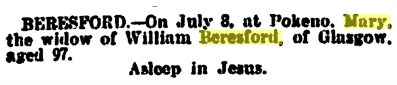
(New Zealand Herald, 10 July 1902, p.1)

 Christine's Compendium of Family History