Wider Circles : Maher & Buckley

Wider Circles : Maher & Buckley

Witnesses to family events can shed light on extended family and friends. I have added articles about other Maher families (the Dookie Mahers and the Epping Mahers) that also had connections to Springfield, Kilmore and Lancefield in an effort to one day establish more precise family connections.

Here is a list of sponsors and witnesses named on baptism and marriage certificates for this family. (This is still a work in progress.)

1862 Thomas Maher & Catherine Costigan, marriage Michael Behan
Johanna Lawler
1863 Anne Maher, baptism
Parents Thomas Maher & Catherine Costigan
Matthew Dwyer (1843-1921)
Anne Maher
1864 Catherine Maher, baptism
Parents Thomas Maher & Catherine Costigan
John Dwyer (1816-1901)
Anne Dwyer (1845-1943)
1866 Mary Maher, baptism
Parents Thomas Maher & Catherine Costigan
Edmond Farrell
Mary Moylan
1868 Roderick Maher, baptism
Parents Thomas Maher & Catherine Costigan
Charles Maher (1825-1902)
Mary Dwyer (1848-1935)
1870 Sarah Maher, baptism
Parents Thomas Maher & Catherine Costigan
Sarah Maher
1876 Patrick Buckley & Anne Hunter, marriage Timothy Crough
Catherine Hunter (1857-1891)
1884 Patrick Buckley & Maryann Scanlon, marriage James Lyons
Sarah Maher
1886 Mary Cantwell, baptism
Parents Thomas Cantwell & Anne Maher
Kate Maher (1864-1931)
Roderick (Rody) Maher (1869-1951)
1888 Elizabeth Cantwell, baptism
Parents Thomas Cantwell & Anne Maher
Sarah Maher (1882-1936)
Patrick Maher (1875-1966)
1889 Ellen Morley, baptism
Parents Walter Morley & Mary Maher
Patrick Maher (1875-1966)
Catherine Maher (1864-1931)
1890 Christina McLeod, baptism
Parents William McLeod & Catherine Maher
Thomas Hunt
Sarah Maher (1882-1936)
1891 Catherine McLeod, baptism
Parents William McLeod & Catherine Maher
Roger (Rody) Maher (1869-1951)
Johanna Mulvey (1871-1939)
1891 Catherine Morley, baptism
Parents Walter Morley & Mary Maher
Johanna Maher (1872-1933)
1892 Thomas Graham Cantwell, baptism
Parents Thomas Cantwell & Anne Maher
Robert Graham
Annie Heffernan
1893 Alice Morley, baptism
Parents Walter Morley & Mary Maher
Ellen Maher (1877-1921)
John Fitzpatrick (1882-1960)
(son of Mary Anastasia Dwyer)
1895 Roderick Cantwell,
Parents Thomas Cantwell & Anne Maher
Edward Fitzpatrick (1879-1956)
(son of Mary Anastasia Dwyer)
Ellen Maher (1877-1921)
1902 Roderick Maher & Anne Buckley marriage John Buckley (1881-1945)
Margaret Maher (1888-1935)
1902 Thomas Michael Maher, baptism
Parents Roderick Maher & Annie Buckley
Patrick Maher (1875-1966)
Nellie Buckley (1849-1935)
1903 John Curry & Hanora Maher marriage Michael Curry (either father
or brother of John Curry)
Johanna Maher (1872-1923)
1903 Richard Oswald Cantwell, baptism
Parents Thomas Cantwell & Anne Maher
Margaret Maher (1888-1935)
1903 Patrick Maher, baptism
Parents Roderick Maher and Annie Buckley
Mary Buckley (1859-1923)
Roderick John Maher, baptism
Parents Roderick Maher and Annie Buckley
John Buckley (1881-1945)
Catherine McLeod (1864-1931)
(per proxy Christina McLeod)
1907 William Maher, baptism
Parents Roderick Maher & Anne Buckley
Katie Cantwell (1883-1936)
(daughter of Anne Cantwell, nee Maher)
(per proxy Chrissie McLeod)

Timothy Crough (1853-1889)

Witness to the marriage of Patrick Buckley and Annie Hunter in 1862. Patrick Buckley’s obituary stated that he had been “in the employ of the late Mr James Crough, when that gentleman was resident at Bawnmore.”

THE LATE TIMOTHY CROUGH.
There are very few old residents of Kilmore but will remember the late Mr Timothy Crough, whose remains were interred in the Kilmore Cemetery on Wednesday, 24th April. Thirty-two years ago when the Government of the country did not pay that attention to our wants which the people can demand from them today, the late Mr Crough, who was connected with the postal department in Ireland before he decided to try his fortunes in Australia, volunteered to give a house to house delivery of all letters and newspapers arriving in Kilmore, trusting for remuneration from the people whom he benefitted. So steady was his conduct and sterling his character that the most important commissions were entrusted to him and were carried out with a fidelity which gained him the confidence of all. After about two years of this important service, he was appointed first Government letter carrier at Kilmore. After about four years’ service in this capacity, he was appointed mail guard on the Sydney line, his section being from Seymour to Badaginnie-the worst patch of road, without exception, between Melbourne and Sydney. This position he occupied until the North-Eastern railway line was opened when he took charge of the travelling post-office between Melbourne and Longwool. This position he occupied till within about two years of his demise, when failing health caused him to relinquish it for the position of sorter in the General Post Office, retaining the salary and emoluments of his more active position. Continual failure of health caused him about five months ago to retire on an allowance, and since then he has been scarcely ever well.
He died at the comparatively early age – for a man who had lived so steadily–of 56 years, and there is scarcely a doubt but that the hardship and accidents of his early coaching days told against him in the end and considerably shortened his days.
Though the notice of his demise was a very short one to his Kilmore acquaintances, a very large number of vehicles and horsemen met the train conveying his remains from Melbourne at the Kilmore East station and followed them to the old Cemetery. The deceased gentleman was well liked and respected along the whole line from Benalla to Melbourne, and there are few who knew him but will have a kindly word for his memory.
He leaves a large family, most of whom, however, are grown up.

(Kilmore Free Press, 2 May 1889, p.2)

Dwyers (Anne, John, Mary, Matthew) and Fitzpatricks (Edward, John)

These seem to be all connected to another Maher family which may have been distantly related to Thomas and Catherine Maher – these are children of John Dwyer and Honora Maher (Hanora being the sister of Catherine’s former employer John Maher). Another of the Dwyer children, Mary Anastasia married Patrick Fitzpatrick and Edward and John Fitzpatrick were two of their children.

James Lyons (1834-1914)

Mr. James Lyons, a resident of Kilmore for about 66 years, died on Friday last after an illness of about eighteen months. The deceased who was about 80 years of age, reared a large family of eight sons and two daughters, some of whom are still living in Western Australia. He was a contractor for many years mostly under the local councils. He was a man, who in early life, was possessed of much sense of humour and full of anecdote. The remains we interred in the Kilmore Catholic cemetery on Saturday, Father Dolan attending to the solemn rites at the grave.(Kilmore Free Press, 14 May 1914, p.3)

Johanna Mulvey (1871-1939)

Johanna Mulvey was born at Kilmore in 1871 to John Mulvey and Mary Ann Hyland, and she died in Fitzroy in 1939. She married James Nugent in 1904, they resided at Essendon and had three children. In 1891 at the age of 20 she was a baptism sponsor of Catherine McLeod, daughter of William McLeod and Catherine Maher.
This is the obituary for her brother, James Patrick Mulvey, that gives an overview of the Mulvey family in the Kilmore district.

Another Kilmore identity passed to eternity on Sunday last, when Mr James Patrick Mulvey succumbed to a somewhat lengthy illness. He was born at Kilmore 74 years ago, being the only son of the late Mr and Mrs John Mulvey, who settled in the district about 80 years ago. They were engaged in farming generally and dairying in particular. After the demise of the parents, the family separated, Mr J.P. Mulvey carrying on the farm for a brief period. He eventually relinquished the rural life and took over the livery stables carried on by Mr Thomas Hammond, the stables being on the site now occupied by M. O. Burgess’ Rendezvous Cafe. Mr Mulvey conducted the business for many years, combining with it passenger traffic between Kilmore and Kilmore East railway station, also conveying the mails. At that period there were seven trips per day with horse-drawn vehicles. He was the first to introduce a motor bus for the conveyance of passenger but did not persist with it on account of the imperfection of the vehicle, which, at that time, was regarded as one of the best obtainable. Mr Mulvey retained the horses when using the motor, and carried on with them to the period when he sold out the business to Mr P. O’Connor. With rapidly increasing motor traffic the livery stable trade commenced to dwindle, and in a couple of years was practically a thing of the past. Soon afterwards it became a memory only, and the whole concern was sold off by auction. Some of the vehicles failed to attract purchasers and were left to fall to pieces. Mr Mulvey, having disposed of his local interests, removed to the metropolis, finally settling at Garden Vale. He had six sisters, four of whom survive, one (Margaret) being Sister St. Paul, of the Carmelite Monastery, Kew. Another (Johanna) is the wife of Mr J. Nugent, who carried on business at Kilmore as blacksmith, wheelwright and coachbuilder prior to his removal to Melbourne. A second sister (Alice) became the wife of Mr Thomas Hammond, who was a licensee of the Railway hotel, Kilmore, for a lengthy period, but relinquished the business and, with Mrs Hammond, transferred their abode to Western Australia, where they remained some years, subsequently returning to Melbourne. Another sister (Esther Ellen-Mrs McGrath) also, with her husband, made their home in Western Australia. Mr Muivey’s remains were brought to Kilmore on Monday and temporarily deposited in St. Patrick’s Church, if which he had been a devoted adherent during his long residence locally. A short service having been conducted, the remains were conveyed to the Kilmore general cemetery, where the interment took place in the Church of England portion, deceased being buried with his wife, who predeceased him many years ago. Rev. Father McHugh, P.P., read the burial service, and the mortuary arrangements were carried out by Messrs Beegan and Matthews in conjunction. Mr James Mulvey, solicitor, of Kilmore, and Miss M. Mulvey, of Garden Vale, are the surviving family, two others being deceased.

(Kilmore Free Press, 26 Sep 1935, p.2)


Tangental Families : The Epping Mahers

Tangental Families : The Epping Mahers

Before her marriage to Thomas Maher in 1862, Catherine Costigan, my gg-grandmother had migrated to Australia and worked as a servant for a family of Mahers in Epping, north of Melbourne.


Catherine Costigan and Thomas Maher married at St Paul’s Pentridge (later renamed Coburg) on 13 February 1862. Catherine declared she was a 21-year-old servant at Epping, and Thomas declared he was a 22-year-old labourer at Lancefield. The details of Catherine’s employment at Epping may shed some light on how she and Thomas came to be acquainted.

In reports of an inquest at which Catherine Costigan and her employers John and Margaret Maher all testified, John Maher is recorded as a wheelwright who had set up his business adjacent to the Travellers Rest Hotel in Epping. Details of the family are as follows:

Charles MAHER

b. c1790 Silvermines, Tipperary, Ire.

m. 2 Jun 1811 Parochial House, Loughmore, Tipperary, Ire.

Anne CAHILL

b. c1792

Children

1. Honora MAHER b. 1812 Loughmore, Tipperary, Ire.; d. 24 Jan 1886 Tatura, Vic.; m. 1839 Tipperary, Ire. John DWYER, 4 children:
Matthew DWYER (1843-1921)
Anne DWYER (1845-1943)
Mary Anastasia DWYER (1848-1935)
Charles (1851-1904)

2. William MAHER b. 1813 Loughmore, Tipperary, Ire.; d. 8 Sep 1893 Kyneton, Vic.; bur. Riddells Creek, Vic.; m. Johanna RYAN, 3 children

Clustered around that picturesque locality [Lower Springfield] there were the following heads of houses:- John and Daniel Egan, James and Thomas Quinlan, William Maher - a venerable uncle of 'yours truly', James Galvin, all of whom-- with the one exception already noted [Mrs P. Sheehan, nee Egan] are only remembered as former residents.

('Reminiscences of an Old Road' by James Alipius Maher, part three 1839)

3. James MAHER b. 1816 Loughmore, Tipperary, Ire.; d. 1911 Yabba, near Dookie, Vic.; m. 11 Apr 1850 Drom and Inch, Tipperary, Ire. Catherine DWYER, 4 children
This family arrived in Australia in 1866 aboard the Fitzjames– James 37, Cathne 35, Mary (Ryan, domestic servant) 16, Ann 11, Honora 9, Cathne 7 & Matthew 5. Catherine Dwyer was previously married to a John Ryan and Mary was her daughter from the first marriage.

One by one the old colonists—the men who moulded this district into the shape it is today, are passing away. The latest to go is Mr James Maher who died at the residence of his son-in-law, Mr Thomas Ryan, of Yabba South, on the 21st October, after attaining the ripe old age of 97 years.

Deceased was a native of Tipperary, Ireland, and arrived in this country with his wife and family in the year 1866. He first settled in Lancefield, district, where he lived for the past 30 years.

The late Mr Maher was a remarkably strong and healthy man, and despite his great age was able to get about till within a month of his death. For months past it was seen that the end was approaching, and five weeks ago he took to his bed. He gradually sank and died, as stated, on the 21st, being conscious to the end.

The deceased gentleman leaves a family of three daughters and one son—Mrs. Moylan (Dookie). Mrs T. Ryan (Yabba South), Mrs P. Moylan (Gowangardie) and Mrs Matthew Maher of Cosgrove South, besides three step-daughters, Mrs Keating, Mrs O'Shea (Cosgrove), and Mrs Tobin (Kaarimba), He also leaves 40 grandchildren and 37 great-grandchildren.

The funeral took place on Monday week and was largely attended. The coffin was borne to the grave by his six grandsons, Messrs. J. and J. Moylan, M. and W. Ryan, J. Maher and R. O'Shea. Mr N. Torgrimson had charge of the mortuary arrangements, and Rev Father Rooney officiated at the grave.

(Dookie and Katamatite Recorder, 2 Nov 1911, p. 2)

4. Margaret MAHER b. 1818 Loughmore, Tipperary, Ire.

5. John MAHER b. 1820 Ire.; d. 9 Jul 1883 Tatura, Vic.; m. Boston, USA, Margaret RYAN, 7 children
Apparently travelled to USA in 1848, then he, his wife (Margaret nee Ryan) and baby Charles (2nd) travelled to Australia aboard the Oliver Lang, arriving 25 Sep 1854. For his business as a blacksmith and wheelwright, John Maher rented a house and paddock near Patrick Burke’s Travellers Rest Hotel in Epping from 1855 to 1862. He later retired to Tatura. Catherine Costigan worked for John Maher at Epping prior to her marriage to Thomas Maher in 1862.

6. Charles MAHER b. 1825 Drum, Tipperary, Ire.; d. 30 Jan 1902 Lancefield, Vic.; m. 17 Apr 1856 St Patrick’s RC, Kilmore, Vic. Bridget RYAN, 9 children
First a farm labourer at Coburg, then a bullock teamster between the Melbourne & Bendigo goldfields. About 1854 he took up farming at Lancefield on a property he called ‘Annievale’.

In the demise of Mr Charles Maher, which sad event occurred last week, the Lancefield district has lost one of its most spirited and enterprising residents. The gentleman named, who was about 76 years of age, resided upon his handsome property for many years where he reared a large and respectable family with whom there is widespread sympathy in their bereavement. Mr.Maher was always a supporter of the Kilmore A. & P. Society, and a frequent successful exhibitor at the annual shows, but he generally left his prize money to augment the society's fund, a circumstance which tended to illustrate his generally generous character. The Lancefield district will mourn deceased very much and Victoria may be said to have sustained a loss in the demise of so worthy a citizen.

(Kilmore Free Press, 6 Feb 1902, p.3)

James Alpius Maher (1869-1940)

J.A. Maher was one of nine children of Charles Maher and Bridget Ryan. He was the author of Kilmore: The Tale of a Century 1837-1937 and wrote a series of three articles about people and places along the Kilmore-Lancefield Road published in the Kilmore Free Press in March 1939.

OBITUARY MR. JAMES A. MAHER

There was widespread regret throughout the Lancefield, Pyalong and Kilmore districts at the death of Mr James A. Maher, of Pyalong, which took place at St. Vincent's Hospital, Melbourne, on the 18th December.

The late Mr Maher was a native of Lancefield, his father, the late Charles Maher, having settled there about the year 1854.
For many years Mr James Maher took a leading part in all activities of the district. He was a member of the West Bourke Agricultural Society when that body was active and was interested in racing, football and other kindred sports.

About the year 1900, Mr Maher took up his residence at "Hollymount," in the Pyalong district, and shortly afterwards he married Miss M. Mulcahy, who predeceased him by some years. Mr Maher continued to live in the Pyalong district until his death, save for a comparatively short residence in Melbourne and a period of about five years when he became a prominent and active citizen of Kilmore.

Here he took a leading part in the Centenary Celebrations in 1937-1938 and was vice-president of the Committee. His book The Tale of a Century is the only available history of the old town and district of Kilmore and his painstaking efforts produced a most valuable and interesting book.

Mr Maher was for some years a member of the Board of the Kilmore Hospital and was always a good friend and supporter of the Institution.

In the Pyalong district, Mr Maher's name was a household word and his advice was frequently sought and never refused. He was liberal-minded and essentially sane in his ideas and opinions, and his place in the community will be hard to fill.

The sympathy of all goes out to his daughter, Mrs Kevin Butler, his son, Mr Gerald Maher, and his surviving brother and sister, Mr Mathew Maher, of Lancefield, and Mrs Norah Minogue, of Melbourne.

After Requiem Mass at St Patrick's Church, Kilmore, celebrated by Rev. Father McHugh, a very large cortege representative of the citizens of Lancefield, Pyalong and Kilmore, followed his remains to the Kilmore Roman Catholic Cemetery on the 20th December.
The coffin-bearers were Dr Commons and Messrs G. C. Maher, K. Butler, T. C. Maher, C. Maher and E. McCarthy.
The pall-bearers were Dr T. Wilson and. Messrs R. Graham, O. Graham. J. Morrissey, C. T. Loughnan, R. Paterson, G. Mulcahy and Colin McNab.

(Kilmore Free Press, 2 Jan 1941, p.4)

The Mystery Noras

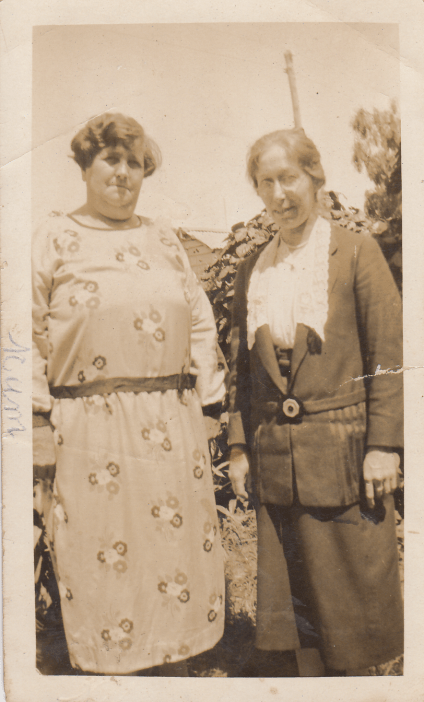
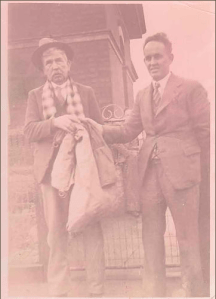
Above: Catherine Maher nee Costigan (left) with another woman and the inscription by Catherine’s granddaughter (Jean Hanson nee Ryan) on the verso reads Dear Grandma Maher and Auntie Nora.
Above: Sarah Ryan nee Maher (left) and Jean’s inscription is My Mum and Nora Fitz, whom Jean said was a Nora Fitzpatrick, but she couldn’t say for certain how she was related.

The background indicates to me that they might have been taken on the same day, and that day might have been in the late 1920s, since Catherine died in 1930.

A photograph we have of Catherine and Thomas Maher’s daughter Nora (Honora Curry nee Maher) appears to rule her out as a candidate. We can also rule out Honora Dwyer nee Maher, (above, sister of Catherine’s employer John Maher), as she died in 1890. While they seem to be two different women, there seems to be a resemblance between them.

Honora Maher and John Dwyer had a granddaughter named Honorah Mary Veronica Fitzpatrick (1894 Kilmore-1955 Wangaratta). On the dates, this may be a match for the ‘Nora Fitz’ in the photo on the right. Honorah Fitzpatrick’s mother’s dates fit (1848 Tipperary-1935 Tatura), however, her name was not Nora, she was Mary Anastasia Fitzpatrick (nee Dwyer). Jean may appears to have labelled the photos decades after they were taken, and it’s possible that her memory was not 100%, especially if contact with these other Mahers was very scarce.

If all this is true, it’s another piece of evidence to link the two Maher families, but still, we are no closer to knowing how the families fit together back in Tipperary. There is more digging to do.

If you have any information or photographs that might shed some light on this, or to confirm a relationship between these two Maher families I’d love to hear from you.

Tangental Families : The Dookie Mahers

Tangental Families : The Dookie Mahers

This family of in-laws referred to by our Mahers as the ‘Dookie Mahers’ turns out to have closer connections to Kilmore and Springfield than first thought.

Thomas Maher b. 1843 Castlefarm, Hospital, Limerick, Ire. ; d. 1917, Dookie, Vic.

m. 1881 St Patrick’s RC Church, Kilmore, Vic.

Margaret Theresa Scanlon b. 4 Apr 1858 Williamstown, Vic. ; parents Thomas SCANLON and Mary Ann BATCH; d. 14 Aug 1948 Kilmore, Vic. bur. Kilmore RC Cemetery
Death notices and obituary

Children

1. Mary MAHER b. 1880 Cashel, Vic. d.1971 Kilmore, Vic.
2. Catherine Frances MAHER b. 1883 Dookie, Vic.; d. 21 Sep 1956 Kilmore, Vic.; m. 1917 Kilmore, Vic. Roderick John ‘Rody’ MAHER
3. John MAHER b. 1885 Cashel, Vic.; d. 1931, Geelong, Vic.
4. Margaret MAHER b. 1887 Cashel, Vic.; d. 1970, Woodend, Vic.
5. Thomas MAHER b. 1889 Cashel, Vic.
6. Ann MAHER b. 1891 Cashel, Vic.; d. 1901, Tungamah, Vic.
7. Michael Dennis MAHER b. 1893 Cashel, Vic.; d. 22 Jan 1990 Sydney, NSW
8. Patrick Matthew MAHER b. 1896 Cashel, Vic.; d. 1974 Box Hill, Vic.
9. Peter MAHER b. 1897 Katandra, Vic.
10. Laurence MAHER b. 1899 Tungamah, Vic.; d. 1970 Carlton, Vic.
11. Joseph MAHER b. 1902 Tungamah, Vic.
12. Francis Paul MAHER b. 1902 Tungamah, Vic.

Margaret Theresa Scanlon’s sister, Mary Ann Elizabeth Scanlon was married to Patrick Buckley, father-in-law of Rody Maher, in 1876 at St Patrick’s, Kilmore.

Ann Maher, b. Cashel, Victoria, died in Tungamah, Victoria, as a result of an horrific farm accident. They were clearing scrub and burning wood in the paddock when an ember landed in her hair and she ran screaming to her mother, thus, unfortunately fanning the flames. Her mother, Margaret Maher, tried to roll her in a blanket, suffering burns to her arms, but the 11-year-old died. Both she and her father, Thomas Maher are buried in the Catholic cemetery out of Dookie. (Kathryn McCrudden, correspondence 2019)

 Place Note : Dookie and Cashel

Dookie is a rural township and district 27 km north-east of Shepparton in northern Victoria. The area east of Shepparton is mostly flat, irrigated farm land, but Dookie is set in undulating country with Mount Major to the south of Dookie township. … During the early 1870s farm selections were taken up and a township site at the foot of Mount Major was surveyed. It was named Dookie South, later Cashel, and adjoins the agricultural college. In 1886 the Dookie agricultural college was begun on the site of the Cashel Experimental Farm (1877) which grew a wide range of fruit, vegetables and cereals. Two years later the railway was extended from Shepparton to about 3 km north of Cashel. The town which formed around the station became Dookie. … The 1903 Australian handbook included a brief reference to Cashel: ‘Cashel (Dookie South) was once a thriving township the business and population having been transferred to Dookie’. Victorian Places

Whereis

 Notices, Headstone and Obituary: Margaret Theresa Maher

The death occurred at his residence, Dookie, on Friday last, of Mr Thomas Maher, at the age of 75 years. Deceased had been in indifferent health for some time, and although he had received medical attention in the city, and later at his home, the trouble, which was an internal one, could not be conquered, and he passed away as stated above. The late Mr Maher was a native of Limerick, Ireland, and came to Australia some 55 years. He took up land at Dookie about 40 years ago, and had resided here ever since. He leaves a wife and large family of grown-up sons and daughters. The funeral, which was a fairly lengthy one, took place on Sunday afternoon at the Dookie Cemetery, the service at the graveside being conducted by Rev. Father Rohan. The mortuary arrangements wore carried out by Messrs Alexander and Torgrimson.
(Dookie and Katamatite Recorder, 21 Jun 1917, p. 3)MAHER.-On August 14, at the residence of her daughter (Mrs.R.J. Maher), Chapel St., Kilmore, Margaret Teresa, the beloved wife of the late Thomas Maher, late of Dookie, and loving mother of Mary, Catherine (Mrs. R. J. Maher), John (dec.), Margaret (Mrs,. T. Collery), Thomas, Anne (dec.), Michael, Patrick, Peter, Lawrence, Paul and Joseph. In her 91st year.
(Kilmore Free Press, 19 Aug 1948, p. 4)MAHER. — Requiem Mass for the repose of the soul of the late Mrs MARGARET TERESA MAHER will be celebrated at St. Patrick’s Church. Kilmore, THIS DAY, at 9.30 a.m. The funeral will leave the church at 3 p.m, for the Kilmore Catholic Cemetery.— D1GGLE and MAHER
(The Age, 16 Aug 1948, p. 4)

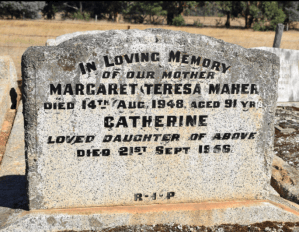
In loving memory of our mother Margaret Theresa Maher
died 14th Aug 1948 aged 91 ys
Catherine
loved daughter of above died 21st Sep 1956
RIP

The death of a very old identity of the Dookie and Kilmore districts in the person of Mrs Margaret Teresa Maher is announced with regret. The deceased was the widow of the late Thomas Maher and she passed away at the residence of her daughter, Mrs R.J. Maher, Chapel Street, Kilmore, on Saturday last, after an illness extending over several years.The late Mrs Maher, who was in her 91st year, was the third daughter of the late Thomas and Marie Ann Scanlon, of Springfield, well-known farmers in that district in the early days; her late father was previously a road contractor and resided at Geelong where the deceased was born. She came to Springfield as an infant and assisted her parents in farming pursuits and when a young woman married Thomas Maher, of Dookie, and they were pioneers of that district. There were 12 children of the union, two of whom predeceased her.On the death of her husband 31 years ago she carried on the farm at Dookie for some years and on retiring lived in Melbourne and Sydney for a number of years, coming to reside at Kilmore 9 years ago. The deceased was a wonderful mother, a great worker for her Church, and loved, and highly respected by all with whom she came in contact during her long lifetime.Left to mourn her loss are seven sons, Thomas (Sydney), Michael (Sydney), Patrick (Melbourne), Peter (Sydney), Lawrence (Melbourne), Paul (Sydney), Joseph (Melbourne), and three daughters, Mary (Sydney), Catherine (Mrs. R. J. Maher, Kilmore), Margaret (Mrs. S. Collery, Kerrie), together with 15 grandchildren and three great-grandchildren. A sister (Mrs. O’Rooke, Melbourne) also survives her.

After the celebration of Requiem Mass at St. Patrick’s Church, Kilmore, the remains were laid to rest in the Kilmore Catholic Cemetery and, the funeral was largely attended. Rev. Father Elliott officiated at the services and the mortuary arrangements were carried out by Diggle and Maher, Kilmore. The casket-bearers were Messrs. Joe Maher, Tom Maher, Michael Maher and L. Maher. Pall-bearers, Messrs. J. Collery, J. Ahearn, T. Scanlon, J. Scanlon, T. Collery and J. Collery.

(Kilmore Free Press, 19 Aug 1948, p. 8)

Place Note: Springfield, Goldie & Forbes

The Scanlons of Springfield

Thomas Scanlon b. 1825 Shanagolden, Limerick, Ireland; parents Bartholomew Scanlon and Catherine McMahon; d. 16 Dec 1882 Springfield, Vic.; bur. Kilmore, Vic.

m. 22 Jul 1855 Shanagolden, Limerick, Ireland

Mary Ann Batch b. 1834 Limerick, Ireland; parents John Batch & Mary Cope; d. 1874 Springfield, Vic.; bur. Kilmore, Vic.

1. Catherine Scanlon b. 1858; d. 1942 East Melbourne, Vic.
2. Margaret Theresa Scanlon b. 04 Apr 1858 Williamstown, Vic.; d. 14 Aug 1948 Kilmore, Vic.
3. Mary Ann Elizabeth Scanlon b. 1859 Williamstown, Vic.; d. 21 Aug 1923 Kyneton, Vic.
4. Sarah Scanlon b. 1860; d. 1893 Bendigo, Vic.
5. Patrick Scanlon b. 1864 Carlton, Vic.
(this child isn’t noted in the text below, but he is listed with father’s name Thos Scanlon and mother’s maiden name Bath)
6. Bartholomew Henry Scanlon b. 1864 Riddles Creek; d. 1943 Kilmore, Vic.
7. Unnamed Female Scanlon b. 1865 Gisborne, Vic.
(father’s name Thomas Scanlon, mother’s name Mary Batt – perhaps died as an infant?)
8. Nora Elizabeth Scanlon b. 1866; d. 1935 West Melbourne, Vic.
9. Thomas P Scanlon
(if his second name was Patrick he may have been the Patrick above)
10. John Scanlon b. 1870 Springfield, Vic.; d. 1945 Werribee, Vic.
11. Alice Priscilla Scanlon b. 1872 Goldie, Vic.; d. 1944 Melbourne, Vic.
12. Ellen Scanlon b. 1873 Goldie, Vic.; d.1960 Carlton, Vic.

Notes from Romsey: A Veritable Garden of Eden

This text is reproduced as published and may contain some factual errors

In 1825 Thomas Scanlon was born to Patrick and Mary Scanlon in Shanagolden, County Limerick, Ireland. Thomas married Mary Batch, who was born in Ballyhahill, County Limerick.

In June 1854 Thomas and Mary left Ireland for Melbourne on the John and Lucy, arriving in September 1854. It is likely they spent time on the goldfields, but by 1864 the Scanlons were living at Riddles Creek. Thomas worked for Samuel Amess as a stonemason, building the bridges on the Melbourne to Bendigo railway line.
During this time, Mary had eleven children. Firstly there were four daughters: Catherine, Mary Ann, Margaret and Sarah. The first son, Bartholomew was born while they lived in Riddles Creek. The family was completed by the arrivals of Honora, Thomas, John, Annie, Alice and Ellen.

Thomas and Mary and their children settled on a 50-acre block of land they called ‘Happy Valley’, in Springfield. Thomas constructed roads in the Springfield and Kilmore districts.

Bartholomew was only eighteen when he lost both his parents. He bought the property from his family and supported his siblings until they left home. Bartholomew and his brother John continued for a while in their father’s road construction business, but Bart lost a lot of money on the contract for blasting the ‘Gap’ on the Lancefield-Kilmore Road.

John married Ellen Keenan of the Post Office Hotel in Romsey, and ran this business for some years until he retired in 1936. A public-spirited man and an excellent sportsman, John was honorary secretary of the Romsey Amateur Turf Club and the Romsey Coursing Club for many years. He was also a committee member of the Romsey Mechanics’ Institute, the Waterworks Trust, the West Bourke Agricultural Society, the football club, the cricket club and the gun club, of which he was club champion.

A keen businessman with a great sense of humour, John was also a highly respected judge of horses and dogs, and he and his brother Tom were both excellent football players for Romsey.

Tom went to the Western Australian goldfields and later purchased a farming property in Western Australia.

Bart Scanlon bought more land in Springfield and became progressively more involved in stock dealing. While establishing the Scanlon dynasty in Springfield, Bart married Bridget O’Dwyer, the daughter of Edmund O’Dwyer, the Springfield Shire Treasurer.

Bart and Bridget had eight children: Molly, who married Percy Smith; Alice, who married Roy Parks; Tom, who married Madge Cummins; Ann, who was unmarried; Peg, who married Horrie Green; Biddy, who married Jack Irwin; Ned, who married Rose O’Connor; and Jack, who married Mary Linehan.

Bart died in 1943 aged seventy-nine, and Bridget died in 1952.

(Mitchell, Peter. Romsey: a Veritable Garden of Eden p. 280-282)

In part three of his ‘Reminiscences of an Old Road’ in 1939, James Alipius Maher wrote ‘On down in the region generally described as Lower Springfield, the names Scanlon and Quirk remain’.

Tom Maher’s Memories of Kilmore

Tom Maher’s Memories of Kilmore

This is an interview with Tom Maher (son of Rody Maher and Annie Buckley)
by Sister Pauline of St Joseph’s Convent, Kilmore, Victoria. The recording was made in 1978 and I transcribed it about 20 years ago.

Tom was involved with the Kilmore Historical Society and would speak to visiting groups of school children about early Kilmore, but when he got too elderly to do this Sr Pauline recorded an interview with him to use with the students.

Some parts of the recording were inaudible and Tom was elderly when the interview was done and so there are some gaps in the transcription.

SP: I’m just getting a project ready about Kilmore, Tom, and we want to see what you can remember about different things in Kilmore. First of all, where did the town get its name?

TM: There’s two Kilmores. There’s Kilmore in Ireland and Kilmore on the Isle of Skye, and my friends from Scotland didn’t know that until I told them. It’ s the Irish one that we got it from I think. It’s from Kilmore in Ireland.

SP:     Does it mean ‘big church’?

TM: Yes, and of course the first church here was St. Bridget’s that was out in Willowmavin and it was on a property that the Aherns had. There’s only the remains of it now. There’s just a heap of rubble and mould and a few old bluestones just to show where it was. I believe that the first mass here was celebrated by a priest going through on a property that Tom Sheehan had, it was then a hotel called …

SP: Doesn’t matter, you’ll think of it later. How many hotels were here, Tom?

TM: It was reputed that there were 52 in the district.

SP: How many hotels here?

TM: Officially it was 32, but then there was shanties all over the place. Where Dr Jayne recently came from up there in the new township, Powlett Street, that was the shanty on the road. It was only road traffic, you see, there was only tracks through here, there was no main road. And they went through about three different directions, three different ways that I can remember of anyhow, that I knew of. Eventually then when the main road opened up … Kilmore wasn’t intended to be built here at all on the situation where it is, it was out at Lake Logie, and there was only one building put up out there. Then as the people with the horses and the wagons came through the town, through what is the town now, they pulled up to water their horses down behind the post office. And as they did there were different places started to pop up and the result was that the town never went out to where it was originally intended by Rutledge, out to Rutledge’s survey. And that’s where Rutledge Street gets its name. As Kilmore got the butter factory there, the manager, Mr J.D. Ryan, he’s pointed out to be about 40 different farms around Willowmavin supplying milk and cream to the factory. But, as the families got larger they had to move on, the population was too big they couldn’t keep up to it. So Gavin Duffy was our Member of Parliament at the time and Kilmore East was known as Gavin Duffy Town and why they changed it I don’t know. But he was the Member of Parliament at the time and he brought in what was known as the Duffy Act and he opened up all the Goulburn Valley to settlers at pretty cheap rates and they started to expose people to the land and that’s why up around the Goulburn Valley and those areas Kilmore was so well known and everywhere you went the people knew of Kilmore. And all over Australia really. One chap recently I knew on holidays, he went up to Queensland, and he remarked he came from Kilmore, and this chap said ‘that’s where they have the trots and the races’. Kilmore is known everywhere, no matter where you go you’ll find somebody that knows somebody or something about Kilmore.

SP: Of course it’s very famous for Ned Kelly was born around here. Tell me what you can remember about Ned Kelly.

TM: Ned Kelly was born at Beveridge, only about a mile from where the old Beveridge church is now. He went to school, or whatever schooling he did (it wouldn’t be much at the time). But Kelly weren’t a bad fellow – he only did what most lads of the time did. They’d often take a horse that was there staying around the village for the night. And they’d plant it in the trees, hide it, and then in a day or two there’d be a pound reward or something like that, and they’d bring it out. Well that was the only thing they done. It was really the fault of the police that the Kellys went out. They were coming around and they were making a nuisance of themselves to Kate Kelly and Mrs Kelly, and one of them went to molest Kate Kelly and Mrs Kelly hit him with a shovel and then the police were down on them all. That forced the boys to go out. When they went out on the road, as they called it in those times, they were well looked after by all the people, because whatever they took – they didn’t take anything for themselves, and whatever they took they gave to the poor people. The banks they held up at those times, Jerilderee and Euroa, they never hurt anybody or done anything wrong in that way. In fact I’ve got a gun here that belonged to my brother and that was Sergent Kennedy’s gun who was in the affair at the Longback Ranges, where one of them was killed.

SP: That was Sergent Kennedy.

TM: Yes, it was Sergent Kennedy’s gun, and it was given to my brother. It’s still here, have you ever seen it?

SP: I think you showed me, yes.

TM: When they were on the road they never done anybody any harm. And this friend of mine who had a property out at … he was a hawker. He saw them and he knew they were in the district. He though when he saw them coming up the road ‘Well this is it, I’m going to be stuck up now’, but to his surprise they just pulled up and asked him if he had any tobacco. He said ‘Yes, how much to you want’, he said. They told him and he gave them what they wanted, and they threw him more money than paid for the tobacco.

A friend of mine and my father’s was a young man, he was only 16 when he went up around the Dookie area breaking in horses. There was a lot of horses tied up around the Ryan’s shanty. He was paying attention to one, looking at it, and a chap said to him ‘You seem to know that horse laddie’ and he said ‘Yes I think I broke that mare in for Tom Ryan’. He asked him in for a drink. He didn’t say he did break her in, he said he may have. So they went in for a drink, and Kelly, asked for a strong drink. The other fellow didn’t know what to ask for and he said ‘I’ll have the same’ and he said ‘No laddie you won’t’ and he got him a soft drink. And he didn’t know until after they’d gone that that was Ned Kelly that he was speaking to.

SP: And what happened towards the end of his life, Tom?

TM: No, it was all up around Glenrowan. There was a school teacher from Romsey was the man who tried to flag the train down, when they took the cannon on the train to Glenrowan when they had the shootout. It was reputed that there was a portion of his armour made here in Kilmore, at the old blacksmith shop, where that was, it’s demolished now, about three miles from here. I don’t know whether that’s correct or not, but it was reputed that the armour was made in different places.

SP: Now, Tom, your brother was a blacksmith. Tell us about him and how he started.

TM: He started working in … in the depression times and he worked very hard. He was taught by a man who was very good and he showed him a fair bit. He was such a good shoer that he was offered a job by the Victoria Racing Club as chief in charge of shoers and blacksmith on the racecourse. He done very good work with trotters. There was a horse over here from Sydney, he came over he accompanying another horse as a foal, and they brought him over again when he was racing. They had difficulty in getting him shod properly. Anyhow they got my brother to do him, and he went down to Flemington and he won the race. They offered him a trip to Sydney for a week, pay all his expenses and everything, and my brother declined. He was going over to the show, and I thought he was foolish, he didn’t take his gear and do the horse but he said he was on holiday and he didn’t want to do it. But he’d been a successful blacksmith here in Kilmore, he’s known practically all over Victoria.

SP: Is he still working?

TM: Yes, he does a little bit just to keep his hand in for friends who were good customers of his years ago. He leased the shop to another chap, but he doesn’t look after it, he just turns up occasionally, doesn’t work it at all. But my brother can’t get out of doing jobs for people who were good customers years ago.

SP: Yes. Tom, tell us a little bit about Whitburgh Cottage – that historical cottage. Do you know anything about that?

TM: The people who started that, Mr Smeaton, he came here, going through like a lot of others at the time. He pulled up on the corner of Powlett Street and … that’s right on the main road. He started doing a few jobs there and he eventually bought the property from there right up to Melbourne Street corner. He started on getting Whitburgh cottage built and he got one portion done first, and then added to it later.

SP: How did it get the name, Tom?

TM: I should think it might come from the Scottish people – it might have been a name from over there. There were Mrs Smeaton and the sons, and Mrs Smeaton reckoned that when she got the stove in the back portion … First of all, they had a kitchen, and they had what’s called a crane and they hang the kettle or whatever they’re cooking with on this crane and they swing it in and out. Mr Smeaton made this crane himself, and I think it’s worthwhile if you ever get the chance to go in and see it when it’s open on Sundays, and ask to have a look at this crane. He’s made it himself. I have a crane in my back yard, it’s not erected of course. This one of his has rather great workmanship because it can be raised or lowered as you wished. Most of them had a chain hanging down and they’d just work it on the chain, lower or higher the article they’re cooking in. When Mrs Smeaton, used to cook in a camp oven of course, then when she got the stove she reckoned she was made, you know. Whitburgh Cottage was eventually procured by the Historical Society, and it’s well worth a visit, especially for anybody who knows much about the earlier days.

SP: Tom, you tell me that you used to go down to Melbourne by horse, how long ago would that have been, do you remember?

TM: Well, when Mrs Morrissey was in hospital, she had a broken leg. Her leg was broken as she was coming home from Kilmore East after taking Mr Morrissey down to the train. She was in Koonara (?) Hospital out in St Kilda Road. It belonged to the Quinlans from Yea, and some of them had connections around Kilmore. We used to go down to see Mrs Morrissey on weekends, and we’d go down from Kilmore on the Saturday afternoon and go right into the centre of the city to the City Club Hotel.

SP: Was it horse or horse and buggy, Tom?

TM: Horse and jinker, and we’d stable the horse there. We’d get from here to right into the centre of the city in three and a quarter hours, and it was good for those times when you come to think of how it would take you that long to drive it sometimes in the traffic now. On the Sunday morning, rather than have the horse standing in the stable all the time, just on the hard bricks or whatever, we’d go in and get her and we’d go for a drive to where the shrine is now. We’d come back, put the horse away, feed her up, then on the Sunday evening after the evening cooled off (it was generally in the summertime then) we’d set home for Kilmore.

SP: What sort of roads were they, Tom, were they bitumen?

TM: No it was all metal roads. They called it McAdam, after McAdam the man who invented it, McAdam, a Scotsman. And we’d drive home to Kilmore.

SP: What year approximately would that have been, Tom.

TM: Somewhere about 1920. Whenever they were short of a driver for one of the fruit wagons, Mr Portbury’s father owned the business then (Mr Portbury’s still in Kilmore), they’d come and they’d get me. Mr Ashton used to drive the wagon with two horses in it and I’d drive one wagon with one horse in it. We’d take all the empties to Melbourne on Monday and we’d stay in the hotel, the Royal Saxon on Monday night, get up about two o’clock in the morning, Mr Ashton would do all the buying, and his daughter is married to my brother, Toc, the blacksmith. We would then load up and be ready to leave the market about 7 o’clock, and we’d set home for Kilmore. It was a big long drag all loaded up with vegetables. We’d get home to about Wallan that night and we’d stay at the Inverlochy Castle Hotel, it’s now demolished, there is a few remains showing where it was. The reason why we stayed that night was that Pretty Sally was a stiff hill in those times, and it was too much on the horses after the long drag from Melbourne to face the hill. So we’d get up early on the Wednesday morning and come into Kilmore. That was your fresh vegetables. And now – later on my two boys used to go down with the man that went down from here in a motor vehicle, go to Melbourne, leave here about midnight, go down, and they’d get the vegetables [and return] in the same morning. A bit of a difference to the times then.

SP: Tom, you were connected with the racing club. Tell us how it began and remember about it.

TM: Kilmore Racing Club was established long before Flemington. We had a few meetings and we had the Hibernians, of which I am a member, we held race meetings every year. The Hibernian race meeting was known as the Kilmore Steeple Chase and it was run over four miles. The big fences that were there then when I was a boy weren’t used when I was a boy, they were finished with but they were still remaining on the course. There was a low fence, paling fence and post and rail and a water jump (there were only two in Victoria, one in Flemington and one here but Flemington was later). When I was a boy Mr Morrissey always had an interest in a racehorse or two and I started looking after them as well as helping him in the shop. Of course I got riding horses on the track, and very keen on it. I was working at the racecourse by that stage, actually I worked 60 years without missing a meeting. I missed working one meeting because of an operation, but I was present at the meeting. I worked 59 out of the 60.

SP: That’s a great record, wasn’t it?

TM: It was mostly honorary those times. I was 44 years Clerk of Course, which is a record for Victoria so far, and mostly without any pay. Until one fellow was paid one time and the other man wasn’t the day I was on, and he jacked up on it and I was offered payment the next time.

SP: What was the duty of the Clerk of Course?

TM: The next day this chap, the secretary said to me, you can take pay if you like or you can give it back as a donation. I said that I’d let the other man go first and if he takes it I’ll take it. He took it and I took it and I’ve taken it ever since. The duty of the Clerk of Course, and the coat that I wear, or did wear is now about a hundred years old. My brother has a whip that belonged to the man that gave it to us, and it’s the same age. It was the whip of the hounds. There were two packs of hounds in Kilmore – a public one and then there was a private pack. The Clerk of Course gets the horses out of the stalls and into an assembling yard, takes them into the mounting yard, and takes them out of there down to the start stalls, or in my day that was an open barrier, and then the stalls came into being. Sometimes there would be nine races and you’d have to do it all on your own. Later on the VRC brought in a rule that there had to be two. I was so keen on the horses and being with them so much that I became an amateur rider. I rode in the central districts of Victoria, and I won the main amateur riders’ race in Victoria twice. During my time of riding, amateurs were not supposed to take money but they did. I found out some of the others did. But I never accepted a penny for riding from anybody, and I never during a race pulled a horse up for anyone, nor did I hit a horse. I got roasted a couple of times for not hitting, but I realised that when a horse was doing it’s best, there’s no point hitting it. As a matter of fact I was told, accused, by the police one day of pulling a horse up and I was trying for my life. He didn’t know that if I hit it, it would have stopped. It was moving at the time. It was a pony called Palaco, his father was Stickup and his mother was Clobber and he was called Palaco. If I’d hit that horse it would have lost – instead of losing by about a head or half a head he’d have lost by a length or more. I had a great time riding around the country … I would say this – that I am one of the only riders who rode against women in races. That happened at Kilmore and Pyalong. The most famous of them all was Mrs Murray who lost her life trying to save Garryowen. They both got burnt, and that’s why the Garryowen trophy got its name.

SP: Tell me, the coat you were talking about, do they still wear heavy a one like that?

TM: No, they don’t. They have a shorter coat. But the one I have is really outstanding as regards to work on it, you know, needlework. I tried to get one one time, but I couldn’t get one from around Australia at the time and I couldn’t get one from England. But it was a heavy coat, it was heavy in the summertime, but in the wintertime it withstood a lot of rain. To my knowledge there was only one man ever killed here at Kilmore in a race.

SP: Kilmore is one of the biggest racing places in Victoria

TM: Yes, racing and trotting. As a matter of fact I’m just reading now about the pacing cup coming up. It’s worth about thirty thousand dollars, trophies and a motor car, things like that … jewellery, things that are given to the owners of the winner.

SP: Tom, can you remember anything about that old gaol, down there near the state school, it was a gaol wasn’t it?

TM: It was a gaol. Some people would say that Kelly was in it, but he was never in it – his father was. It was only a gaol for about eleven years I think. It was sold then and eventually it was made into a butter factory. Mr J.J. Ryan, Geoff Ryan’s father – he was the manager and then he bought it, and it went for quite a few years. And then a — bought it and they were going to extend it — put all the men who were working there out of work.

SP: What about that monument?

TM: The monument up there, I had a lot to do with that. That was a sentry tower from the gaol and it was situated approximately behind, between the Presbyterian Church and the gaol. It was about fourteen foot six high and about six foot six square. There were windows to look out and you could go to the top of it. It was taken up there by volunteer labour. As a matter of fact the road that it was taken up on was built by soldiers after the First World War. I know very well because I carted the shovels and picks and things to them working on it. I know some of the men who worked on it, and they’ve gone now, those fellows. There were three men worked on that job, farmers and different ones. Mr Clancy was one of them, he carted material up. It was taken down brick by brick, bluestone by bluestone. It was marked, I don’t know how, and it was re-erected up there and used as a Hume and Hovel memorial.

SP: Did they actually pass over there?

TM: No they didn’t pass there, they passed nearby. The plaque is on the front. A few years ago when I was more active I used to go up there and keep it clean. It’s always messed up by vandals, rubbish around, and a target for bottles and things like that, even rifle shooting. The girls used to come up with me and clean it up. We did put a container up there but they used to empty the containers and make a mess around. Eventually we got the council to put up a very good container on a post and bolted and the vandals cut that padlock, and the beautiful drum that was there, that was taken.

SP: Senseless isn’t it? Can’t understand it.

TM: Some of the drums that we’d gave there had been rolled down the hill towards Kilmore East. I took lots of visitors up there and from that point you can see right up through to Bendigo, and you can see at the end of the ranges Mt Disappointment, right across to Mt Macedon. Everybody reckoned it was a wonderful view. Pretty Sally of course, you can see the traffic going along the main highway.

SP: What about that Mechanics’ Hall, Tom, what do they use that for?

TM: That’s not to be used.

SP: No, but it was used.

TM: It was used for years and years. I knew it had a library in the back but there were some great entertainments, dances and concerts and things held there. I won a competition there one time in bed-making.

SP: Good heavens, how did they do that?

TM: They had single beds there and they had the clothes to put on. Another thing I won there was a ladies’ hat dressing. I was pretty lucky I got an easy one to do and then you had to wear the hat. I was pretty lucky in sporting events.

(END OF SIDE A)

…that was built after St.Bridget’s, I suppose, in Willowmavin. When we were at St.Bridget’s there were about seventy-five pupils there.

SP: Who taught in it, Tom?

TM: I couldn’t tell you now.

SP: Not nuns or brothers.

TM: No, I don’t think so. I first started school in 1908 where you are now. That was just after my mother died. There was four boys. My father had a small property out there and we came into the town and he took on the mail contract from Kilmore to Lancefield. That was three days a week by horse drawn vehicle. We had to walk to school in those days, there were no buses or no school buses, no rides, nobody came to pick you up when it was wet. When my two boys started school Sr. Barbara, now Sr. Pauline taught them at school. After my mother died I went down for a while with my auntie to South Melbourne. I went to the nuns there for a while. My cousin stayed with my father and when he wanted to go to Melbourne to work, he was an apprentice saddler, he went down there and I came back home.

SP: What about that little brick place that used to be a school up near the church, Tom, wasn’t there a school up there?

TM: The bluestone, that was the old school that I went to there – two big rooms.

SP: Is that where you started or where you finished?

TM: No, I started down there … [meaning St.Bridget’s]

SP: … at the convent, and then the Brothers had that building, I see.

TM: The sisters were in the big buildings where the College is now, and later on when the changeover came the brothers had the buildings and they also had what we call the St.Pat’s – the bluestone buildings, two big rooms.

SP: Tom, tell us what you remember about Hume and Hovel.

TM: Hume and Hovel set out from Sydney or thereabouts to try and find Port Phillip or Westernport Bay. They travelled across country. The first I can remember of them was Mansfield and Euroa, and there’s camps at the different places showing where they passed nearby. That’s why the Hume and Hovel monument is built there because they didn’t pass close by but they passed within tow or three mile of it. Wandong, I believe, was called Hume’s Gap and I don’t know why they changed that. Anyhow they were criss-crossing as they travelled along. They crossed one creek on a Sunday and they called it the Sunday Creek, and it’s still known as the Sunday Creek. It flows into the Goulburn. They passed another creek and it was dry, there must have been a drought because they called it the Dry Creek. There were two Dry Creeks that I know of, there was the Dry Creek near Kilmore East and I’ve only known it to stop once. The other one is up in the mountains. As they were travelling along they got to the top of the mountains where we get our water supply from and they travelled along to the end of it. They should have been able to, with their … glasses, to have seen the Bay or Westernport Bay. It must have been a hazy day because they couldn’t see it and that’s why they called it Mt. Disappointment. They crossed from there to the hills just below between Beveridge and Wallan. They climbed that, and they couldn’t see anything from there and they headed out across country, and they came out at Corio Bay. They called one creek there that is now known as Hovel’s Creek and you’ll see a cairn or two along the road as you go down that way, if you’re going to Geelong. They weren’t very far out in their estimations after all that distance to get so close to Westernport Bay as what they did. I can’t remember much more about that.

SP: Can you remember the names of any other places that were named after the

SP: Where did Burke and Wills go Tom?

TM: No, I don’t know. There was a lot of timber brought in from the Mt. Disappointment area and it was cut up on the saw-mills out there. After the disastrous bushfires of 1939 they brought it in the logs and milled it in Broadford. Every other town was the same, they had to have dugouts and things like that. In fact my cousin was working at the mill and he was on holidays, and every one of his mates got burnt to death. He was brought back to try and identify them. I had a friend, she got so hot, she got into the waterhole, the dam that was near the house. The water got so hot they had to get out of it.

SP: Tom, can you remember how the priests used to travel in the early days?

TM: By horseback?

SP: Do you remember any of the priests?

TM: No.

SP: Was that around your time?

TM: They travelled fifty kilometres to get to Lancefield and Baynton. I think I might have a book on it or something there …

SP: How far, what radius would they have come? Lancefield would have been the furthest, would it?

TM: No Baynton was further. They used to say masses in private houses out in … places like that, the outlying places. They travelled in horseback. Then when Fr. Martin got the motor buggy, when we were kids, sometimes we’d have to give him a push up the road. The noise, you could hear it rattling, it used to frighten all the horses about the place. Tommy Kelly was driving it, he was the altar boy who worked around the church, rang the bell, which is not ringing nowadays, he rang it twelve, twelve, six or twelve and you could set your watch by that. You could hear that bell – I know that I’ve heard it about nine miles out. He was going with Tommy Kelly to say mass at Darraweit Guim when the motor buggy was a bit top-heavy and it overturned. The steering wheel pinned Tommy Kelly down and Fr. Martin got away. He tried to lift the motor buggy off him. He could only ease it but it weighed so much he had to let it down again and Tommy Kelly was killed. He is buried in the Kilmore cemetery.

SP: What relation was he to Tommy Kelly that we’ve got? Is Tommy Kelly related to him?

TM: No, no relation. Fr. Martin became Dean Martin afterwards. He was our parish priest. He reckoned he’d never have another motor vehicle, but of course as time progressed he’d be like everybody else and get another one – a motor vehicle.

I remember an old couple who had a building that’s on the corner of Rutledge Street and Powlett Street – it’s on the south side. Cregans was their name, they were an Irish couple. He was a bootmaker. When the First World War was started, he read it out of the paper. His wife said to him, ‘Oh John wouldn’t it be a terrible thing if the Britons invaded Australia’. Another old lady, she used to ask us as we were coming from school how the war was going. I Kilmore we had about twelve or fourteen cadets, and they were only school age. One of those kids was a bit of a wag and he said ‘oh, the Germans are out at Bylands’. She said ‘Oh, the cadets will stop them’. The brothers had a boat up on the reservoir. The chain was broken.

SP: Tom, tell me something about the hospital, was it always there?

TM: Yes it was, as far as I know it was. One of our priests, Fr. Clarke was one of the main ones I think that started getting a hospital started here in Kilmore. His name is on the memorial ward up at the hospital now.

SP: Wasn’t there a priest that had his hand blown off in some accident?

TM: Oh yes, I was coming home from Melbourne. I was riding a horse down the road and poor old Fr. Gleeson, he was a very … man Fr. Gleeson. He had a detonator and he had a nail or something and he was prising it and it blew off and blew his hand off.

SP: And there was something about his journey to Melbourne, who took him down?

TM: I don’t know who took him down, but I drove the first ambulance in Kilmore. It was a horse-drawn ambulance, no motor vehicle, I couldn’t drive one then. But every time anything would happen the police would come down and get me. I’d get nothing for it, it was a thank-you job. I’d have to drive this horse that was kept at the livery stables.

SP: Where was that, Tom?

TM: Down where Putkers Bakery is, and next door was a photographer’s. there was about five blacksmith shops and a goat … and a coach painter when I was young, and four or five bakers. You could get a loaf of bread for eleven pence those days.

SP: What about the fire brigade, Tom, were you connected with that?

TM: Yes, I was twenty-five years in the fire brigade. I had a long-service medal for that.

SP: And was that a horse-drawn thing too?

TM: No, it was manpower. We’d be generally knocked-up by the time we got there, and the water would hardly trickle through the hose.

SP: Why couldn’t they get a horse to pull it, Tom?

TM: We did when … came about. We tried sitting in a motor vehicle and holding it and dragging it that way, but it was so fast it nearly rattled the wheels off.

SP: But why didn’t the have horses?

TM: It would mean somebody keeping a horse and looking after it all the time.

SP: And how many men would pull the …

TM: However many turned up. There could be half a dozen of us or more. It had ladders on it, and it had buckets on it – little buckets they were.

SP: How much water would you carry?

TM: No water, you just had to take a chance on what was in the …

SP: How would they manage about bushfires and things like that?

TM: I saw my father and others go out to a bushfire and they had to break branches off trees and do the best they could. And by the time they got out to a bushfire, it had gone miles. One fire I remember, it went right down to Darraweit Guim and then the wind changed and it came back right alongside the same area that it went down. Things were difficult then. If you got a wet bag, if you were lucky, it’d soon dry from the heat. They’d only break branches and beat it as best they could. Things have changed now.

SP: Yes, they certainly have.

TM: I’d forgotten some things that I’d like to tell you about. I hope you’ve enjoyed these few words I’ve had to say. When I was fit enough to go round with you and some of the girls, I really enjoyed it. They seemed to enjoy the talks and whatever I showed them. So I wish you all well and hope you are obedient at school. So goodbye, Tom Maher.

Anvil Chorus Ends for ‘Toc’

Anvil Chorus Ends for ‘Toc’

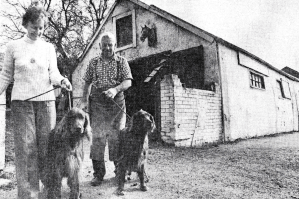
This article by Roger Sanders appeared in The Sun on 11 June 1975 and features Patrick Francis ‘Tock’ Maher (1903-2000), son of Rody Maher and Annie Buckley.

Pat “Toc” Maher, Kilmore’s landmark blacksmith, has hung up his apron for the last time.

“I’d say that 58 years in the game is long enough,” he said as he looked around his earthen-floor shop in the town’s main street.

“I’ll still potter about a bit and look after some stud horses, but generally I’ll take things easy.”

Toc, 71, has had the smithy’s shop with the plaster horse’s head over the door for 40 years.

He left Kilmore College at 13 to work for the previous owner Charlie Stray, a general blacksmith and wheelwright.

“In those days we charged seven shillings to shoe a horse and four bob for removes (removing shoes, trimming hooves and replacing the same shoes),” he said.

“Nowadays the charges are $12 and $10 for a pacer or trotter and a little bit less for a hack or pony.”

Toc, who can still swing a hammer with the best of them, can remember when up to 20 horses were waiting in the yard for shoes.

“We used to get a lot of customers of the highway before trucks and cars took over,” he said.

“A lot of them were furniture drays on their way to the bush from Melbourne.”

A big man, Toc is as well known in Kilmore, 60 kilometres (37 miles) north of Melbourne, as his white cement smithy’s shop.

He has been a member of the town fire brigade for 45 years, 20 of them as captain, and a member of the Kilmore Water Trust for 30 years.

He is also on the committee of Kilmore Racing Club and Kilmore Agricultural Society.

Although retired from his old forge and anvil, Toc still tends horses one day a week at Mr and Mrs Geoffrey Levitt’s Willowmavin Stud, near Kilmore.

One of his charges is the New Zealand-bred filly Philomel, which won the Hallam Handicap at Moonee Valley on May 31.

He also keeps a close watch on the 100 other thoroughbreds on the stud.

Toc has never shod a Melbourne Cup winner in the thousands of horses he has handled, but he has looked after horses for visiting royalty.

And until recently he and an assistant kept many of Melbourne’s milk cart horses on the road.

Now Toc will have more time to spend with his wife Hilda and their two dogs.

The busy ring of his anvil will still be heard in Kilmore, but from now on it will be a younger man wielding the hammer.

58 Years at the Track

58 Years at the Track

This article appeared in the Weekly Times, 3 July 1974 and features Thomas Michael Maher (1902-1978), son of Rody and Annie (nee Buckley) Maher.

Tom Maher, a groundsman for Kilmore Turf Club, would be tipped as a good stayer in anyone’s book. He started work at the race club in 1916 when only a lad and he’s still working there, 58 years later.

During that time, Tom has helped out as time-keeper and assistant judge, among other things, and he used to ride in pony races at the club years ago.

He worked on the scratching board until 1926, then took over as Clerk of Course, and continued in this position for the next 44 years, missing only one meeting during that time because of an operation. He did the job in an honorary capacity for the first 30 years. He retired in 1970, and the club had reserved a job for him on the gate in the mounting yard.

Tom was born at Springfield, near Kilmore. His father carried the mail from Kilmore to Lancefield for 33 years in a horse-drawn vehicle. Tom’s mother died when he was five, and at 14 he started work in Morrissey’s hardware and timber shop.

Tom rode track work for his boss, who had an interest in Synvanmore, and who owned several other race horses. The first race he won was a hack race at Kilmore. Other wins included the Richmond Cup at Caulfield, Coongy Handicap and Bagot Handicap.

Tom later trained as a hobby and rode as an amateur around the central district of Victoria, and thinks he would have been the last amateur to ride among the pros at Hanging Rock.

“I never accepted payment or pulled a horse,” Tom will tell you. “I once had to put up 42 pounds dead weight. I was nine stone and had to make up three stone, so I bought a lead weight.

“When I used to ride at Heathcote in the depression years I had to ride 30 miles home after the race, as there was no other means of getting there.”

A highlight of Tom Maher’s long association with Kilmore Turf Club came in 1973, when he was made an honorary life member in recognition of his service to the club.

Mr Maher owned a horse called Molineaux at one time. “It won at Moorfield three years in succession, and also won the Sunbury Trial Hurdle,” he recalls.

He’s a 50 cent bettor, and says he has a good bank balance from betting. “I keep my sporting kitty separate from my housekeeping money. My longest odds has been in doubles,” he saus.

“A lot of chaps who are riding now – well, I knew their fathers as apprentices. I’ve led in some famous jockeys too – including Billy Duncan, Bill Williamson, and Jack Purtell, who is the most gentlemanly man I’ve ever met on the turf.”

Mr Maher remembers the days when they used to have picnic races at Springfield, a big steeple-chase with a water jump at Kilmore, and a Kilmore Grand National run over four miles.

“There’s a lot of talk about women riders these days, but they’re not new,” says Mr Maher. “We had some jolly good women riders back in the old days, the most notable being the late Mrs Violet Murrell, and Mrs Spiers.”

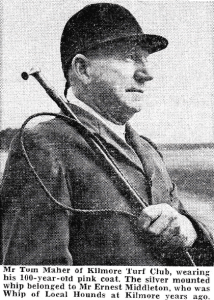
Mr Maher is proud of his pink coat, which he thinks must be 100 years old. It was given to him by Mr Ernest Middleton, who was the Whip of Local Hounds in the days when Kilmore had a hunt club, before the turn of the century.

“Mr Middleton’s father wore it before him, so that would make it about 100, and it’s still in good condition,” said Mr Maher. He is also the proud possessor of Mr Middleton’s whip.

Murder at Epping

Murder at Epping

bwcommonheath Catherine Maher (nee Costigan) (my gg grandmother) was a witness to a murder that occurred at Epping in 1858. An inquest was not held until February 1864, after the victim’s body was discovered. Catherine, by then married and living at Lancefield, testified at the inquest.

The scene of the murder was the Traveller’s Rest Hotel, Epping. The proprietors of the hotel were Patrick and Sarah Burke, the accused was Patrick’s brother, Batholomew (‘Bartley’) Burke who was alleged to have murdered his wife Mary. Bartholomew, a labourer, and Mary had three young children and resided in a tent next to the hotel. In 1858 Catherine Costigan was a servant for John and Margaret Maher. John was a wheelwright who rented a house and paddock from Patrick Burke for his family and business. The house was next to the hotel and close to the tent.

In 1858 Mary disappeared and Bartley Burke had told everyone that he had paid her passage to Sydney. He continued to live in the tent for several weeks and, after leaving the children in the care of friends and relatives he moved on himself.

In February 1864 a detective named Williams, acting upon information he’d received, found the remains of Mary Burke on the former site of the tent. Patrick Burke and his son Martin were charged with being accessories and an inquest into the death was held at Northcote later that month. Catherine’s testimony concerned her having heard and seen what may have been the fatal shooting.

The Leader, 20 Feb 1864, p.6

THE EPPING MURDER.

Catherine Maher, a married woman, residing at Lancefield, deposed: I recollect residing with John Maher, at Epping, about five years ago, as a servant. He rented the piece of land his house was then on from Patrick Burke, the landlord of the Travellers’ Home Hotel. The house might be about thirty yards from the hotel, and was on the same side of the road. I knew Bartley Burke and his wife, as they lived in a tent just outside the back corner of Mr Maher’s house. The tent could be seen quite clearly from the house. One night, after ten o’clock, I heard the report of firearms in the direction of Burke’s tent, whilst I was going out of the back door of the house. The night was dark. I distinctly saw the flash of the gun. The report I heard almost simultaneous with it. There was no one with me at the back door at the time, Mr and Mrs Maher being in the house, but in a minute or so afterwards, as I was turning to go into the house, the latter came out beside me. When I went inside they both asked me where the shot had been fired, and I replied about Burke’s tent. Previous to that night I was constantly in the habit of seeing Mary Burke about the tent, but never saw her afterwards. Burke remained at the tent between six and seven weeks afterwards. On the next, morning after the shot was fired, Patrick Burke, the hotelkeeper and his wife went away in their gig towards Melbourne. Could not tell what particular dress Mary Burke wore or the color of her hair. On one occasion saw, her beaten by her husband. She seemed at that time to be, a little groggy. About a minute before the report of the gun I heard a person near the tent exclaim ‘look out.” I heard no screaming, however, either before or after the report. The tent contained no separate apartments. The chimney attached to it was built of stone. On the morning after the shot, the second child came to me and said that her father told her he had sent her mother off to Sydney. There were three children the, eldest I think was about eight years of age. I had no conversation with them afterwards upon the subject. To Inspector Bookey : I had no conversation with Mrs Patrick Burke about what evidence I was to give. To, the Jury : I never saw, Bartley Burke with firearms in his hands. The day after the shot was fired was not a Sunday, The tent remained up about a month after that.

John and Margaret Maher also gave evidence at the inquest …

John Maher, a wheelwright, residing : at Epping, deposed: I rented a paddock and house near Patrick Burke’s hotel, from 1855 till some time in 1862. I recollected Bartley Burke and his wife, living near my place in a tent. I often saw the latter, but did not know her Christian name. On one occasion, late at night, I heard a shot fired near their tent, as I was in bed. I did not make any inquiries at the time or afterwards regarding the shot ; it had become impressed in my memory from the fact that it was rather a late hour to go opossum shooting. I never saw Mary Burke afterwards, but I saw her husband frequently. He remained about the place for some weeks, but how many I do not exactly remember. Some days previous to the shot being fired, Burke and his wife had a quarrel at my place. Burke struck her with a stick of some kind, upon which I separated them, putting him out of the house. Where the blow was struck I cannot tell, it is too long since then.. Burke’s tent was situated about the place where the bones were found. I have not seen him within the last three years. I frequently saw him with a gun, but of what description I cannot remember.

Margaret Maher, wife of the preceding witness, deposed: I recollect living near Patrick Burke’s hotel, about six years ago and remember a tent nearby occupied by Bartholomew Burke and his wife. One night, about ten o’clock, I heard the report of a gun, near the tent, the night was dark and I saw the flash of the gun very distinctly. I remember the shot, because it was so near the tent. I was in the habit of seeing Mrs Burke almost daily, but I did not see her for two days before the shot was fired. Never saw her afterwards. I had some conversation with the second youngest child on the morning afterwards, I asked the child if her mother was at home, when she replied that her father had sent her to Sydney that morning. Mrs Burke left the place before, but she then called in and bade me good bye. On one occasion she had a few words in my place with her husband, who struck her with a stick. She was then a little groggy, but he seemed quite sober. Heard, no words near the tent before or after the report of the gun. There was no light in the tent at the time. It remained standing for two or three weeks afterwards. I saw Burke between eight and nine o’clock on the morning after the shot was fired, going from his own tent to the public-house. I afterwards saw him return to the tent. Patrick Burke and his wife had left in their gig for Melbourne, before that. Mary Burke’s hair was either brown or black, and very long, but whether it was ever plaited or not I could not tell.

After several days of evidence from about ten witnesses, a jury verdict was delivered …

The jury, without retiring, unanimously agreed upon the following verdict :— “That, on or about the 19th of September, 1858, at Woolert, Mary Burke died from violence, inflicted upon her by her husband Bartholomew Burke. We find the said Bartholomew Burke guilty of the wilful murder of the said Mary Burke.”

After the inquest the search was on for Bartley Burke …

Geelong Advertiser, 29 February 1864, p.2

A reward of one hundred pounds is offered in Friday night’s Gazette, for the apprehension and conviction of Bartholomew Burke, charged with the wilful murder of his wife, Mary Burke, on or about the 9th September, 1853 The following is given as the description of the man Bartholomew Burke—Irish, aged about 43, 5 feet 7 or 8 inches high, medium build, dark complexion, hair, whisker and moustache, probably now turning grey; formerly a soldier in H.M. 40th regiment at Melbourne, acting as officers’ servant, discharged in 1857. He afterwards lived with his wife at Gisborne or Kyneton. About 1860 he worked at Kew for two contractors, named respectively Morgan and Sobie, being then known by the name of Moore. In 1849 (? 1S59) he worked at Gardiner and Cheltenham under two contractors, named respectively Dwyer and Malone, at the time when one George Oldham was murdered there by one Regain About two years ago he was at work stone breaking near the Plough Inn, Plenty-road. His general appearance is that of a labourer. During his military service he was for some time employed on escort duty.

Kyneton Observer, 29 March 1864, p.2

Considerable difficulty seems to be experienced in coming, across the whereabouts of the missing Bartholomew Burke, the supposed Epping murderer. Scarcely a day passes but some one is apprehended who is fancied to answer the description, and, as a matter of course, shortly after discharged ~ but it seems hard that this should be the law, as many innocent persons may thereby have their characters materially damaged.

He was found in December 1864 in Tasmania, and further charged with absconding …

Mercury (Hobart), 19 December 1864, p.2
ABSCONDING – John Burke alias Bartholomew Burke alias Moore, charged upon his own confession with a murder committed in Victoria, was discharged, a further charge of absconding in June 1851, was preferred against him and he was remanded for examination to the 22nd inst.
The inquest was widely reported on and these reports can be found on the Trove Newspapers website.
Jack’s Unlucky Break

Jack’s Unlucky Break

This article by Mark Nunan of the Seymour Telegraph appeared on 22 May 1996. Uncle Jack (my grand-uncle Roderick John Maher, son of Rody Maher and Annie Buckley) was a Carlton supporter all his life.

bwcommonheath

At ninety-two years of age, Jack Maher can still vividly remember the day when his VFL career ended before it began.
A Carlton recruit of considerable talent, Maher broke his right leg in two places during the final practice match before the regular season of 1925.
“I can remember kicking four goals before I broke my leg,” said Maher. “But I was being pretty well looked after by (then captain) Pat Kennedy. He was giving me a lot of the ball.”
Reflecting of taking six months to recover from his severe leg break, Maher said pensively: “I never went down there again after that.”
The other matter which contributed to Jack never playing VFL football, was his job on the railways, which he held for 46 years.
“Working on the railways my employment came before my football,” said Jack.
“At times I would be all over the state, up at Benalla or Yarrawonga, all over the place.”
At the time, less than a decade after the cessation of the First World War, Maher had already forged a reputation as a champion left foot goal kicker with the Seymour Football Club.
In 1926, after sitting on the sidelines for the entire 1925 season, Maher resumed with Seymour and kicked 12 goals in his first match back against Yea. In his next two games he kicked bags of eight and seven goals, taking the three-game total to 27.
Jack is quite confident that he is the oldest living member of the Seymour Football Club, having taken over the mantle when Percy Ballantine passed away three or four years ago.
He spent 15 years of his life playing for Seymour, between 1920-1935.
Despite never having played a game with Carlton, his loyalty for the club has stretched over three-quarters of a century.
“It would be an understatement to say I was wrapped to see them win the flag last year,” said Jack.

bwcommonheath

Popular Mailman

Popular Mailman

This article appeared in the Kilmore Free Press on 7 July 1838 (page 2) on the retirement of Rody Maher (my great grandfather) as mail contractor between Kilmore and Lancefield.

bwcommonheath

On Wednesday afternoon last week at the residence of Mr and Mrs Stockfeld, at “The Gap”, on the Kilmore-Lancefield Road, there being a gathering of residents of the Springfield, Mt William and Lancefield district, who met to do honour to Mr Roderick (“Rody”) Maher, who was making his last trip on the mail route from Lancefield to Kilmore, via Springfield. Despite the cold and showery nature of the day, there was a very representative attendance of about 50 persons present – a definite testimony to the popularity of Mr Maher.

Mr M. Clement, of Springfield, referred to the wonderful services and many kindnesses rendered by Mr Maher during his term, in which he travelled about 250,000 miles; and he then called on Dr Wilson to speak on behalf of the residents.

Dr Wilson said they all felt a certain amount of regret at parting with the services of their old friend Rody Maher, but he was pleased to have the honour of making the presentation. He was possibly the oldest friend of Rody, as they were boys together about 60 years before at Tickawarra school. His recollections of Rody were the happiest and most cheerful, and he recalled the Rody was a magnificent footballer. He had been on the track for 30 years, during which time he rendered services which would never be equalled for the courtesy, consideration, kindness and many little acts done for the people along the track. He had done wonderful service. In wet, sunshine or shadow, he was always punctual, and every obligation was always cheerfully carried out. He (Dr Wilson) had the pleasing duty of handing him a wallet of notes subscribed by the residents, not as a reward for many kindnesses, but as a token of regard felt for him, and as a slight recompense for all he had done for them. (Applause)

Mr Maher said that when he started on the job he fully intended to carry it out to the best of his ability. His work had never been questioned by the Postal Department. He also tried to do all he could to oblige the people on the route. He thanked the residents of Springfield, Mt William and Lancefield for all the kindness they had shown to him, and all postal officials for their treatment. He specially thanked Mr and Mrs Brazier, of “High Park”, who always had a warm lunch for him; the business people of Lancefield, who had never delayed him; and Mr and Mrs Heald who had treated him as one of their own. A lot of respect was due to Mrs Stockfeld, who looked after the goods for the Mt William people. If ever she left, he hoped the residents would gather as they had that day, and he would be there. He thanked them all sincerely. (Applause)

Prior to the above ceremony, an excellent afternoon tea was enjoyed by all present; and, afterwards, all stood and drank the health of Mr Maher, with musical honours.

“Mercury”

bwcommonheath

Esteemed local historian James Alipius Maher penned a series of articles entitled ‘Reminiscences of an Old Road’, published in the Kilmore Free Press in March 1939 about the Kilmore-Lancefield Road. Part one discusses Rody Maher and other mail contractors who carried out the service before the advent of the railway.