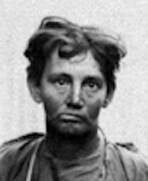
Many hardworking, law-abiding ancestors have lived their lives leaving behind a sparse and unremarkable trail of records, and often no images. My great-grandmother Florence Rosaleigh Mary Webster was not one of these people. The details of her early life are a little hazy, but her descent into vagrancy, alcoholism and petty crime kept Brisbane law enforcement and court reporters occupied for over two decades.

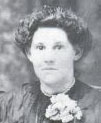  |
Florence’s life began near Caboolture, Queensland in an area ironically called Downfall Creek. Now a part of Chermside West, it was possibly named in 1843 by missionary and farmer Carl Friedrich Gerler (1817-1894) when a bullock dray broke down there while establishing a mission outstation at Caboolture.
Her father, George Thomas Webster, had been born in Maldon, Victoria, where his father Joseph searched for gold. Joseph and Elizabeth Webster moved their family to Queensland in around 1867 and farmed at Downfall Creek and later at Kilcoy. The year 1867 coincides with reports of gold having been discovered in the area, so no doubt he Joseph Webster made some efforts in that regard as well.
On 16 May 1883 at the Methodist Church in Ann Street, Brisbane, George married 16-year-old Alice Jane Payne. Alice was born in Birtsmorten, Worcestershire, and had migrated to Australia with her parents at the age of 10. At the time of the marriage, George was a 22-year-old labourer of Downfall Creek, and Alice was a resident of South Brisbane, so how the two became acquainted is unknown.
George and Alice’s firstborn was a boy named William Joseph, born on 18 June 1884, but he died only 40 days later on 28 July, and was buried at Lutwyche Cemetery. Next came George ‘Victor’, born 1885, then Florence Rosaleigh Mary in 1886, then George Arthur in 1889.
| A little boy, aged three years, named Victor Webster, was drowned in a well on Tuesday at Downfall Creek. The lad was on a visit to his aunt, and between 11 and 12 o’clock he was missed. His aunt called him, but getting no answer she went outside and looked down the well in the back yard. There she saw bubbles coming to the surface, shortly followed by the boy’s head. She immediately ran to where her father was working, a distance of about one mile. When he arrived he took the body out of the well. The well was roughly covered by a few slabs. An enquiry will be held.The Week (Brisbane, Qld.), 2 Nov 1889, p. 11. |
The aunt was Ada, she was 13 years of age at the time, her mother Elizabeth was visiting Sandgate, and before she left she had instructed Ada to ‘take care of the children’ (how many she was taking care of is not mentioned any of the reports). Nor do any reports mention George Snr or Alice, but one can only imagine the loss of this boy to be devastating for all concerned. Florence was three years old at the time and Alice was weeks away from giving birth to George Arthur. The inquest ruling was accidental death and Victor was buried at Lutwyche Cemetery with his brother.
What became of Florence’s father after this time is uncertain. Some Ancestry family trees have him passing away at the Dunwich Asylum in 1920, though there doesn’t seem to be any evidence for this. He seems to have disappeared by the late 1890s. Alice had two further daughters Edith Payne Osborne (1897) and Laura Osborne (1901), and would later wed their father, William George Osborne in 1908. On that marriage certificate Alice declared she was a widow living at Charlotte Street, Brisbane.
By this time Florence had met and married John William Kyling, a labourer from Warwick in the Darling Downs region, where his German immigrant parents were hotel keepers.
Their first child John Henry Kyling was born in October 1905 and John and Florence married the following month. This photograph from the christening was published in the Queenslander in March 1906 and shows five generations: Elizabeth Carseldine (nee Payne) (middle left), Mary Alsop (nee Kendrick) (middle right), Alice Osborne (nee Payne) (left), Florence Kyling (nee Webster) (right), and baby John Henry Kyling.
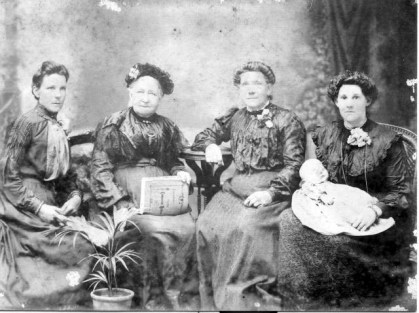
In 1908, at the age of three, John Henry died of measles and bronchopneumonia and was buried at Toowong. On the death certificate, John was listed as a wharf worker and the couple were living at Warren Street, Fortitude Valley. Two girls followed, Marie Alice Caroline (my grandmother) in 1909 and Mervis Florence Irene (pronounced Mavis) in 1911.
In the 1913 electoral roll John and Florence were living at Stanley and Peel Street, Brisbane South, and John was working as a salesman. In June the same year the final child was born, but something was wrong. He was registered as Charles Allen Arthur Kyling with no father listed. In fact, the certificate has the word ‘illegitimate’ written across under the father’s details section. Florence was 24 years of age and living at ‘Stephens Street West End’ (South Brisbane). I cannot find what happened to this child, and I assume he was adopted. I wonder whether he might have tried to find his mother later on, as someone has written in pencil ‘D. 1951’ next to her name on the original birth certificate.
In 1917 Florence’s remaining brother, George Arthur Webster, was killed in Begium fighting with the 9th Battalion, leaving his widow Augusta Elizabeth Madeline (nee Hoffman) and four young children.
In 1919 John had commenced working as a coach painter and was living at Melville Terrace, Wynnum with a woman named Anna Kruger. In 1925 and all the way through to John’s death in 1947 Anna appears as Annie Kyling in the electoral rolls. As the informant on John’s death certificate, she appears as ‘Annie Kruger, no relation’.
Florence appeared in the electoral roll in 1925 at Kingsley Terrace, Wynnum, then not again until 1949 when she was at Eventide Home.
In the intervening 24 years Florence, was homeless, and is noted in newspaper reports as having camped at Victoria Park and Anzac Park, Toowong, and occasionally sleeping in vacant houses. She went before the court on at least 26 occasions under her maiden name, usually receiving a short sentence of less than six months. Charges were mostly for theft, trespass and vagrancy, and one charge of unlawful assault when she was confronted by an angry house occupant in 1933. She carried out her offending in areas such Spring Hill, Brisbane, Kedron, Fortitude Valley. It would be safe to say that she committed many more crimes than those she was charged with, as from the timing of the court visits that she would reoffend almost immediately upon release from gaol, and sometimes when her ‘camp’ was searched she would be found with other items obviously stolen.
She would take anything she could lay her hands on, hiding as many small as items as she could inside her clothing. Cash, watches, silverware, jewellery, bicycles, all of which (unless she was caught with them) would be sold to her cohorts or pawned for money to buy food and alcohol. Her modus operandi was to enter houses alone during the day when either the occupants were out or when occupants were at the rear of the house, and enter through a window or unlocked door. At one stage she engaged in a door knocking campaign to beg for money and entering those houses where she received no response to her knock.
Senior Constable D. McGrath of the City Police Court, acted as prosecutor for at least a dozen of Florences court appearances. He had an extensive record of presenting such cases in court, and there were many, many petty criminals he saw time and time again. Florence always pled guilty, so he usually only had to present the details to the judge who would pass usually a moderate or light sentence depending on the circumstances.
On the rare occasion where there was a quote from Florence she was appealing to the judge that she was hungry and needed money to buy food. Mention was made of her and her homeless cohorts consumption of methylated spirits. In 1946 at age 60 when she was picked up on her final vagrancy charge, for which she received a sentence of two months’ gaol, she was described as having been sheltering in a tennis court shed in Anzac Park, Toowong, and in a filthy condition.
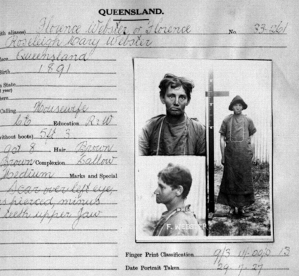
After a short stay at Eventide Home in where she resided from 1949, she was admitted to Brisbane Mental Hospital, Goodna on 12 March 1951 and died there on 20 August from cerebral thrombosis.
Mervis was the informant on her mother’s death certificate. Under children she lists Marie Alice Caroline 42 years, Mervis Florence Irene 40 years, I male deceased. There is no mention of Charles Allen Arthur Kyling.
 Christine's Compendium of Family History