Lost Family … Reginald Lawson

Lost Family … Reginald Lawson

Occasionally I find people that have been lost to the family.
Reginald Worthington (who became known as Reginald Lawson) was a sibling of my paternal grandfather, and the details of his life are sketchy.
bwwaratah

Birth and Marriage

Reginald Worthington was born at Paddington, Sydney in 1912 to my great-grandmother Clara Worthington, probably named after her oldest brother, Reginald Mark Worthington.

No father was declared at registration, and there seems no likely identifiable candidate. The father of her first two children, Harry Budd, was a resident of Cobar and Clara was residing in Sydney by 1909. Harry married Elsie White in 1910 and they had three children, two of whom were born by the time of Reg’s birth. Clara’s two youngest children (whom she kept with her and raised), Kathleen Leah and John Arthur were declared as the children of WWI soldier Thomas Goodwin.

But Reginald, in the middle of the five has no links confirmed with any father.

On 26 Sep 1932 at the age of 20, he married Mary Grace (‘May’) Giltrow at Kogarah near Sydney. May, the daughter of a coach builder, had been born in Sheffield and had migrated to Australia. She was 19 years of age and had just completed a course in millinery at Kogarah Trades School.
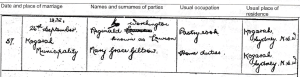
On his marriage certificate, he gave his occupation as pastry cook, he stated that he was born at Paddington, that his mother was Clara Worthington, no father listed.

Reg and May lived at Bexley and had two children. He passed away on 10 Dec 1993 aged 81 and May died 23 Aug 2012. Both are buried together at the Woronora Memorial Park, New South Wales.

I’m interested in Reg’s early life and how he came to have the name Lawson, the surname he used all the time, though on his marriage certificate he declared his name to be ‘Worthington known as Lawson’.

Arthur Charles Leitch Bayliss, Guardian of Minors, gave consent in writing for Reg to marry, indicating that he had previously been a ward of the state.

One of the witnesses to the marriage was a man named Frederick Dobson.

Frederick Dobson

The electoral rolls for 1936 and 1937 reveal at least three residents of 27 Princes Hwy, Kogarah:

Lawson, Jessie, dressmaker 
Lawson, Reginald, labourer 
Dobson, Frederick, clerk

In 1938 Frederick married Beryl Reid and seems to be missing from the rolls until 1954 and 1958 he and his wife Beryl are shown as living at 27 Princes Hwy, Kogarah

Frederick and Beryl’s marriage was reported in The Hurstville Propeller on 9 June 1938 and show that Fred and Reg were more than mere lodgers at 27 Princes Hwy:

LOCAL WEDDINGS: DOBSON-REID
Floral arches decorated with autumn-toned flowers were features of the decorations in the Rockdale Methodist Church on Saturday afternoon, 14th May, for the marriage between Beryl, youngest daughter of Mrs D. and the late Mr F. Reid, of Baxter Avenue, Kogarah, and Frederick Dobson, of Princes Highway, Kogarah. Given away by her brother (Mr Herbert Reid), the bride wore a tailored gown of trained off-white satin with a tulle, veil embroidered in true lovers' knots mounted on cut tulle and held in place by a coronet of orange blossoms. She carried a shower bouquet of orchids and tube-roses, with trails of Cecil Bruner roses. Mrs Rose Sonta attended her sister as matron of honour, wearing gold brocaded satin with a circular tulle veil, dotted with gold sequins, mounted on a floral halo. Her shower bouquet comprised autumn-toned decorative chillies and gladioli. Little Pauline Forrest was flower-girl, in an early Victorian frock of ice-blue brocaded taffeta, with a blue tulle veil held in place by a gold medallion in her hair. She carried a basket of pink frangipani and autumn-toned flowers. The bridegroom's cousin, Mr Reginald Lawson, was best man, and during the signing of the register, Mr Jack Brown sang "Until," with organ accompaniment. Navy-blue crepe splendour was worn by the bride's mother for the reception at her home, with a shoulder posy of lily of the valley. She was accompanied by the bridegroom's aunt (Miss J. Lawson), who chose a navy-blue costume, her posy being also lily of the valley.

So according to the article, Fred and Reg were cousins, and Jessie was Fred’s aunt.

Fred was two years younger than Reg but, like Reg, he was born at Paddington with no father listed. His mother’s name was Belle Georgina Dobson.

From the New South Wales Police Gazette 14 October 1914:

Paddington.—A warrant has been issued by the Children's, Court Bench, Sydney, for the arrest of Fred. Holstein, charged with failing to make adequate provision for the payment of preliminary expenses of and incidental to and immediately succeeding the birth of an infant. He is 35 years of age, 5 feet 4 or 5 inches high, medium build, florid complexion, fair hair, ginger moustache, blue eyes, round face; dressed in a blue serge sac suit and black hard hat; a German; sneaks good English: recently employed at Millard s Motor Garage, Phillip-street, Sydney. Complainant, Belle Georgina Dobson, 125 Wallis-street, Woollahra.

Belle never married, lived at 125 Wallis Street, Woolhara throughout her life and died there in 1943.

The Lawsons (updated April 2022)

Miss Jessie Lawson is shown as living at the same addresses in Kogarah in the electoral rolls:

1930-33: 27 Rocky Point Road, Kogarah, dressmaker 
1935-43: 27 Princes Highway, Kogarah, dressmaker
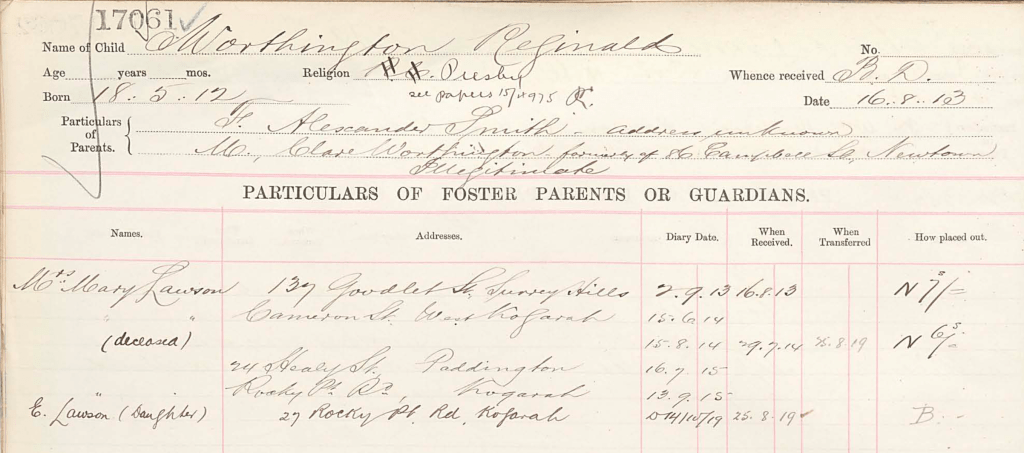
The entry for Reginald Worthington in the NSW Dependent Children Register shows that he was born on 18 February 1912 and fostered to Mrs Mary Lawson of Surry Hills (later of Kogarah) on 16 August 1913, when he was only 18 months old. After Mary Lawson died in 1919, when Reginald was only 7, her daughter Ethel Jane Lawson became his guardian, and she is noted as living at 27 Rocky Point Road in that year. Ethel died in 1929 aged 42 and her sister Jessie appears at the address from the following year.

The entry lists Reginald’s parents as Alexander Smith (address unknown) and Clara Worthington (formerly of 86 Campbell Street, Newtown). As yet I haven’t been able to find out anything further about Alexander Smith.

Fred Dobson also has an entry in the NSW Dependent Children Register, which confirms that he was also fostered by Mary Lawson of Kogarah
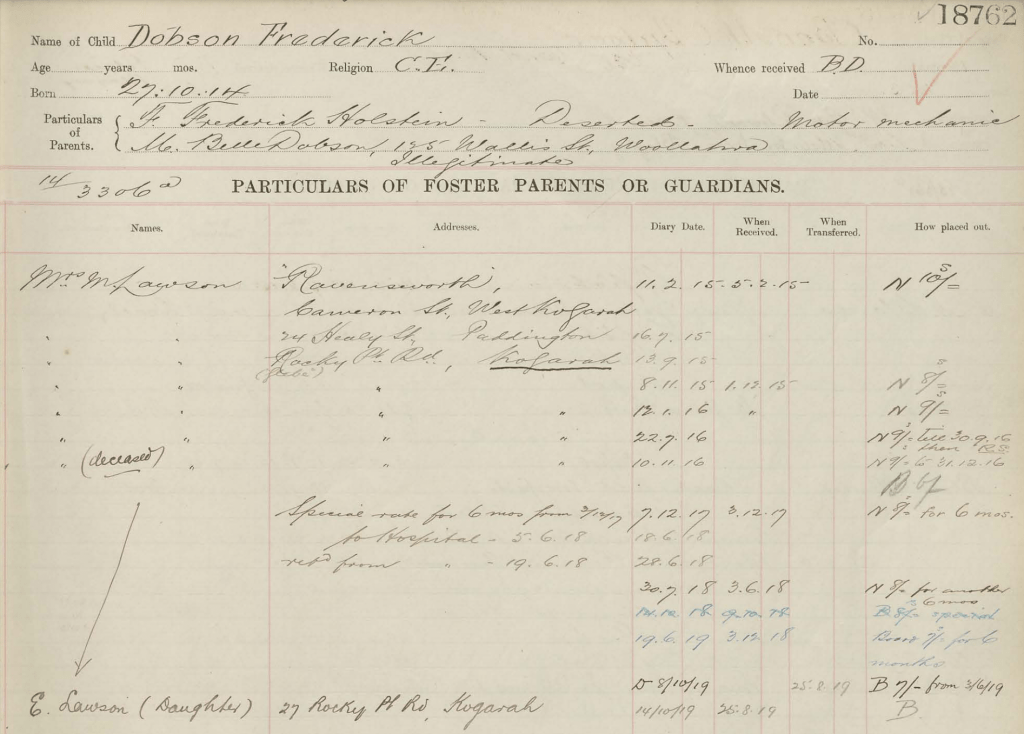
Photo Gallery of a Petty Criminal

Photo Gallery of a Petty Criminal

Many hardworking, law-abiding ancestors have lived their lives leaving behind a sparse and unremarkable trail of records, and often no images. My great-grandmother’s brother Leo Albert Worthington was not one of these people. His criminality spread over thirty-five years and at least eleven aliases.

I’ll start by saying that Leo was not a particularly good criminal, as his arrest record seems to show.

I’ll also state from the outset that even though Leo’s family life was rough and poverty-stricken, this is not meant to provide excuses for Leo’s actions, only to provide some context for his life.

He was born on 26 September 1893 at Forbes in central New South Wales to John Joseph and Mary Ann Worthington. He was the ninth child of eleven children. As the drought and depression of the 1890s set in, John Joseph lost his farm at Moonbi and the family moved into the Forbes township and he took work as a contract labourer. When work opportunities dwindled in 1900 he left the family, going north to seek work and was never seen again. Mary Ann went to the police in 1903 reporting him missing and a warrant was issued to no avail. She stated that she and the children were left destitute.

Mary Ann took the children to Cobar where her mother lived. Here the family were subject to a number of sad events, one being that on 4 Apr 1905 Leo, aged only 12, was convicted of stealing goods from a railway carriage at Cobar and was sent to the Carpentarian Reformatory for Boys for three years.

The Carpentarian Reformatory was established at Brush Farm, Eastwood, NSW in Sydney’s north west. It was named after the philanthropist, Mary Carpenter. At the time Leo was sent there it was run by the State Children’s Relief Department.

A year before Leo got there, the annual report of the Reformatory was reported on in the Goulburn Herald:

THE CARPENTARIAN REFORMATORY.
THE annual report of the superintendent of the Carpentarian Reformatory, Mr F. Stayner, has been received by the Minister for Education. Dealing with the way in which inmates are recruited, he says they come to the institution from the various police courts, quarter sessions. and so on for minor offences. Instead of sending them to jail, the magistrate orders them to the institution for not less than one year and not more than five years. Sometimes, however, the lads are not allowed to remain for a year, and no impression can be made on them in less than the time named, and nothing taught them in less than two years. Truancy and wandering in the streets also furnish their crop of recruits to the reformatory. Several trades are taught, such as tailoring, joinery, boot-making, and so on, and the boys are also employed in gardening and orchard work. Out of 361 boys who have at various times been discharged from the institution, 83 per cent have turned out well.
(Goulburn Herald, 1 April 1904, p.5)

Leo was unfortunately not to be amongst the reformatory’s success stories.

If he was released after the three years was up, it would have been a month before the death of his grandmother aged 85 at Cobar, but there is no evidence that he returned to Cobar. In fact, it’s hard to pinpoint where he was until his next convictions in May and June 1914 in Sydney for drunk and disorderly, stealing from the person and indecent language. His sheet has him as a labourer from Forbes who was born on 23/07/1893.

By this time he was aged 21 and had the tattoos that would appear beside all his mugshots ‘pierced heart inside left forearm and woman’s head outside right upper arm’.

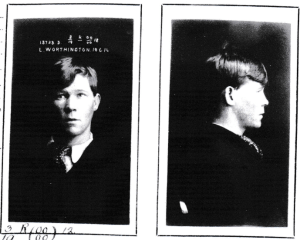
Leo Worthington, Sydney, 1914

At some stage, Leo’s mother contracted tuberculosis and from September 1914 until March 1916 she was a resident at the Waterfall hospital for consumptives. She succumbed to the illness on 20 March 1917 and Leo’s name was left off the family notice in the newspaper.

In the meantime, in 1915-1916 Leo was racking up convictions at Molong, Crookwell and Sydney, mostly for bad behaviour and violently resisting arrest.

Two months after his mother’s death, on 8 May 1917 Leo, aged 23 and apparently a shearer, enlisted in the Australian Imperial Force, 1st Light Horse. Though the lives of soldiers were difficult and dangerous, for young men with few prospects, enlistment in the armed services could provide an opportunity to break out of a cycle of crime, to travel, to be a part of something, and two of his brothers had already enlisted. However, Leo was discharged on 28 Nov the same year because of his criminal convictions.

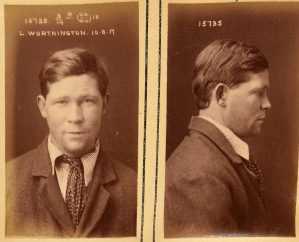
In August 1917, before he was officially discharged, he was convicted in Sydney for two charges of shop breaking for which he received a sentence of two years. His sheet says he was a labourer from Forbes who was born on 23/07/1893.

Leo Worthington, 1917

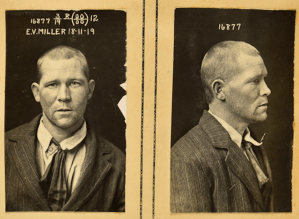
After release (and before his prison haircut had had time to grow out) in October 1919 he was charged in Sydney with unlawfully wearing a military uniform and a month later with shooting with intent to cause grievous bodily harm, for which he was sentenced to 12 months. He used the name Edward Vivian Miller and said he was a wool classer from Orange born 3/8/1894.

‘Edward Vivian Miller’, 1919

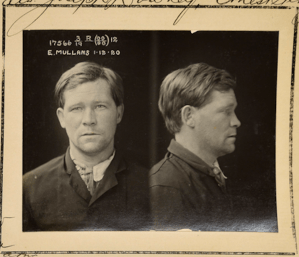
On 9 November 1920 at Maitland Quarter Sessions he was convicted for breaking into a warehouse and stealing goods valued at £300 and sentenced to four years penal servitude. His sheet has him using the name Edward Mullins, a labourer from Forbes born on 01/08/1893.

‘Edward Mullins’, 1920

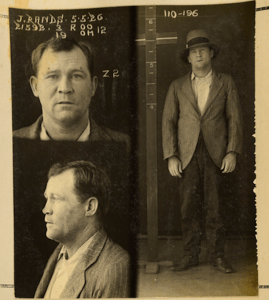
After release, he was charged in May 1924 with attempting to break into a shop with intent to steal. He absconded after release on bail. He finally ended up at Sydney Quarter Sessions in May 1926 and was sentenced to three years hard labour.

‘James Rands’, 1926

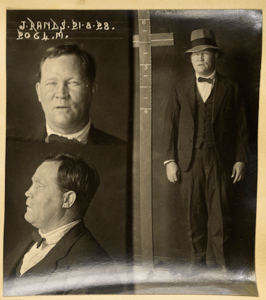
In 1928 his photo was retaken for some reason, and he doesn’t seem very healthy.

‘James Rands’, 1928

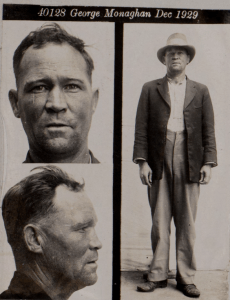
Upon release, Leo ended up in Victoria where he was convicted of shop breaking and sentenced to 12 months. He used the name George Monaghan, and said he was a native of Victoria born in 1893.

‘George Monaghan’, Victoria, 1929

Having pleaded guilty to a charge of shop breaking, George Monaghan, who said that his correct name was Leo Worthington, aged 36 years, shearer, of Gertrude Street, Fitzroy, admitted 14 previous convictions, mostly in New South Wales.He had served a sentence of imprisonment for 12 months for shooting with intent to do grievous bodily harm and a sentence of imprisonment for four years for shop breaking.

Judge Moule said that on the occasion which had given rise to the charge nothing of much value had been stolen. Monaghan would be sentenced to imprisonment for 12 months. He would also be declared an habitual criminal and would be detained in a reformatory prison at the expiration of his sentence during the pleasure of the Governor.
(The Argus, 14 Dec 1929, p.32)

I’ve given an overview of some of the crimes that caused incarceration on the occasions of his photographs being taken, but his petty criminality extended well beyond these charges, and finding all reports in the police gazettes to put together a timeline was like untangling a ball of sticky wool. Apart from Edward Vivian Miller, Edward Mullins, James Rands and George Monaghan, he used the aliases Joseph Downey, James Downey, Ernest Sergeant, James Mitchell and James Cavanagh. It must have been a very difficult job for the police to match up descriptions of offenders trying to evade detection by giving false information. Additionally, many of his cohorts had numerous aliases. Fortunately, each prison portrait sheet contains all the known aliases and all the previous photograph numbers so it’s relatively easy to collect the set.

The online criminal photographs go up to 1930, and when further records go up there will be at least two more photos to add to the gallery from the next decade.

In March 1933 Leo was sentenced to twelve months’ imprisonment for having stolen a silver watch and chain from a man in the street in Sydney. He was convicted under his own name and was recorded as a 41-year-old labourer.

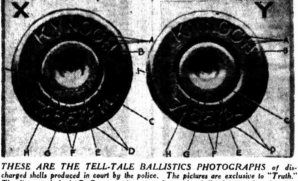
In 1934 he was sentenced to six months’ imprisonment for possession of an unregistered automatic pistol at Redfern. Ballistics testing on that pistol revealed that it was a match for a casing found at the scene of a shooting that had occurred at Glebe four days before the gun was recovered.

Arthur North of Glebe had initially told police that he had found the gun in an alley at Redfern nine months before he was shot in the leg, that it had accidentally gone off while he was looking at it, and that he had given it away before police arrived at the scene.

When Leo’s involvement was unearthed by the ballistics, he said that he had taken the gun to North’s house, and that he was showing North how to use it when it accidentally went off, and that he had fled the scene and called an ambulance. The story was corroborated by North and accepted by the magistrate.

In police circles, the case is regarded as being of considerable importance in that it established a precedent for the legal acceptance of ballistics photographs. Science had proved that both shells had been fired from the same weapon and the proof was corroborated — if proof can be corroborated— by the dramatic admission of Worthington that the shot which wounded North was fired from the identical pistol.
(The Truth, 8 April 1934, p. 19)

I don’t believe that anyone else in the family has ever made a contribution to forensic science but, apparently, The Truth thought Leo did!

In June 1939 he was sentenced to three years imprisonment for assault and robbery at Maroubra in January that year.

After the expiration of this sentence, things seemed to settle down. In 1943 Leo was living in Bourke Street, Surry Hills and is recorded as a labourer in the electoral roll. In 1949 he was living in Toowomba and is recorded as a labourer.

In 1951 he married Rose Ann Mitchell Cuddy (nee Teague) at Toowomba. He was 58 years of age and Rose Ann was 75. In 1954 they both appear in the electoral roll residing in White Street, Everton Park, a suburb of Brisbane.

Rose Ann died in 1956 aged 79 and was buried at Lutwyche Cemetery, Brisbane. In 1958 Leo was living at 139 Latrobe Terrace, Paddington, an inner suburb of Brisbane, and working as a salesman.

Leo died on 26 Feb 1961 in Brisbane Hospital of heart failure, the culmination of heart problems he had apparently been suffering with for about 12 years. He was buried with Rose Ann at Lutwyche Cemetery.

Leo’s youngest brother Eugene Henry (‘E. Worthington, brother, 68 Albany Road, Stanmore, Sydney, New South Wales’) gave information for his death certificate. Interestingly, Gene gave their father’s name as Leo Albert Worthington.

Unsurprising that Gene would be hazy on his father’s name, as he hadn’t seen him since he was four years of age. Leo’s passing left Gene as the only living child of the family.

Shipmates and Cohorts

Shipmates and Cohorts

Some snippets of information about the brief time John Worthington (Fortune, 1806) spent in the colony of New South Wales 1806-1814.

bwwaratah


Attempted Escape

On Tuesday last a Bench of Magistrates was convened; before whom were brought Isaac Peyton, John McDonald, and several others, who stood charged by Benjamin Peat with contriving a plot to seize and take away a Hawkesbury boat the joint property of McDonald (one of the prisoners) and himself. In consequence of the witness having prudently given information to a King's boat of their design, which he considered manifest from the appearance of the mail boat in pursuit of him when going out, the pursuers were in turn pursued, and cheated a precipitate retreat; - which was by no means a proof of the equity of their intentions. A Frenchman who was recognized by the witness in the boat was shortly after apprehended, and he 'with the true French nonchalance' brought a Dutchman into the same predicament, and several Englishmen followed among whom was Peyton, whose wife being likewise implicated in the charge of intended escape, was also apprehended. In the course of the search about the small bays, creeks, and inlets, a considerable stock of provisions was found, which the two foreigners declared to have been purposely deposited there for their use of the voyage to some of the Asiatic settlements. The whole of this as well as a quantity of wearing apparel and other property, was claimed by Peyton ; who urged that his motive for removing it rather was a wish he had entertained of taking up his residence in that part of the country, where secluded from the eve of inquiry, he had designed to open a small distillery; - but a mariner's compass, quadrant, and Epitome, rather militated against the candour or the acknowledgement. Other persons, who had before eluded suspicion were now implicated by their companions, Dutch, French, and English, and all the parties committed for further examination.
(Sydney Gazette, 28 June 1807, p.1)
Isaac Peyton, Hugh McDonald, William Welch, and Susannah Harris were indicted for seducing from their duty the several prisoners hereafter mentioned, by contriving their escape from this colony in a vessel named the Argument whereof Hugh McDonald was a part owner; and Dennis Maloy, John Wetherington [Worthington], George Boyden, Jas. Darbyshire, and James Hargraves were likewise indicted for attempting their escape from this their lawful place of confinement, by consenting to the plan of the above, and assisting to carry them into execution.
Three persons who had likewise engaged in the plot being accepted as evidences for the Crown; viz. Brian Overhand, Francois Francisco, a Frenchman, John Simmons, a Dutchman, they gave evidence accordingly, which added to that of Peat was conclusive and incontrovertible. The principals rested their defence on a positive denial of the facts; but the accessories declared the charge to be just, and by an acknowledgement of their design in this last stage of the trial, threw themselves on the mercy of the Court; which cleared, and re-opening all but Susannah Harris were found guilty, and sentenced McDonald, Peyton, and Welch to pay a fine of £50 to the King, to be imprisoned 12 months; and to remain in gaol until the fine be paid :—The others to receive 300 lashes each.

The testimony of this case is documented at the Macquarie University website. Of the cohorts, John Worthington, Bryan Overand, James Hargraves and James Darbyshire all had travelled to Australia aboard the Fortune. All four admitted they intended to leave the colony, and received 300 lashes.

Who among the convicts was most likely to try to escape? There were occasional cases where the escapees were people who had been in the colony for some years, and who even had families and property. But escapees were most often from among the latest arrivals, those for whom the colony was strangest and most disorienting, and the urge to return strongest. In the earliest years they seemed to fear most of all the idea of unrelenting labour and slave-like existence, whether or not they actually experienced such conditions.
(Grace Karskens, '''This spirit of emigration'': the nature and meanings of escape in early New South Wales', Journal of Australian Colonial History, Vol. 7, 2005, p. 8)

In this case, they certainly were a mixed bunch. Karskens refers to Peyton and Harris as from the former group, having a large house, children and Peyton’s established stonemason business, and she says financial difficulties may have influenced his decision to leave. But Worthington and his Fortune shipmates, having arrived in August the previous year and having served only eight months of their sentences, were relatively unencumbered.

Surprise Release

Three years later John Worthington and James Hargreaves found themselves on the receiving end of an act of kindness by the incoming Governor Macquarie:

GOVERNMENT and GENERAL ORDERS.
Government House, Sydney,
Friday, 5th January, 1810.
HIS EXCELLENCY the Governor, as an Act of Grace and Favour on the Occasion of his taking Charge of the Government of this Territory, has thought proper to direct that the undermentioned Persons now confined in the Gaol of Sydney shall be released and set at Liberty this Afternoon: namely, James Hargrave, John Worthington, William Henry, James Hardwicke, Thomas Jones, James Stoneham, John Draper, Ralph Summers, James Smith, Thomas Hayes, George Dunstan, Garret Armstrong, John Anson, Lawrence Parory, and Hadji (a black man). The Governor trusts this Act of Clemency will have the desired effect on the minds of those men now released from Confinement, and that it will stimulate them to be more orderly, and better Members of Society for the future. By Command of His Excellency,
I. T. CAMPBELL, Sec.
(Sydney Gazette, 7 Jan 1810, p.2)

Macquarie was the last autocratic Governor of New South Wales and he would hold the post for 11 years. He took the reins after the chaos and tension of the previous Governor Bligh regime. There were controversial aspects to Macquarie’s leadership (as there were for all the previous governors), but as far as convict relations were concerned, he was a liberal.

In a developing society harbouring a divide between free settlers and convicts, Macquarie used the carrot rather than the stick – treating emancipated convicts relatively well, entrusting them with positions of authority, and providing plenty of work through infrastructure building. That Macquarie had landed at Sydney Cove on 31 December 1809 and had the above noticed published so quickly could be seen as a small olive branch to set the tone for a new chapter of administrator-convict relations.

Trouble Again

For all of Macquarie’s good intentions, John Worthington wound up before the judiciary again less than six months later, accompanied by two further shipmates from the Fortune, Isaac Hogg and Samuel West. While not a significant case in its own right, it’s significant to tracing John Worthington’s history in the colony, as there are so few records of him . Three chickens had been stolen on Saturday, 16 June 1810 from John Palmer at Woolloomooloo, and these were found having been killed and put in the yard at Worthington’s residence. In the courtroom, the three deceased chickens were presented for identification as those belonging to Palmer. Testimony was provided by William Yarls, a servant of Palmer (who had reared the fowls and discovered they were missing), John Redmond (who searched Worthington’s residence and found the fowls), Enoch Kinsela (publican and Fortune convict), John Robinson (butcher, neighbour of Kinsela, Palmer employee and Fortune convict).

Place Note: Woolloomooloo Farm, Sydney

After the First Fleet’s arrival in Sydney, the area was initially called Garden Cove or Garden Island Cove after the nearby small wooded Garden Island, off the shore. The first land grant was given to John Palmer in 1793 to allow him to run cattle for the fledgeling colony. In the 1840s the farm land was subdivided into what is now Woolloomooloo, Darlinghurst and parts of Surry Hills. Wikipedia Swampy land that was regularly flooded did not make it especially attractive to early settlers. But it was fertile, and after the colony’s commissary-general, John Palmer, was granted land here in 1793, he built a house and made a good fist of farming. The native melaleucas and casuarinas were replaced with fruit trees and he even experimented with growing tobacco. The success of his endeavours resulted in the valley becoming known as The Farm. Dictionary of Sydney

West (also a Fotune shipmate) had been an employee of Palmer and was seen in Palmer’s yard on the night of the crime, but he denied involvement. Hogg had been an employee of neighbour Enoch Kinsela, who had allowed him to stay there, and in the time Hogg had been there other birds had gone missing from Palmer’s. Blood and feathers had been found in the pocket of the jacket Hogg was wearing and he confessed.   Worthington denied involvement, saying that he merely gave accommodation to his shipmate on the evening of the robbery. The court found Worthington and Hogg guilty, sentencing them both to twelve months’ hard labour. West was directed to sleep at the gaol until further orders.

The Lumber Yard

Worthington is shown in the muster of 1811 as a carpenter in the government lumber yard. The lumber yard was not far away from Palmer’s farm, Sydney Gaol and the Male Orphan Institution where his children would later reside.

Worthington’s time in the colony preceded the construction of Hyde Barracks, and prisoners lived in individual (presumably very basic) places of residence.

The Last Official Record : Settling a Debt

Thomas Rose of Sydney, dealer ... Plaintiff

and

John Worthington of Sydney ... Defendant

Writ for sixteen pounds sterling on a promissory note dated 5th January 1814 drawn by defendant payable to bearer on a day now past.

Upon the defendant's voluntary confession and consent, the court gives judgement for the plaintiff.

Damages £12.0.0 Costs £3.15.4. Execution to pursuant to the confession.

Thomas Rose was a baker operating in Chapel Row (later renamed Castlereagh Street) and he later dealt in imported goods. An advertisement in the Sydney Gazette in 1815 shows him offering imported linen, clothing, footwear, copper tea kettles, tools, haberdashery items.