 Life in England

Little of John Worthington’s life in England can be found in the official records (so far). We know from the transportation and muster records in Australia that he was tried at the New Bailey, Salford, on 1 May 1805, and transported to Australia aboard the ship Fortune the following year.
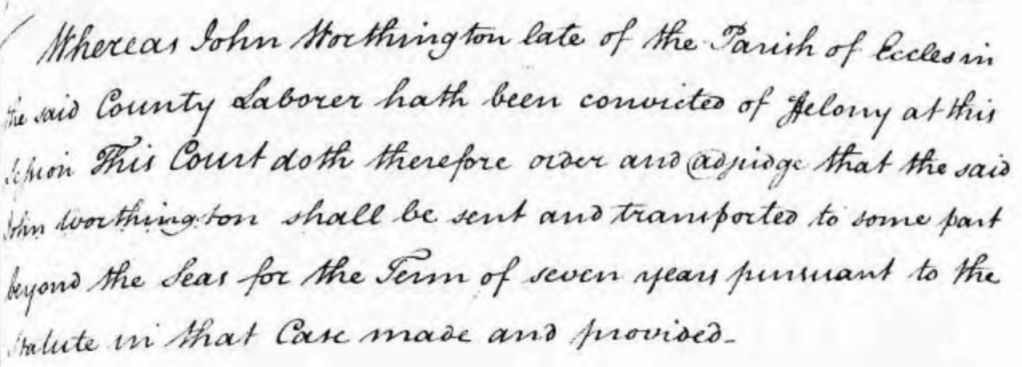
Whereas John Worthington late of the Parish of Eccles in the said county labourer hath been convicted of felony at this session This court doth therefore order and adjudge that the said John Worthington shall be sent and transported to some point beyond the seas for the term of seven years pursuant to the statute in that case made and provided.
The indictment rolls indicate that on 15 January 1805 Worthington stole a load of wood from John Greaves of Pendlebury. Filed with this is a record of an earlier larceny offence which took place on 31 August 1801 – the theft by Worthington and a cohort (John Wych) of scythes owned by a William Brown at Stretford. In both instances, Worthington is described as a labourer and resident of Barton Upon Irwell. (Pictured above: Bridgewater Canal, River Irwell, a 1936 etching)
Other possible records
a) Register of Duties Paid for Apprentices’ Indentures, 1710-1811 (TNA), a John Worthington apprentice to Peter Bradburn, cabinet maker at Eccles 3 May 1789. If this is the same person he would have been about 13 years of age.

b) A Land Tax record for 1798 shows a John Worthington as one of 12 occupants of a property owned by a Mr Norris situated in Back Acton Street, Manchester. This seems unlikely to be the same John, but it’s not completely out of the realm of possibility.
c) Calendar of Prisoners 11 Dec 1800 (held by Lancashire Archives).

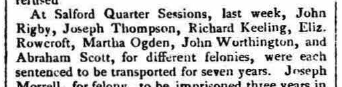
d) Notice in the Lancaster Gazette dated 15 May 1802:
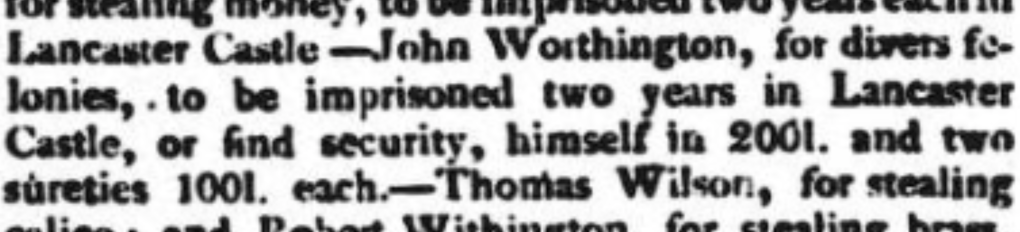
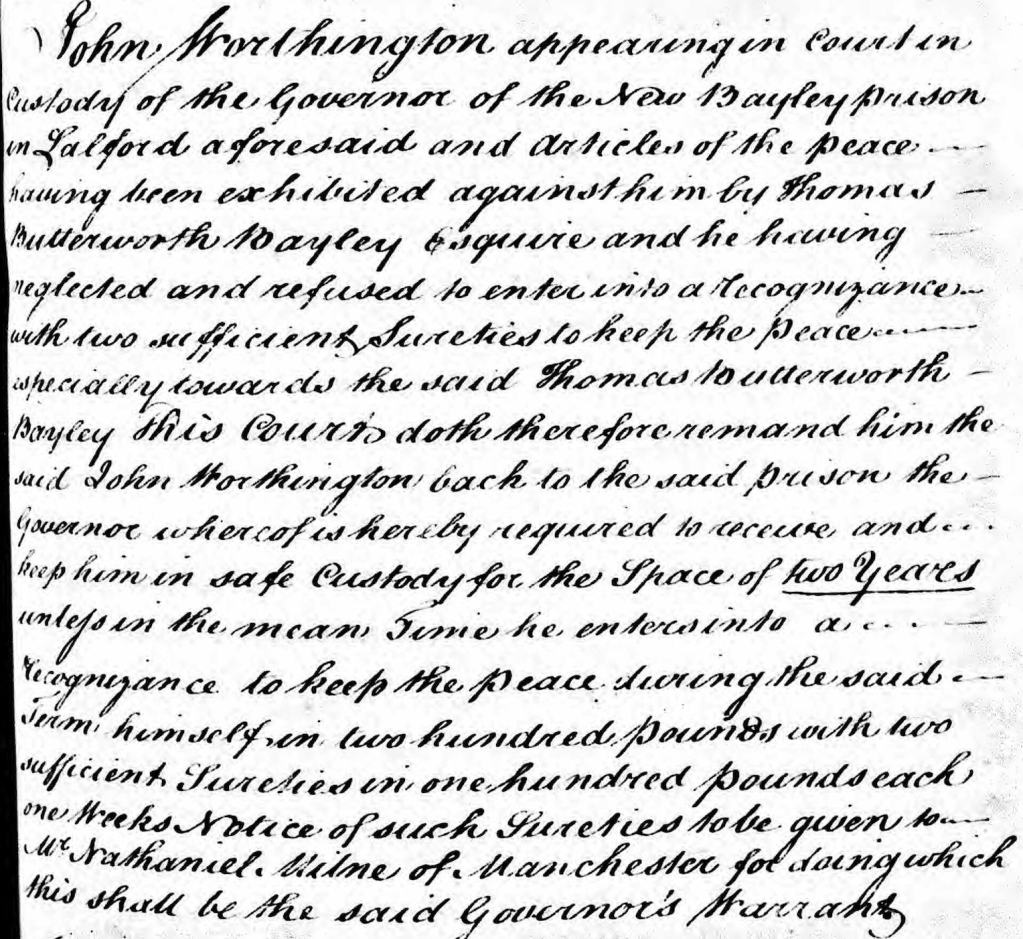
e) Lancashire Quarter Sessions Order Book 1802:
Likely birth record?
His age at the time of his conviction is not given in the indictment, but there are at least two contemporaneous records that do show his age.
According to the jailhouse register of the New Bailey on the day of his court appearance, John Worthington was 28 years old on 1 May 1805,

and then when he was transferred from Lancaster Castle to the Prison Hulk Perseus his age is recorded as 29 years on 1 June 1805.

I believe these two pieces of information hold significance because John Worthington was present on both occasions to give his information, and I believe that he was therefore born some time in May 1776.
The only John Worthington I can find likely to have been born in May 1776 in the area is:
Baptism: 26 May 1776 St Mary the Virgin, Eccles, Lancashire, England
John Worthington - Son of James Worthington & Martha
Abode: Pendleton
Occupation: Weaver
Source: Manchester Central Library
Another piece of evidence relates to the information contained on the headstone of James Worthington and Martha Aldred in the churchyard of St Mary the Virgin, Eccles. The churchyard was unfortunately cleared of headstones in the 1960s. No photographs were taken but inscriptions were recorded.
The inscription appears on the Find a Grave website and lists James Worthington, along with Martha (and two subsequent wives of James – Jane and Rachael) and then John Worthington is listed last without a year of death.
2096
James Worthington
died Decr 27th 1821 aged 68 years
Martha his Wife died
Augst 4th 1786 agd 34
Jane Worthington 1788
Rachael Worthington 1811
John Worthington
This information could be interpreted in three ways:
Scenario 1: John Worthington is buried with his father and stepmothers, but his date of death was left off the transcription – either because of transcription error, or because the date wasn’t readable.
Scenario 2: John Worthington, the son of James and Martha, was listed here and without dates because he was lost to the family. This sometimes occurs to memorialise family members who are absent, abroad, missing or killed in action. His name could have been added to the headstone by his father, or one of his siblings, and would explain why he is the only child of James and Martha to be memorialised on this stone with his parents.
It is not uncommon to have more people buried in a grave than listed on a headstone and also to have people memorialised on a stone but who are not buried in the grave. Cemetery Symbolism
or …
Scenario 3: John Worthington, the son of James and Martha, was listed at the bottom of the headstone, perhaps on a flagstone, as the person responsible for placing the headstone.
Scenario 1 seems unlikely because John is the only one of the five not to appear in the burial register.
Scenario 3 seems unlikely because it implies that John has placed the headstone for his mother, his two stepmothers and his father after they have all died, remembering all their dates and placing them in order. When his mother Martha died, John was only 10 years of age and it is very difficult to believe that there was no stone at all on this grave until John was old enough to commission it. I think that the person most likely to have erected the memorial would be the father, James.
Without a photograph of the headstone, it is impossible to draw a 100% solid conclusion about any scenario and impossible to know whether there was a flagstone. Either way, it seems that John Worthington is not buried at St Mary’s, only mentioned on the headstone for some reason.
The contributor of the transcription on the Find A Grave website has assumed Scenario 3 to be true and made a connection with another John Worthington who is buried at Swinton Unitarian Cemetery. It is noted as a “calculated relationship”, i.e. it is speculative. I think it is worth taking a look at a closer look at this.
Just to Confuse Things: Swinton John Worthington
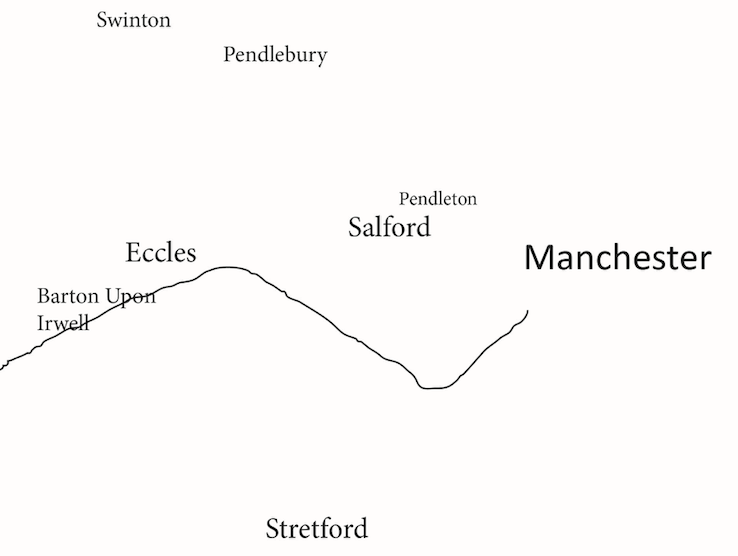
The John Worthington buried at Swinton Unitarian Cemetery (whom I will call Swinton JW) was born in the same year as John Worthington (Convict JW) and died in 1869 aged 93. He was buried in Plot 1 at Swinton Unitarian Cemetery.
He married Sarah Longworth in 1798 and from then until 1815 they had nine children: Martha, James, Samuel, Ann, Margaret, Lee, Anne, Sarah and John. Buried in the same plot are Lee and his wife Sarah (nee Porter), Lee’s son John Worthington plus his wife Mary (nee Ford) and their two children, Annie and Henry.
The fact that the youngest four children were born after 1806 means that he is not Convict JW. The family shows as residents of Pendleton in the christening records of the first two children and in the records of all subsequent children, the family were residing at Swinton. This John Worthington was a weaver by trade, but there were many weavers in the region and, especially since the christening records do not give the mothers’ maiden names, it’s impossible to confirm that the children are all of the same couple.
Sarah Longworth appears to have died in Nov 1835 at the age of 62 and was buried at St Mary’s, Eccles. I have no idea why she would be buried in a different cemetery to her husband and son’s family. In her burial record John Worthington is listed as her husband, and their residence as Swinton, but her maiden name doesn’t appear on the burial record, so it’s impossible to say with complete certainty that this was Swinton JW’s wife. There are no parents listed for either Sarah Longworth or Swinton JW on the marriage banns document, nor do parent names appear on the death records for them.
The fact that Swinton JW’s first two children were called Martha and James could lend some weight to the idea that Swinton JW was the son of James Worthington and Martha Aldred of Pendleton. However, Convict JW’s firstborn was also called James, and he had no female offspring so we have no way of knowing whether a female child would have been called Martha. Also, the fact that Swinton JW was a weaver, the same profession as James the father, lends weight to his being of that family, though this fact is not in itself conclusive evidence either.
So who were Swinton JW’s parents? There is a possible clue in his burial place – he was of the Unitarian congregation. There was a John Worthington christened at Cross Street Chapel, Central Manchester in April 1776. This couldn’t have been Convict JW, who was born the following month. Additionally, Cross Street Chapel is a Unitarian church (a noted ‘meeting place of Unitarians since 1761’). The parents of this child were John Worthington (calendar man) and his wife Betty.
The only UK census record I could find that might have been Swinton JW is:
1861 - aged 85 - widower - 16 Whit Lane, Pendleton - domestic gardener - birthplace Eccles - residing with daughter Matha (aged 63 - widow - domestic general servant - birthplace Pendleton)
Naturally, there is more digging to do, and if anyone has further information that can shed more light on this, I’d love to hear from you.
 Ship : Fortune (1806)
Departed: 28 Jan 1806 – Portsmouth, England
Arrived: 12 Jul 1806 – Sydney, NSW
Master: Captain Henry Moore (Lt, RN)
Particulars: Convict vessel ; 622 ton ; contractors Mestaer and Locke
Notes: Carried male convicts, one of whom was John Worthington. Fortune‘s muster of convicts was mixed with the muster of Alexander. Numbers aboard the two ships vary: 242 (Log of Logs), 298 (contractor Shelton) and convict Hawkins 306 (see publication reference below). Lord Hawkesbury wrote on 19 December 1805 to A. H. Bradley, Commissioner of Convicts, giving Bradley a list of convicts in his care and asking that he allow 150 free of any infectious disease to be selected from the list and put on board Alexander and Fortune. These transports were to be escorted by four other ships, including the Lady Sinclair, which carried William Bligh who was going out to become Governor of NSW. The Fortune departed the fleet after stopping at Rio. One soldier and three convicts died on the voyage. The Captain brought the news of the death of William Pitt which had occurred five days before the Fortune sailed.
Byrnes, Dan. The Blackheath Connection
Hawkings, David T. Bound for Australia. North Sydney : Library of Australian History, 1988.
Ship Muster Entries for John Worthington

The above entry in the transportation register was unfortunately indexed in Ancestry as stating he was 22 years old, but the entry itself seems to indicate 29 years old (in keeping with the information on other records). I can’t make out the stated occupation, but in the final column it says he hailed from Manchester.


The ship muster entry lists both John Worthington and Martha Ogden as having been tried at the Quarter Sessions on 1 May 1805, and both receiving a sentence of 7 years.
 Life in Australia
| 12/07/1806: | Arrived at Port Jackson aboard the ship Fortune. |
| 1806: | Convict Muster: John Worthington, Fortune, prisoner, carpenter employed in the lumber yard, Sydney |
| 27/06/1807: | Sydney Gazette: John was one of nine prisoners in court for attempting to escape. John was one of four of the party that admitted the intention to leave the colony and he was found guilty and received 300 lashes. |
| 05/01/1810: | Colonial Secretary’s Papers: John Worthington is one of 15 prisoners to be released from Sydney Gaol on the occasion of Lachlan Macquarie taking charge of the Government. |
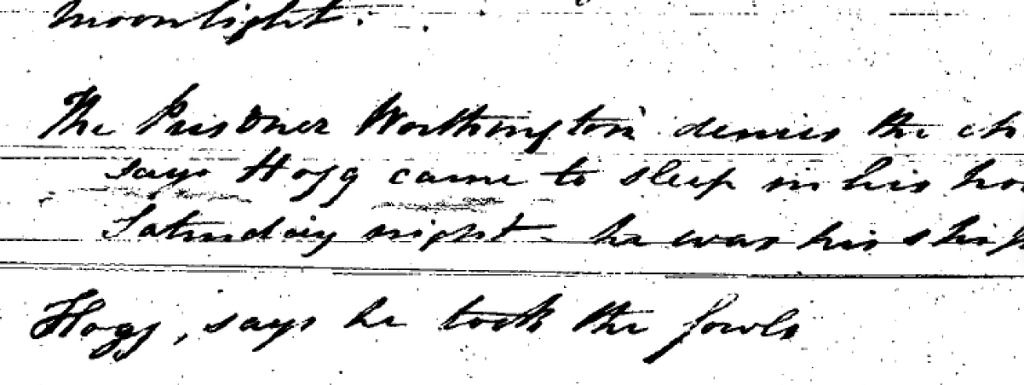
| 23/06/1810: | Colonial Secretary’s Papers: Convicted with two other men by the NSW Bench Magistrate for the crime of stealing fowls. The other men, Hogg and West, were shipmates from the Fortune. John Worthington denied the charge. Though Hogg admitted stealing the fowls, they were found at Worthington’s residence, and he was sentenced to 12 months hard labour. Interestingly, a dead chicken was presented to the court as evidence. |
| 1811: | Muster entry: John Worthington; Tried Manchester May 1805; Fortune; 7 years. |
| 02/08/1814: | Civil Jurisdiction index: John Worthington – defendant owing £16 to a dealer named Thomas Rose. |
| 1816-17: | Muster entry: John Worthington; Arrived July 1806; Fortune; tried Manchester March 1805; sentence expired in 1812; left the colony. |
| 1819: | Muster entry: John Worthington; Arrived July 1806; Fortune; tried Manchester March 1805; sentence expired in 1813; left the colony. |
| 1820: | Muster entry: John Worthington; Arrived July 1806; Fortune; tried Manchester March 1805; sentence expired in 1812; left the colony. |
| 1821: | Muster entry: John Worthington; Arrived July 1806; Fortune; tried Manchester March 1805; sentence expired in 1812; left the colony. |
Just to Confuse Things: John Worthington of the Elizabeth, 1821
There was another John Worthington transported to Australia for life aboard the Elizabeth in 1820. Elizabeth John Worthington (also listed in the musters as a government carpenter) died in Sydney aged 47 in 1825 (i.e. born 1778).
The 1825 muster confirms this:

The Lancaster Gazette report of this conviction dated 1 Apr 1820 reads ‘William Eckersley, 32, and John Worthington, 46, for robbing Edmund Taylor, on the highway, at Eccles – Guilty.’ If this report is right, he would have been born in 1774. There appears to be no evidence confirming that he was the same man as Fortune John Worthington, especially as there is no evidence that Fortune John Worthington returned to England after he disappeared from the official record in Australia.
Disappearance
The last official record declaring the presence of John Worthington seems to have been on 2 August 1814.
Thomas Rose of Sydney, dealer ... Plaintiff
and, John Worthington of Sydney ... Defendant
Writ for Sixteen Pounds sterling on a promissory note dated 5th January 1814 drawn by defendant payable to Bearer on a day now past.
Upon the defendant's voluntary confession and consent, the Court gives Judgement for the Plaintiff.
Damages £12.0.0 Costs £3.15.4 Executive to issue pursuant to the confession.
Between 1808 and 1813 four children were born in the colony and given Worthington’s surname. Their mother was a convict named Catherine Malone(y). James, Thomas, William and John were variously listed in the official records as Warrington, Worrington and Warrenton by their illiterate mother.
Thomas had resumed the name Worthington by 1832. James curiously resumed the Worthington spelling around 1839, after having used ‘Warrington’ in his petitions for land, at the time of his marriage, and after his first two children were registered as ‘Warrington’.
To me, this is an indication that the father, who always used the correct spelling, was still around and about up to this time. He is noted in the musters as having ‘left the colony’ by the time of the 1816 muster, and it is possible that the court order to pay Thomas Rose money that he did not have may have caused him to consider moving away from the Sydney region and perhaps assuming another name to avoid authorities.
John, the youngest child (who lived with his mother and stepfather at Cornwallis), retained the name Warrington and William used ‘Warrington Fry’, (adding the surname of his adopted family).
 Christine's Compendium of Family History